

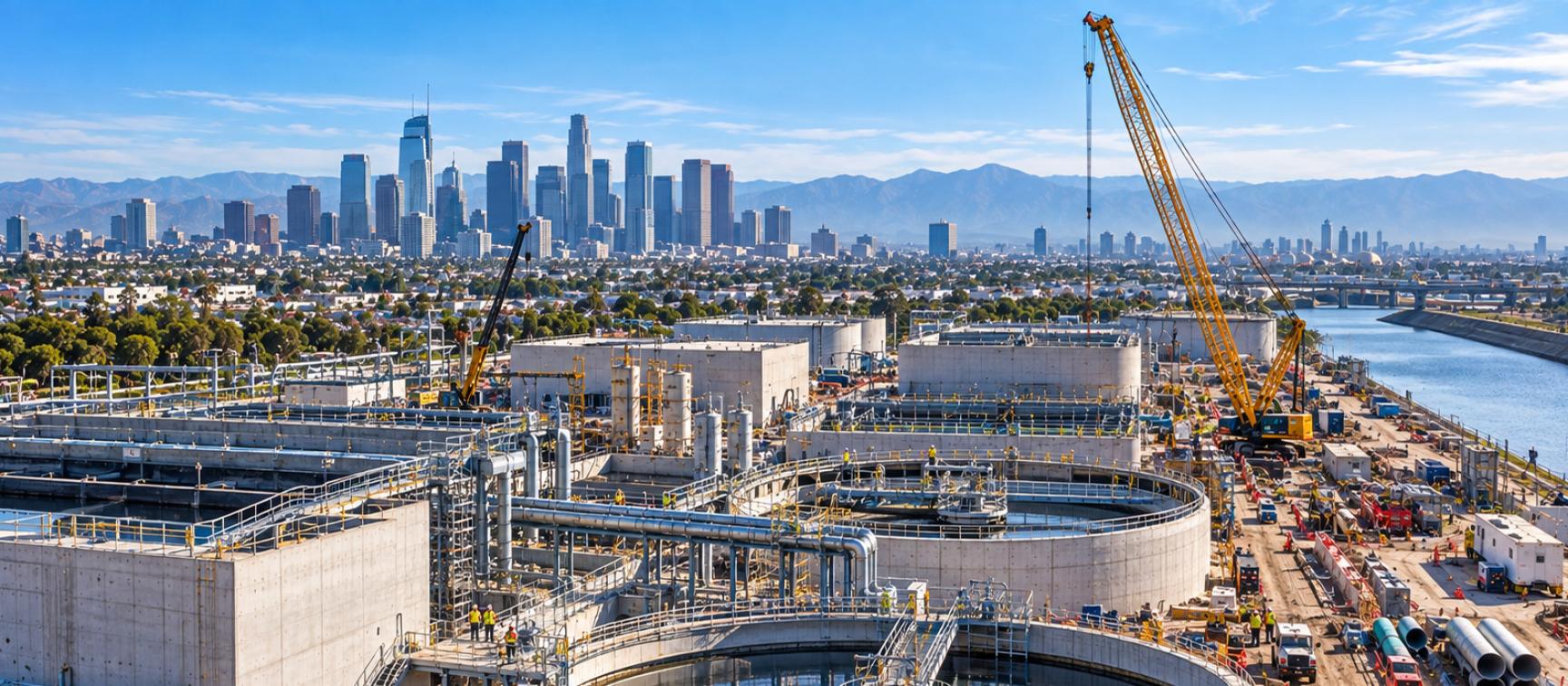
Pure Water Los Angeles: Inside the $21-$26 Billion Plan to Transform the City's Water Supply
Los Angeles uses approximately 450 million gallons of water every day.
For generations, much of that water has traveled hundreds of miles before reaching the city, arriving from sources including the Eastern Sierra, Colorado River and Sacramento-San Joaquin Delta.
Now Los Angeles is planning something very different.
Instead of allowing huge volumes of treated wastewater to leave the city, it wants to purify that water and use it again.
Pure Water Los Angeles is a proposed multibillion-dollar water recycling program being developed jointly by the Los Angeles Department of Water and Power (LADWP) and LA Sanitation and Environment (LASAN).
If fully developed, it could eventually produce up to 230 million gallons of purified recycled water every day.
The latest City estimates put the long-term program cost at approximately $21 billion to $26 billion, making this potentially one of the most significant water infrastructure programs in the United States.
For the construction industry, the scale of what is being considered is enormous.
Advanced water purification facilities, treatment plant upgrades, more than 40 miles of major pipeline, pumping stations, storage facilities, groundwater infrastructure and new electrical systems could all form part of the program.
But Pure Water Los Angeles is about more than building infrastructure.
It represents a fundamental change in how one of America's largest cities thinks about water.
Why Los Angeles Is Rethinking Its Water Supply
Water and Los Angeles have always had a complicated relationship.
The city developed by importing huge quantities of water from distant sources, and that system remains critical today.
According to LADWP, approximately 50% of Los Angeles' water currently comes from local sources, including groundwater, recycled water and supplies delivered through the Los Angeles Aqueduct. The remainder is purchased and imported from other agencies.
That dependence creates long-term challenges.
Drought, climate change, environmental restrictions, seismic risk, groundwater contamination and increasing imported water costs can all affect supply.
California's recent droughts demonstrated how quickly those pressures can become real.
Pure Water Los Angeles is intended to create another option.
The goal is to take water already available within the city, purify it to extremely high standards and return it to the water supply.
If the program reaches its maximum proposed capacity, LADWP says it could help Los Angeles transition toward approximately 70% local water supply.
That is a major shift for a city historically dependent on water transported across California and the Southwest.
From Wastewater to Drinking Water
The basic concept behind Pure Water Los Angeles is straightforward.
The engineering required to achieve it isn't.
Wastewater arriving at the Hyperion Water Reclamation Plant would first undergo conventional treatment before additional treatment through upgraded membrane bioreactor systems.
That water would then move through advanced purification processes capable of removing contaminants at extremely small scales.
Los Angeles has already demonstrated some of the technology at the Hyperion Advanced Water Purification Facility.
That facility uses three key treatment stages: membrane bioreactor treatment, reverse osmosis and ultraviolet advanced oxidation.
The existing demonstration-scale facility produces approximately 1.5 million gallons of highly purified recycled water per day. Water production began in April 2025 following completion of construction in 2023.
Pure Water Los Angeles would take the underlying concept to an entirely different scale.
The proposed maximum capacity is 230 MGD.
That's more than 150 times the capacity of the existing Hyperion advanced purification facility.
A Massive Construction Program
The treatment technology gets much of the attention, but building Pure Water Los Angeles would involve far more than constructing one purification plant.
Current planning documents identify potential infrastructure including:
- Advanced water treatment facilities for indirect potable reuse
- A new direct potable reuse treatment facility
- More than 40 miles of new trunkline
- Three new pump station facilities
- Three new 9-million-gallon storage facilities
- Two new groundwater treatment facilities
- Two new production well fields
- New power infrastructure
The final configuration is still being evaluated, so those components may change as environmental review, engineering and planning progress.
Even so, the proposed scope demonstrates the scale of the construction challenge.
This isn't simply a treatment plant project.
It's a new water production and distribution system being integrated into one of America's largest and most densely developed cities.
More Than 40 Miles of Pipeline Through Los Angeles
Perhaps one of the most interesting construction challenges will be the conveyance system.
Current plans contemplate more than 40 miles of new trunkline carrying purified water through the Los Angeles area.
Building major water pipelines is challenging anywhere.
Doing it through Los Angeles adds another level of complexity.
Existing utilities, highways, residential neighborhoods, commercial districts, traffic, environmental constraints and limited working space all have to be considered.
Route selection alone requires extensive engineering.
LADWP says it is currently evaluating potential conveyance alignments and facility locations based on factors including hydraulics, constructability, environmental impacts, proximity to integration points and opportunities for regional collaboration.
Once construction begins, those decisions translate directly into excavation, utility relocation, traffic management, trenching, tunneling, pipeline installation and restoration.
For heavy civil contractors, this could ultimately become as much a conveyance project as a treatment project.
Three 9-Million-Gallon Storage Facilities
Storage will provide another substantial construction package.
Current plans contemplate three facilities capable of storing approximately 9 million gallons each.
Combined, that's approximately 27 million gallons of storage capacity.
Large water storage structures bring their own engineering requirements around foundations, structural concrete, seismic performance, mechanical systems, piping, valves, instrumentation and site development.
And in Southern California, seismic resilience isn't an optional consideration.
Water infrastructure has to continue functioning after major events.
That means resilience has to be engineered into everything from pipelines and pumping stations to treatment facilities and electrical systems.
The Hyperion Transformation
At the heart of Pure Water Los Angeles sits the Hyperion Water Reclamation Plant.
Rather than simply building a new facility elsewhere, Los Angeles plans to transform how water moves through one of its existing wastewater assets.
LASAN would upgrade Hyperion's secondary treatment process using membrane bioreactor technology, producing higher-quality source water for subsequent advanced purification.
That creates a particularly interesting construction challenge.
Working inside an existing treatment facility is very different from constructing a greenfield plant.
Wastewater doesn't stop arriving because construction is underway.
Existing systems have to continue operating while new infrastructure is installed, tested and connected.
That creates complicated sequencing requirements.
Shutdowns have to be planned carefully. Temporary systems may be needed. Mechanical and electrical tie-ins have to be coordinated. Commissioning has to happen without compromising existing operations.
For Project Managers and Superintendents with water and wastewater experience, those are familiar challenges, just on an unusually large scale.
Indirect and Direct Potable Reuse
Another reason Pure Water Los Angeles is significant is that the program is being designed with multiple potential pathways for using purified water.
One is indirect potable reuse.
Under this approach, highly purified recycled water can be introduced into groundwater basins before eventually being extracted, treated again and distributed through the drinking water system.
Los Angeles is also preparing for direct potable reuse, where purified recycled water could eventually be integrated more directly into the drinking water supply.
California's evolving regulatory framework has opened the door for these types of projects, creating opportunities for utilities to rethink wastewater as a dependable local resource.
For engineers and contractors, that creates a new generation of highly technical infrastructure projects.
From 1.5 MGD to 230 MGD
Los Angeles isn't beginning entirely from scratch.
The existing Hyperion Advanced Water Purification Facility provides a working demonstration of the treatment technologies behind the larger program.
The facility was delivered using progressive design-build, with Walsh Construction serving as the contractor and Brown and Caldwell as design engineer.
Construction was completed in July 2023, with water production beginning in April 2025.
Its capacity is approximately 1.5 MGD.
Pure Water Los Angeles could eventually reach 230 MGD.
That difference illustrates the scale of the challenge ahead.
Technology that works at demonstration scale has to be engineered, constructed and operated at a scale capable of contributing meaningfully to the water supply of a city with millions of residents.
A $21-$26 Billion Infrastructure Pipeline
The financial scale has also become clearer.
Current LASAN estimates put the total programmatic investment at approximately $21 billion to $26 billion over a multi-decade rollout.
Los Angeles is exploring several ways of financing that investment.
Potential sources include EPA Water Infrastructure Finance and Innovation Act (WIFIA) loans, U.S. Bureau of Reclamation water recycling grants, California State Revolving Fund financing, municipal bonds and other state and federal programs.
For the construction market, the significance is obvious.
Even when spread across many years, a $21-$26 billion program represents an enormous pipeline of engineering, construction and professional services opportunities.
When Will Construction Begin?
This is where it's important to distinguish Pure Water Los Angeles from projects already deep into construction.
As of September 2026, the wider program remains in the planning and environmental review stage.
LASAN says the program is currently in Phase Three, with environmental review and community engagement continuing through late 2026. The Master Plan and Hyperion Program Implementation Plan were finalized in early 2025.
Current planning indicates that the first major phase, capable of producing approximately 50 MGD of purified recycled water, could become available no sooner than 2040.
So this isn't a project that will appear overnight.
It is a multi-decade infrastructure program.
And that may make it even more significant for the construction industry.
The professionals entering water and wastewater construction today could potentially spend a substantial part of their careers working on projects connected to this program.
The Workforce Challenge Behind Pure Water
Programs of this scale require far more than capital.
They require people.
Over its lifetime, Pure Water Los Angeles could generate demand across virtually every part of the water construction market.
Project Executives and Project Managers will be needed to coordinate complex packages.
Superintendents will be responsible for treatment facilities, pipelines, pumping stations and major civil works.
Project Engineers will manage RFIs, submittals, procurement, field coordination and documentation.
Schedulers and Estimators will help contractors manage programs extending across years rather than months.
Civil, Structural, Mechanical, Electrical, Process and Controls Engineers will be needed to design and integrate highly technical systems.
Safety, Quality and Commissioning professionals will become increasingly important as individual facilities move from construction into operation.
And because much of the work involves specialized water infrastructure, experienced professionals won't always be easy to find.
Water Construction Is Becoming More Technical
Projects like Pure Water Los Angeles also demonstrate how the water construction market is changing.
A modern water project isn't simply concrete tanks and underground pipe.
Advanced purification brings together membrane systems, high-pressure pumping, chemical treatment, sophisticated instrumentation, automation, electrical infrastructure, cybersecurity and advanced process controls.
At the same time, traditional heavy civil expertise remains essential.
Someone still has to build the structures.
Someone has to install more than 40 miles of pipeline.
Someone has to construct the pump stations, storage facilities and groundwater infrastructure.
The future of water construction sits at the intersection of heavy civil construction and increasingly sophisticated treatment technology.
That combination makes experienced professionals particularly valuable.
A Bigger Story Across Southern California
Pure Water Los Angeles isn't happening in isolation.
Southern California is seeing billions of dollars invested in water recycling and reuse as agencies look for more resilient local supplies.
Los Angeles is already constructing a separate major groundwater replenishment project at the Donald C. Tillman Water Reclamation Plant, which is designed to produce up to 45 MGD and provide a drought-resistant local supply capable of serving up to 500,000 residents.
Elsewhere in the region, other utilities are advancing their own major reuse programs.
Taken together, these projects suggest that advanced water recycling could become one of the most important areas of U.S. water infrastructure construction over the coming decades.
Building a Water Supply Instead of Importing One
Perhaps the most interesting thing about Pure Water Los Angeles is what it represents.
Los Angeles isn't discovering a new river.
It isn't constructing another aqueduct hundreds of miles across California.
It's looking at water already flowing through the city and asking how much of it can be safely recovered.
That requires extraordinary treatment technology.
But it also requires extraordinary construction.
Treatment facilities, pipelines, storage tanks, pumping stations, electrical infrastructure and groundwater systems all have to be designed, financed and built before the concept becomes a dependable water supply.
With a potential 230 MGD capacity, more than 40 miles of new trunkline and an estimated investment of $21 billion to $26 billion, Pure Water Los Angeles provides a glimpse of just how large the next generation of American water infrastructure could become.
For the construction professionals who specialize in water, wastewater and heavy civil infrastructure, projects like this aren't simply interesting engineering stories.
They represent decades of work ahead.
At Approach Talent USA, we work with contractors and engineering businesses across the U.S. water, wastewater and heavy civil sectors, connecting them with experienced Project Managers, Superintendents, Engineers, Estimators and other construction professionals needed to deliver complex infrastructure.
Recent News
Florida's $1.2 Billion One Water Project: Building for the Next Generation of Growth
Suicide Prevention Awareness Month: Why Mental Health Matters in U.S. Construction
130 Feet Beneath Alexandria: Inside the RiverRenew Tunnel Project Transforming the Potomac