

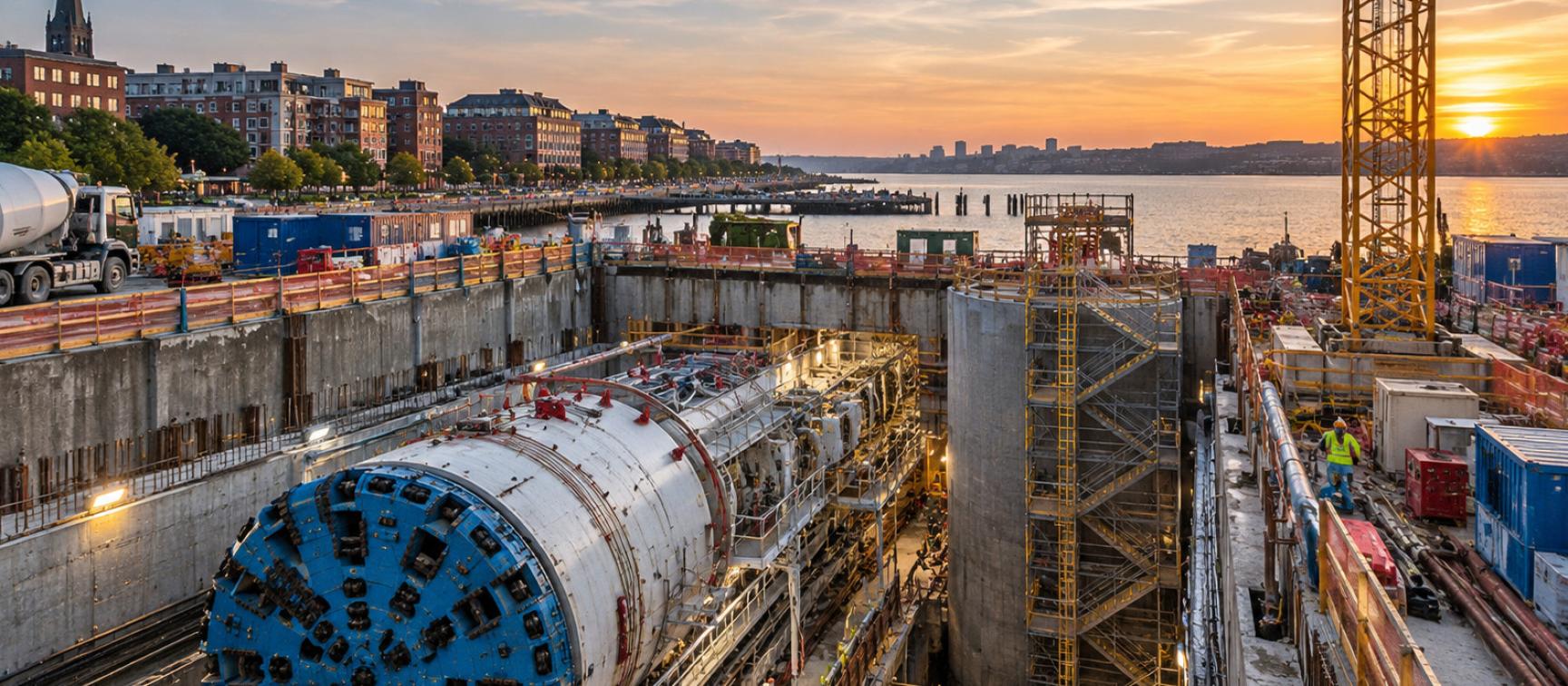
130 Feet Beneath Alexandria: Inside the RiverRenew Tunnel Project Transforming the Potomac
Some of America's most impressive infrastructure is infrastructure you'll never see.
Beneath the streets and waterfront of Alexandria, Virginia, a 2.2-mile tunnel running as deep as 130 feet underground is now capturing wastewater that previously overflowed into the Potomac River and its tributaries during heavy rainfall.
The project is called RiverRenew, and after eight years of planning, design, and construction, the system officially went live in summer 2026.
It is the largest infrastructure project in Alexandria's history, combining deep tunneling, microtunneling, major sewer construction, diversion structures, and a pumping station extending roughly 12 stories underground.
For the construction industry, RiverRenew is a great example of what it takes to deliver complex infrastructure beneath an established American city.
And the results are already being seen.
In its first month alone, RiverRenew prevented 27 million gallons of combined sewage and approximately two tons of trash and debris from entering local waterways.
Why Was RiverRenew Needed?
Like many historic U.S. cities, parts of Alexandria are served by a combined sewer system.
Rather than having separate pipes for stormwater and sanitary wastewater, these older systems carry both through the same network.
Most of the time, that isn't a problem.
During heavy rainfall, however, the volume of water entering the system can exceed its capacity. When that happens, combined sewage can overflow directly into nearby waterways.
For Alexandria, those waterways include the Potomac River, Hunting Creek, and Hooffs Run.
RiverRenew was built to dramatically reduce those events.
The completed infrastructure is designed to prevent approximately 120 million gallons of combined sewage every year from polluting Alexandria's waterways.
That's roughly equivalent to preventing more than 180 Olympic-size swimming pools of combined sewage from reaching local waterways each year.
The Engineering Solution Is 130 Feet Underground
Instead of trying to completely rebuild Alexandria's historic sewer network from the surface, engineers went underground.
Very far underground.
The centerpiece of RiverRenew is the Waterfront Tunnel, extending approximately 2.2 miles beneath Alexandria and reaching depths of around 130 feet.
The tunnel essentially acts as enormous underground storage and conveyance infrastructure.
During wet weather, combined sewage that would otherwise overflow into waterways can be diverted into the tunnel.
From there, it is transported to AlexRenew's wastewater treatment facility, where it can be properly treated before being released.
The project also included a new six-foot-diameter sewer pipeline, two major diversion facilities, and the huge underground pumping station required to move captured flows back into the treatment process.
Meet Hazel: 465 Feet of Tunneling Machinery
You don't excavate more than two miles beneath a historic city using conventional equipment.
RiverRenew required its own tunnel boring machine.
Named Hazel, the TBM measured approximately 15 feet in diameter and 465 feet long.
Hazel and the tunneling crews excavated more than two miles underground, operating around 100 feet below the surface for much of the drive and passing deep beneath the Potomac River for roughly half of the journey.
That required careful management of geology, groundwater, tunneling pressures, spoil removal, segment installation, logistics, surveying, and safety.
Above ground sat historic neighborhoods, businesses, roads, utilities, and waterfront areas that needed to continue functioning while construction progressed below them.
That is one of the things that makes underground infrastructure construction so technically demanding.
The public may barely notice what's happening.
Underground, an enormous construction operation is taking place.
Microtunneling Added Another Challenge
The main tunnel wasn't the only underground work.
Construction of the Hooffs Run Interceptor required a combination of conventional open-cut construction and microtunneling.
Microtunneling allows large-diameter pipelines to be installed beneath roads and other obstacles while significantly reducing the amount of surface excavation required.
For dense urban construction, that's a major advantage.
It also adds another specialist discipline to a project already involving deep shafts and TBM tunneling.
A Pumping Station 12 Stories Underground
Building a tunnel that captures millions of gallons of wastewater creates another challenge.
You eventually have to get that water back to the surface.
RiverRenew's answer is one of the project's most impressive structures: a pumping station extending approximately 12 stories underground.
At its lowest level sit two enormous tunnel dewatering pumps.
Together, they can move up to 20 million gallons of wastewater every day.
The pumps lift flows approximately 130 vertical feet from the bottom of the Waterfront Tunnel into AlexRenew's treatment plant.
Separate wet-weather pumps provide another 45 million gallons per day of pumping capacity.
Before RiverRenew could become operational, crews had to test and commission these systems, along with the hydraulic equipment controlling valves throughout the pumping station.
For construction professionals, this highlights something that can sometimes get overlooked when discussing major projects.
Finishing construction isn't the same as finishing the project.
Complex infrastructure still has to be tested, commissioned, integrated, and proven under operating conditions.
Nearly $550 Million Invested by Late 2025
RiverRenew also represents an enormous financial commitment.
Virginia's 2025 progress report showed that AlexRenew had invested nearly $550 million in the wider RiverRenew capital program by that point, including approximately $375 million on the Tunnel Project alone.
Financing included:
- $321 million through the EPA's Water Infrastructure Finance and Innovation Act
- $185 million through Virginia's Clean Water Revolving Loan Fund
- $140 million in state grants
Virginia also authorized $90 million in American Rescue Plan Act funding specifically for the RiverRenew Tunnel System Project.
This wasn't simply a construction project. It was a major long-term public infrastructure investment requiring coordination between AlexRenew, the Commonwealth of Virginia, EPA, contractors, designers, suppliers, and the City of Alexandria.
$275 Million Flowed Into Virginia
Major infrastructure spending doesn't stop at the project boundary.
By late 2025, RiverRenew had invested more than $275 million within the Commonwealth of Virginia, supporting approximately 250 local firms.
That gives a much better sense of the economic footprint created by a project of this scale.
There are the major contractors everyone sees.
Behind them sit hundreds of subcontractors, consultants, equipment manufacturers, suppliers, logistics providers, testing businesses, engineering specialists, and professional services companies.
And behind all of those companies are people.
The Construction Teams Behind RiverRenew
RiverRenew brought together an extensive team of major contractors and engineering specialists.
AlexRenew credits Traylor-Shea Joint Venture, Kokosing, Jacobs, Brown and Caldwell, Schnabel, its resident engineering team, numerous subcontractors and suppliers, and multiple public agencies with helping deliver the program.
A project combining tunneling, microtunneling, deep shafts, major pumping infrastructure, wastewater treatment integration, concrete structures, mechanical systems, electrical infrastructure, and commissioning requires an equally diverse professional workforce.
That includes roles such as Project Managers, Superintendents, Project Engineers, Construction Managers, Tunnel Engineers, Civil Engineers, Mechanical Engineers, Electrical Engineers, Schedulers, Estimators, Safety Managers, Quality professionals, and Commissioning Managers.
The challenge isn't simply finding construction professionals.
It's finding people who have worked in these environments before.
Experience delivering underground heavy civil infrastructure, major water projects, tunnels, pumping stations, or live wastewater facilities can take years to develop.
Building Through a Pandemic and Historic Inflation
RiverRenew's construction timeline also crossed one of the most disruptive periods the industry has experienced in decades.
AlexRenew says the team had to contend with the pandemic, significant inflation, international conflicts, supply-chain pressures, and escalating construction costs while still working toward a legally mandated completion deadline.
Despite those challenges, AlexRenew reports that the project was delivered on budget and in approximately eight years, which it describes as roughly half the time typically required for infrastructure of comparable scale.
Earlier project reporting demonstrates just how real those pressures were.
In 2022, AlexRenew estimated that construction escalation alone could potentially add more than $30 million to the final contract value, partly because materials and equipment couldn't simply be delayed without putting the completion deadline at risk.
That's a challenge construction teams across the U.S. will recognize.
On a major infrastructure program, schedule, procurement, cost, and risk are inseparable.
And Now We Know It Works
Perhaps the most interesting RiverRenew statistic arrived after construction was largely finished.
The system officially entered service around the end of June and beginning of July 2026.
During July, Alexandria experienced several storms.
RiverRenew captured approximately 27 million gallons of combined sewage during its first month.
During the largest storm, on July 21, 2.08 inches of rain fell and the new tunnel reached 89% of its storage capacity.
The system also intercepted approximately two tons of trash and debris that could otherwise have reached Virginia's waterways.
For a project that spent years underground and largely invisible to the public, those numbers provide a very tangible measure of what the investment achieved.
Industry Recognition in 2026
RiverRenew has also now received recognition from the construction industry itself.
In August 2026, Engineering News-Record named the RiverRenew Tunnel System an Award of Merit winner in the Water/Environment category of its 2026 MidAtlantic Best Projects competition.
Projects were evaluated by an independent panel on areas including construction challenges, community contribution, safety, design, and construction quality.
That's particularly fitting for a project where so much of the most difficult work will ultimately remain completely invisible.
Why RiverRenew Matters to U.S. Construction
RiverRenew isn't just an Alexandria story.
Combined sewer systems exist in older cities across the United States, and utilities face increasing pressure to reduce overflows, modernize aging infrastructure, improve water quality, and make systems more resilient to extreme rainfall.
Solving those problems can require some of the most sophisticated heavy civil construction in the industry.
Deep tunnels.
Large-diameter pipelines.
Pump stations.
Shafts.
Treatment plants.
Controls.
Electrical infrastructure.
Complex commissioning.
And highly experienced people capable of bringing all of it together.
RiverRenew shows what that investment can achieve.
After years of construction beneath Alexandria, a piece of infrastructure most residents will never physically see is now preventing millions of gallons of pollution from reaching the Potomac.
For the engineers and construction professionals who delivered it, that's quite a legacy.
At Approach Talent USA, we work with contractors and engineering firms delivering complex water, wastewater, tunneling, and heavy civil infrastructure across the United States, connecting them with the Project Managers, Superintendents, Engineers, Estimators, and construction professionals needed to deliver America's critical infrastructure.
Recent News
Inside San Francisco's $2.84 Billion Wastewater Transformation: Turning Waste Into Renewable Energy
White-Collar Construction Careers in 2026 and Beyond: Why Demand Has Never Been Higher
Inside Fort Worth's $464 Million Mary's Creek Water Reclamation Facility