

Inside San Francisco's $2.84 Billion Wastewater Transformation: Turning Waste Into Renewable Energy
San Francisco is in the middle of one of the largest wastewater infrastructure transformations in the United States.
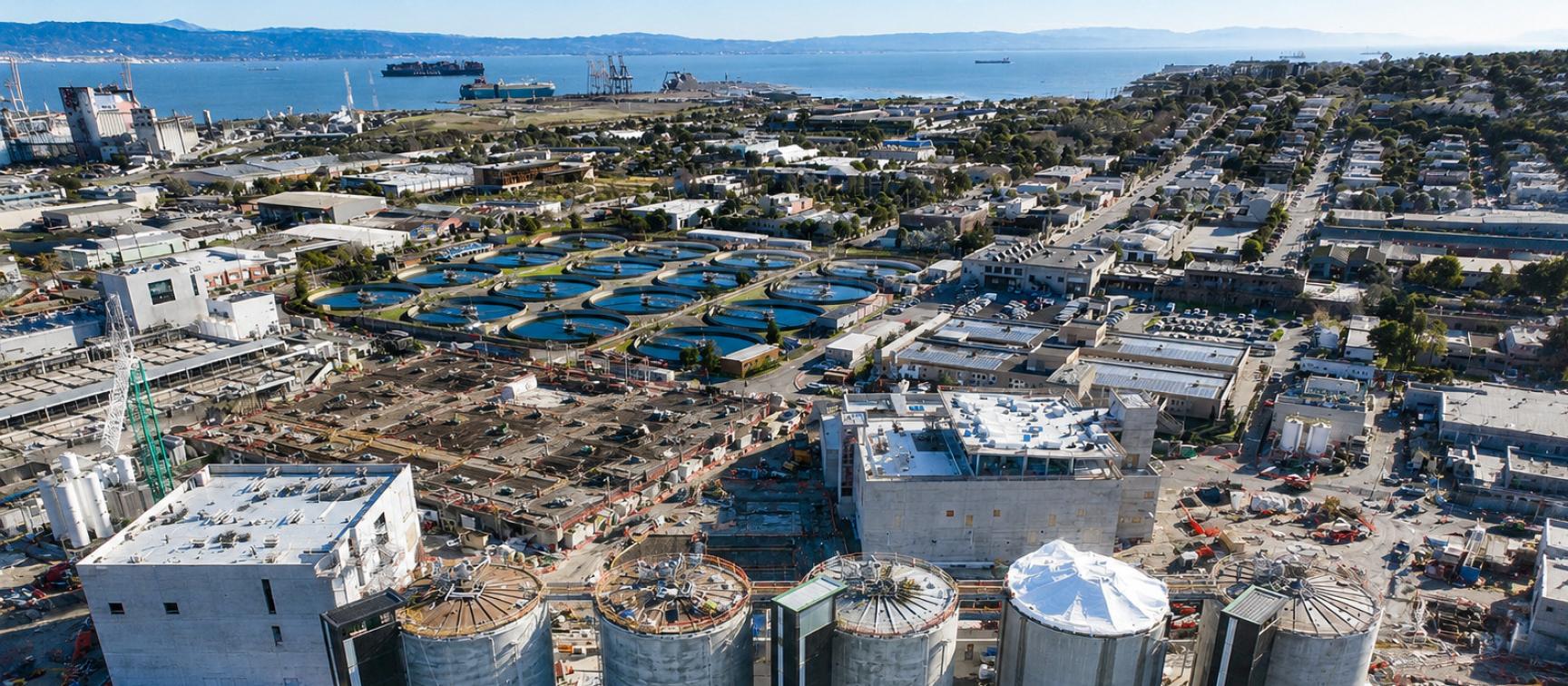
At the city's Southeast Treatment Plant, construction is progressing on the Biosolids Digester Facilities Project, a $2.84 billion investment replacing aging solids treatment infrastructure with a modern system designed to produce higher-quality biosolids, capture odors, improve seismic resilience, and recover more value from wastewater.
The scale is significant. The Southeast Treatment Plant handles nearly 80% of San Francisco's combined stormwater and wastewater, making it one of the city's most critical pieces of infrastructure.
And unlike a greenfield development, much of this work is being delivered while the existing treatment plant continues to operate.
For the construction industry, that creates an enormous technical challenge involving heavy civil construction, process mechanical systems, electrical infrastructure, instrumentation and controls, commissioning, and complex sequencing.
Why Does San Francisco Need New Digesters?
The Southeast Treatment Plant was originally built in 1952, and much of its existing solids treatment infrastructure has reached or exceeded its useful life.
The plant also sits in San Francisco's Bayview neighborhood, meaning odor, noise, visual impact, and construction disruption all have to be considered alongside engineering and operational requirements.
The San Francisco Public Utilities Commission is investing more than $5 billion across the wider Southeast Treatment Plant to turn the facility into a modern resource recovery center.
The Biosolids Digester Facilities Project is one of the largest pieces of that investment.
Instead of simply replacing aging equipment like-for-like, SFPUC is fundamentally changing how the plant handles the solids left behind during wastewater treatment.
A $2.84 Billion Construction Program
Current San Francisco capital planning documents put the total Biosolids Digester Facilities Project budget at approximately $2.84 billion.
As of March 2026, construction of the core biosolids facilities was reported to be more than 70% complete.
Work underway includes installation of process equipment and piping, mechanical systems, electrical infrastructure, plumbing, HVAC, instrumentation, and controls.
Construction originally started in August 2019. Testing is underway in 2026, with process fluids expected to be introduced into the new digesters in fall 2026.
Substantial completion is currently anticipated in 2027, followed by final completion in summer 2028.
The long delivery schedule gives some indication of the complexity involved. This isn't simply a case of building five tanks and connecting pipework. The new facilities have to become part of a functioning wastewater treatment process serving one of America's largest cities.
Five Enormous New Digesters
At the center of the project are five new anaerobic digesters.
Each stands approximately 65 feet tall.
Digesters perform one of the less visible but essential functions within wastewater treatment.
After wastewater passes through various treatment stages, solids remain. Anaerobic digestion uses microorganisms in an oxygen-free environment to break down organic material within those solids.
That process produces two valuable outputs: biosolids and biogas.
San Francisco's new facilities are designed to improve the quality of both.
The EPA says the completed system will be capable of producing up to 24,000 dry tons of Class A biosolids annually by 2045.
Class A biosolids have undergone treatment that significantly reduces pathogens, allowing the material to be beneficially reused rather than simply treated as waste.
In other words, what enters the plant as sewage can leave as a usable resource.
Turning Sewage Gas Into Renewable Natural Gas
The biogas side of the project is particularly interesting.
Anaerobic digestion naturally produces a methane-rich gas.
Rather than treating that gas purely as a waste product, SFPUC is building a dedicated Biogas Utilization Project designed to provide 100% beneficial use of the biogas produced by the new digesters.
The approximately $121.5 million design-build contract calls for the biogas to be cleaned and upgraded into pipeline-quality renewable natural gas.
Once processed, that renewable gas can be injected into the existing natural gas pipeline network.
Construction began in late 2025 and is expected to continue into early 2027.
It effectively turns part of San Francisco's wastewater stream into an energy resource.
For a construction project, that also introduces another layer of technical complexity. Gas treatment equipment, process piping, mechanical systems, controls, safety systems, electrical infrastructure, and pipeline integration all have to work alongside the wastewater treatment process.
3,300 Jobs Associated With the EPA-Backed Project
Major infrastructure investment also means major workforce requirements.
The U.S. Environmental Protection Agency estimates that the WIFIA-backed Biosolids Digester Facilities Project will create approximately 3,300 jobs.
EPA's project data lists $1.427 billion in WIFIA project costs, supported by a $699 million federal WIFIA loan.
That financing is significant in its own right.
The original WIFIA agreement was one of the largest water infrastructure loans of its kind when it was executed, helping San Francisco fund a project that will serve the city for decades.
But the employment impact extends beyond the people physically working inside the plant.
A project of this scale creates demand across engineering, construction management, specialty contracting, equipment manufacturing, logistics, testing, commissioning, safety, quality, and professional services.
Building Inside a Live Treatment Plant
One of the biggest construction challenges is something that doesn't necessarily show up in the headline figures.
The Southeast Treatment Plant cannot simply shut down while construction takes place.
Nearly 80% of San Francisco's combined stormwater and wastewater still has to be treated.
That means new infrastructure must be constructed, tested, commissioned, and integrated alongside existing systems without compromising treatment performance.
For contractors, this changes everything.
Temporary systems may be required. Tie-ins need careful planning. Shutdown windows become critical. Construction sequencing has to account for plant operations. Safety teams are working within an active industrial environment, and commissioning becomes just as important as physical construction.
It also means communication between the owner, designers, contractors, subcontractors, commissioning teams, and plant operators is essential.
This is where experienced construction leadership becomes particularly valuable.
Seismic Resilience Matters in San Francisco
There is another engineering challenge unique to projects in this part of California.
Earthquakes.
The new facilities are being constructed to meet modern seismic standards, improving the reliability of critical wastewater infrastructure following a major seismic event.
For a city surrounded by water and crossed by major fault systems, maintaining wastewater treatment following an earthquake is a public health issue as much as an infrastructure issue.
That seismic requirement affects structural engineering, foundations, equipment anchorage, piping, electrical systems, and the way individual components are connected.
It adds another layer of complexity to an already highly technical construction program.
Making the Plant a Better Neighbor
The project isn't only about treatment capacity and resilience.
The Southeast Treatment Plant has operated in the Bayview community for decades, and odor has historically been one of the most visible impacts for nearby residents.
The new biosolids facilities include advanced odor-control systems specifically designed to reduce that impact.
SFPUC has described its goal simply: the new facility should work better, look better, and smell better.
New digesters have also been positioned farther from existing residences, while modern odor treatment equipment will capture and treat air from the solids handling process.
It's a reminder that major infrastructure projects increasingly have to deliver community benefits as well as engineering performance.
A Project Recognized for Sustainability and Safety
The project has already received significant industry recognition.
In 2023, the Biosolids Digester Facilities Project achieved Envision Platinum, the highest level available under the Institute for Sustainable Infrastructure's Envision framework.
The project also received the National Safety Council Occupational Excellence Achievement Award in both 2024 and 2025.
Those achievements matter on a project where hundreds of workers, multiple trades, major structures, heavy equipment, process systems, and live plant operations all have to coexist.
The Construction Expertise Behind a Project Like This
Modern wastewater plants sit at the intersection of heavy civil construction and advanced industrial engineering.
The Biosolids Digester Facilities Project requires expertise across concrete, structural steel, process piping, mechanical equipment, electrical distribution, HVAC, instrumentation, controls, odor-control systems, gas processing, commissioning, and startup.
That creates demand for professionals including:
- Project Managers
- Senior Project Managers
- Construction Managers
- Superintendents
- Project Engineers
- Civil and Structural Engineers
- Mechanical Engineers
- Electrical Engineers
- Instrumentation and Controls Engineers
- Process Engineers
- Estimators
- Schedulers
- Safety Managers
- Quality Control Managers
- Commissioning Managers
And as the project moves from heavy construction toward testing and commissioning, the skills required change again.
Building the facility is one challenge.
Proving that thousands of individual components operate correctly as a single treatment system is another.
Why This Project Matters Beyond San Francisco
The Biosolids Digester Facilities Project reflects a much bigger change happening across America's water and wastewater sector.
Many treatment plants built during the middle of the 20th century are reaching the point where major equipment and structures need replacement.
But utilities aren't simply rebuilding what was there before.
New projects are increasingly expected to improve energy efficiency, recover resources, reduce emissions and odors, meet stricter environmental standards, withstand extreme events, and operate with more sophisticated automation and controls.
San Francisco provides a striking example.
A treatment plant built in 1952 is being transformed into a modern resource recovery facility capable of turning wastewater solids into Class A biosolids and converting digester gas into renewable natural gas.
That transformation requires billions of dollars of investment and thousands of people to design, build, test, and operate it.
For America's construction sector, that's the bigger story.
Water and wastewater facilities may not always attract the same attention as skyscrapers, airports, or major highways, but the engineering behind them is becoming increasingly sophisticated and the investment required to modernize them is enormous.
At Approach Talent USA, we work with contractors and engineering firms delivering complex water, wastewater, and heavy civil infrastructure across the United States, connecting them with the Project Managers, Superintendents, Engineers, Estimators, and construction professionals needed to turn major infrastructure investment into operating facilities.
Recent News
Inside California's $6 Billion Sites Reservoir: Building One of America's Largest New Water Storage Projects
Expert Advice to Prepare for a Construction Job Interview: Building Your Career in the U.S.
Inside Tampa Bay's $181 Million Water Treatment Expansion: Building for Florida's Future