

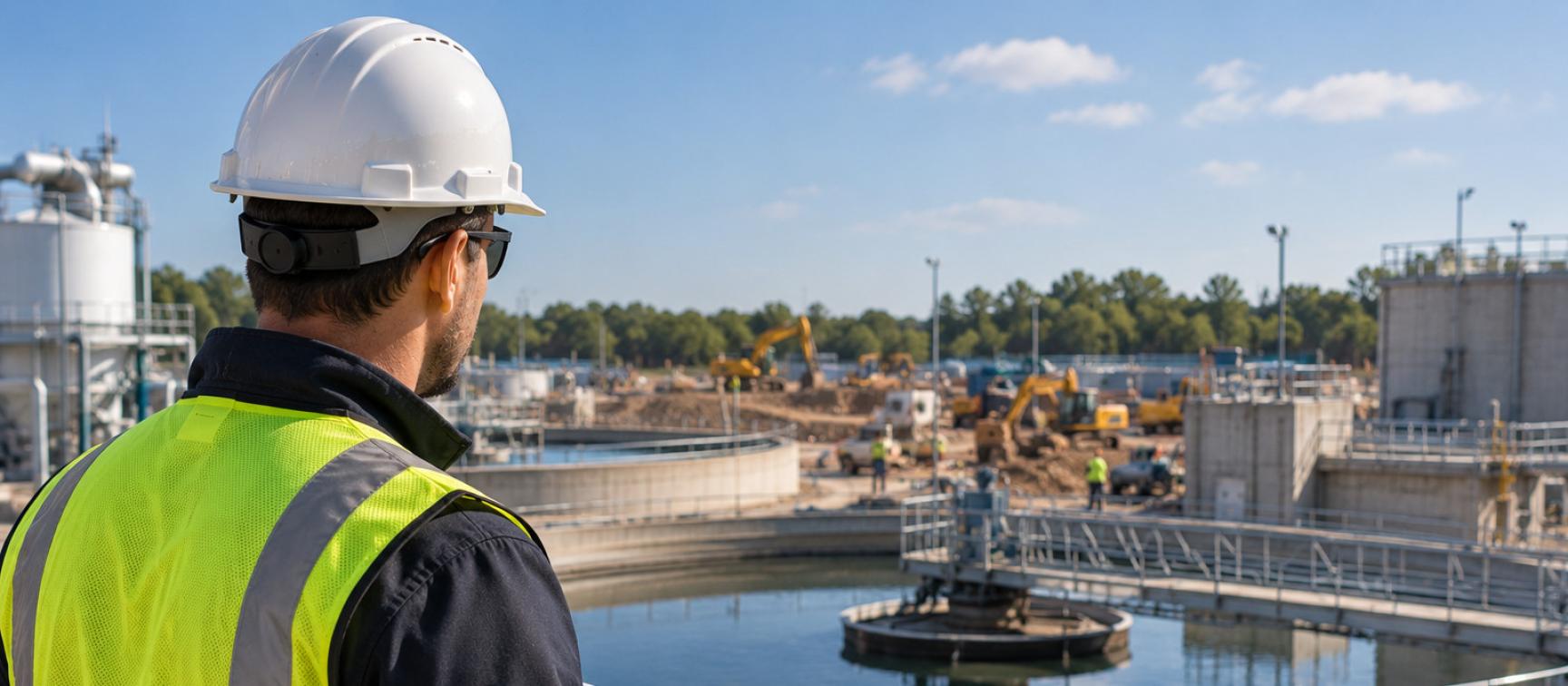
Inside Tampa Bay's $181 Million Water Treatment Expansion: Building for Florida's Future
Florida's continued population growth is placing increasing demands on the infrastructure responsible for supplying drinking water to its communities. Across the Tampa Bay region, where more than 2.6 million residents depend on a shared regional water supply, maintaining sufficient treatment capacity has become a significant priority.
In March 2026, Tampa Bay Water broke ground on a $181 million expansion of its Regional Surface Water Treatment Plant, marking the beginning of a major construction program designed to increase drinking water production, improve operational reliability and support future growth.
The expansion will provide up to 12.5 million additional gallons of drinking water per day, with construction scheduled for completion in 2028. The project is being delivered by Veolia Water North America and CDM Smith through an established public-private partnership.
What makes this investment particularly interesting is the approach being taken. Rather than constructing an entirely new treatment facility or increasing permitted withdrawals from local rivers, Tampa Bay Water is expanding and optimizing its existing infrastructure to produce more drinking water from the resources already available.
Why Tampa Bay Needs More Drinking Water Capacity
Tampa Bay Water supplies wholesale drinking water to Hillsborough, Pasco and Pinellas counties, alongside the cities of Tampa, St. Petersburg and New Port Richey. Its regional supply system combines surface water, groundwater and desalinated seawater, providing flexibility in a part of Florida where rainfall patterns and water availability can vary considerably throughout the year.
The Regional Surface Water Treatment Plant has been a central part of that system since it began operating in 2002. Located in Tampa, the facility treats water drawn from the Alafia River, Hillsborough River and Tampa Bypass Canal, using a combination of advanced clarification, ozone disinfection and biological filtration.
The plant was designed to provide an average of up to 90 million gallons per day, with a maximum rated treatment capacity of 120 million gallons per day.
However, population growth across the region means additional supply is required. Tampa Bay Water's long-term planning forecasts indicate that the region could need up to 38 million gallons per day of additional drinking water supply by 2043.
The current expansion is intended to address the nearer-term requirement, helping meet regional demand through approximately 2033 while longer-term water supply projects continue to be evaluated.
Expanding Treatment Capacity Without Increasing River Withdrawals
One of the most important features of the project is that it will increase the amount of drinking water produced without requiring additional permitted withdrawals from the region's rivers and canals.
Historically, the Tampa Bay region relied heavily on groundwater. Over time, excessive groundwater withdrawals contributed to environmental damage affecting local lakes and wetlands.
The development of Tampa Bay Water's Enhanced Surface Water System helped reduce that dependence by allowing the region to make greater use of available river water, particularly during periods of higher rainfall.
The current expansion builds on that approach by improving the efficiency and capacity of the existing treatment processes.
Rather than developing another water source, the project will allow more water to pass through the treatment facility when suitable surface water is available. This means the region can increase its reliable drinking water supply while continuing to manage withdrawals within existing permitted limits.
For the water infrastructure industry, it demonstrates how improvements to treatment technology and operational efficiency can provide additional capacity without necessarily requiring an entirely new facility.
What Is Being Built at the Regional Surface Water Treatment Plant?
The $181 million construction program involves upgrades across several stages of the drinking water treatment process, alongside new mechanical equipment, piping, valves and supporting infrastructure.
One of the principal improvements is the addition of a fifth treatment process train, increasing the plant's ability to process raw water through its existing treatment system.
The project includes an expansion of the facility's ACTIFLO high-rate clarification process, which removes suspended particles and color from incoming surface water. This technology allows the plant to treat substantial volumes of water within a relatively compact footprint.
Additional ozone treatment capacity will also be installed. Ozone is used as the plant's primary disinfectant and plays an important role in treating water before it passes through subsequent filtration processes.
The expansion will introduce additional biologically active filters, which help remove remaining organic compounds from the water. Secondary disinfection systems will also be expanded to accommodate the increased production capacity.
Other improvements include new piping and valves connecting onsite water storage to the plant influent, together with upgrades to residuals processing equipment used to manage materials removed during treatment.
Importantly, Tampa Bay Water has identified that some existing infrastructure, including finished water storage, pumping and transmission pipelines, already has sufficient capacity to support the expansion. This allows investment to be concentrated on the treatment processes that need upgrading rather than rebuilding the entire facility.
Construction Progress During 2026
Following the March 2026 groundbreaking, construction activity has moved into the early stages of developing the additional treatment infrastructure.
Tampa Bay Water's published project update reports that ground reinforcement has been completed beneath the area designated for the fifth treatment train. Belt filters have also been positioned, while work has progressed on the chemical building tanks, including forming and testing activities.
The same update places construction progress at approximately 10% complete, demonstrating that the project has moved beyond preliminary site preparation into the development of new process facilities.
The early construction stages are particularly important on treatment plant projects because the foundations, underground utilities and structural arrangements must accommodate substantial mechanical equipment and associated pipework.
Equipment installation and commissioning will follow as the new structures become ready, with construction scheduled to continue through 2028.
Delivering Major Construction Within an Operating Treatment Plant
One of the greatest challenges facing the project team is the need to expand the facility while maintaining the existing drinking water supply.
Unlike a new treatment plant constructed on an undeveloped site, this project involves significant civil, mechanical and electrical works within a facility that must remain operational throughout construction.
That creates additional considerations for construction planning, particularly when installing new piping, connecting equipment to existing treatment processes and integrating upgraded systems with the plant's established infrastructure.
Contractors must coordinate construction activities around operational requirements, ensuring that existing treatment capacity remains available while new facilities are built and commissioned.
The sequencing of works is especially important where new systems need to connect to existing processes. Shutdowns and tie-ins must be carefully planned to avoid unnecessary disruption, while testing and commissioning activities need to demonstrate that the expanded treatment processes can operate reliably before being brought into service.
For Project Managers and Superintendents, this type of environment requires close communication with plant operators, engineers, subcontractors and commissioning specialists.
Maintaining drinking water quality and operational reliability remains the priority throughout the construction program, making coordination between the construction and operations teams essential.
Veolia and CDM Smith Delivering the Expansion
The project is being delivered through a public-private partnership involving Veolia North America and CDM Smith.
Both organizations have an established relationship with Tampa Bay Water and have been involved in the facility's development and operation.
CDM Smith received its Notice to Proceed for Phase 2 construction in March 2026, marking the transition from engineering and design into the main construction phase.
The company has described the project as an integrated progressive design-build program, allowing the design and construction teams to work collaboratively as the project develops.
This approach can be particularly valuable on complex treatment plant expansions, where equipment procurement, design coordination, constructability and operational requirements need to be considered together.
CDM Smith has also identified improvements to the plant's supervisory control and data acquisition (SCADA) system as part of the wider modernization effort. The upgrades are intended to improve operational monitoring, control and reliability as the expanded treatment processes are integrated into the existing facility.
Modernizing the Plant's Control Systems
Beyond the physical expansion of treatment capacity, Tampa Bay Water is investing in improvements to the technology used to monitor and operate the facility.
SCADA systems play an important role in modern water treatment plants, allowing operators to monitor equipment performance, treatment conditions, flows and other operational parameters.
As new treatment processes are introduced, the control systems must be capable of managing additional equipment while continuing to communicate with the existing plant infrastructure.
Tampa Bay Water has separately advanced a SCADA modernization project, including an approximately $20.4 million construction-phase contract amendment approved in August 2026.
The work is intended to update hardware and software, strengthen cybersecurity, improve system integration and enhance the reliability of plant operations.
For construction teams, these upgrades introduce another specialist element to the project, requiring coordination between electrical contractors, instrumentation specialists, controls engineers and commissioning personnel.
Integrating new technology into an operating facility can be complex, particularly where existing systems need to remain functional during installation and testing.
Part of a Wider Investment in Florida's Water Infrastructure
The Regional Surface Water Treatment Plant expansion is one component of Tampa Bay Water's wider infrastructure investment program.
The utility is also progressing the South Hillsborough Pipeline, a major transmission project intended to move additional drinking water into parts of Hillsborough County experiencing significant growth.
That project involves approximately 26 miles of pipeline and is designed to transport up to 65 million gallons per day, with completion also targeted for 2028.
Together, these projects illustrate the relationship between treatment capacity and water distribution infrastructure. Increasing the amount of drinking water produced at a treatment plant is only beneficial if the wider network can transport that supply to the communities where it is needed.
The investment is therefore taking place across multiple parts of the regional water system, from treatment facilities and pumping infrastructure to major transmission pipelines.
For Florida's heavy civil construction market, this creates opportunities across different project types, including treatment plant construction, large-diameter pipeline installation, underground utilities and mechanical and electrical infrastructure.
The Construction Professionals Behind the Project
Major water treatment plant expansions require experienced construction professionals who understand the technical and operational demands of working within essential infrastructure facilities.
Project Managers play a central role in coordinating the different construction packages, managing subcontractors, overseeing procurement and maintaining progress against demanding schedules.
Superintendents are responsible for organizing site operations and ensuring that civil, structural, mechanical and electrical activities progress safely and efficiently, particularly where construction is taking place alongside operational treatment processes.
Project Engineers support the technical delivery of the work, coordinating design information, equipment submittals, RFIs, construction documentation and the interfaces between different disciplines.
Mechanical and electrical specialists are equally important, particularly when installing new treatment equipment, process piping, pumps, valves, chemical systems and electrical infrastructure.
As the project progresses, commissioning teams and instrumentation and controls specialists will become increasingly important in ensuring that the expanded facility performs as intended.
For construction professionals working in the U.S. water and wastewater sector, projects like Tampa Bay provide opportunities to gain experience with advanced treatment technology, complex operational environments and multidisciplinary infrastructure delivery.
Building for Florida's Future
The expansion of Tampa Bay Water's Regional Surface Water Treatment Plant represents an important investment in the region's long-term drinking water reliability.
By increasing production capacity by up to 12.5 million gallons per day without increasing permitted river withdrawals, the project demonstrates how existing infrastructure can be optimized to meet growing demand while continuing to protect valuable water resources.
The construction program also highlights the challenges associated with modernizing essential infrastructure. New treatment processes, mechanical equipment, electrical systems and controls must all be installed and integrated while the existing facility continues supplying drinking water to millions of residents.
With an estimated investment of $181 million and completion scheduled for 2028, the project is another example of the substantial construction activity taking place across Florida's water infrastructure market.
As population growth continues to drive investment in drinking water supply, experienced contractors and construction professionals will remain central to delivering the infrastructure needed to support communities across the state.
At Approach Talent USA, we specialize in recruitment across the U.S. water, wastewater and heavy civil construction sectors. We work with contractors seeking experienced Project Managers, Superintendents, Project Engineers, Estimators and other construction professionals to deliver major infrastructure projects throughout the United States.
Recent News
Inside Cleveland's $3 Billion Project Clean Lake: The Underground Tunnels Transforming Wastewater Infrastructure
Inside Illinois' $1.45 Billion Water Infrastructure Program: Building a New Regional Water Supply
Inside Cartersville’s Wastewater Expansion: Building Capacity for Georgia’s Growth