

Inside Cartersville’s Wastewater Expansion: Building Capacity for Georgia’s Growth
Cartersville, Georgia is in the middle of a major investment in the infrastructure needed to support its next phase of growth.
The city’s Water Pollution Control Plant is undergoing a four-year expansion that will increase continuous treatment capacity from 15 million gallons per day (MGD) to 25 MGD. The upgraded facility is also being designed to handle 42 MGD maximum daily flow and up to 55 MGD instantaneous flow, giving the system significantly more capacity when flows rise above normal operating levels. Carterville
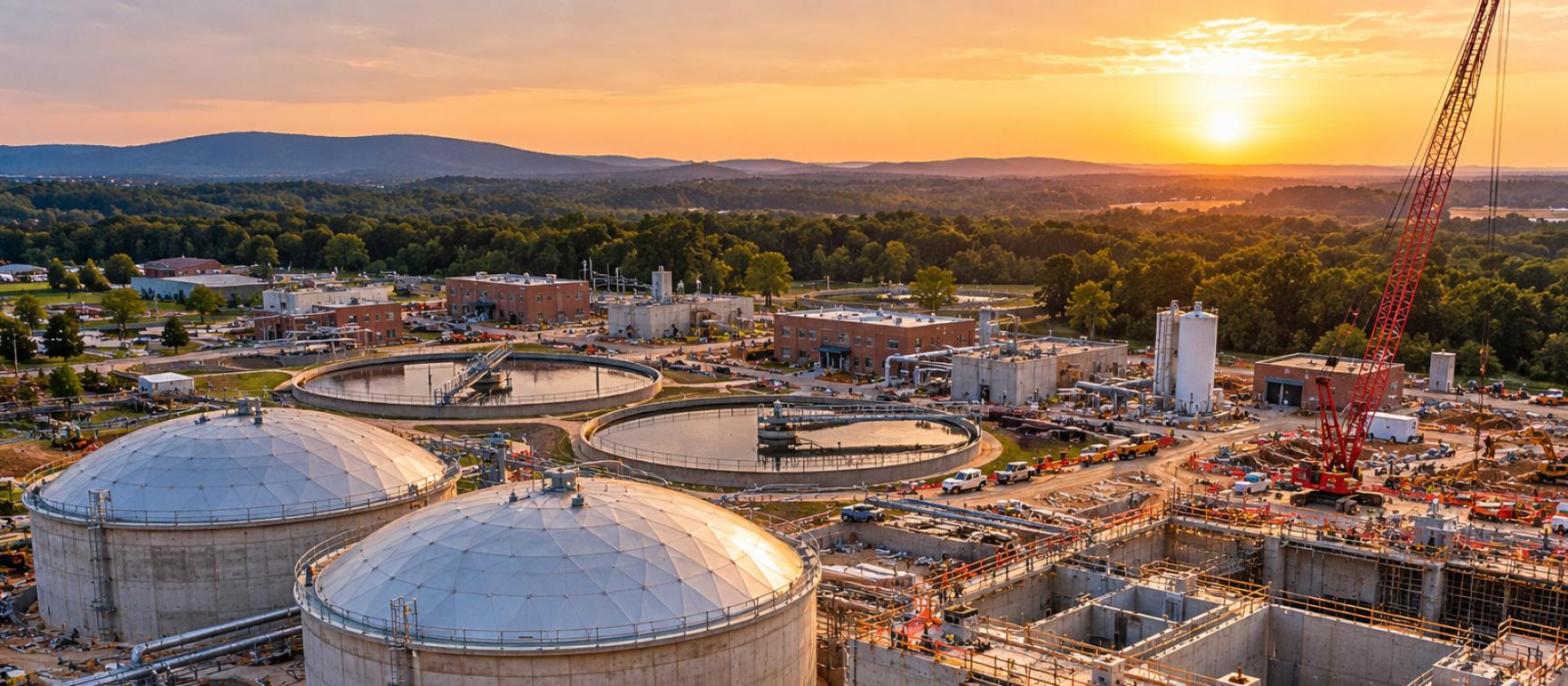
Construction is now well underway. As of September 30, 2026, both new equalization tank domes had been installed, work was continuing on the new influent pump station and headworks facility, and crews had started mass excavation for three new bioreactors. Carterville
For the construction industry, however, the story behind the project is about more than another wastewater plant expansion. Cartersville provides a good example of how industrial development and population growth can quickly translate into major investment in the infrastructure operating behind the scenes.
Growth Is Driving the Investment
Cartersville sits around 45 miles northwest of Atlanta in Bartow County, an area experiencing both residential development and increasing industrial water demand.
The City says the wastewater expansion is needed primarily because of increasing demand from its largest water customer, the Bartow County Water System. That additional demand is being driven by a combination of large industrial customers and residential growth, with the finished facility designed around projected requirements through 2050. Carterville
This is an important part of the infrastructure story surrounding economic development.
New manufacturing plants, distribution facilities, housing developments and commercial projects are highly visible signs of investment, but they also place additional pressure on water and wastewater systems. More people and businesses ultimately mean more wastewater that needs to be collected, treated and safely returned to the environment.
For growing communities such as Cartersville, treatment capacity therefore becomes part of the infrastructure needed to support continued development.
From 15 MGD to 25 MGD
The project will add 10 MGD of continuous treatment capacity, representing an increase of around 67% compared with the plant's existing 15 MGD capacity.
Planning for that expansion followed a capacity evaluation by engineering firm Hazen and Sawyer. The evaluation considered residential, commercial and industrial development across both Cartersville and Bartow County and concluded that a 10 MGD expansion was appropriate to maintain capacity and regulatory compliance over the longer term. Municode Meetings
The project isn't simply adding one new treatment train to the side of the existing facility.
It involves substantial new infrastructure across the plant, while parts of the existing site are also being demolished, replaced or integrated into the expanded operation.
What's Actually Being Built?
Some of the scale of the work becomes apparent from the construction progress already reported by the City.
Early works included demolition of the former laboratory building, four secondary clarifiers and old sludge digesters. Excavation then began for new headworks infrastructure and two 6-million-gallon equalization tanks. Underground piping was also installed around the new headworks and septage receiving facility. Carterville
By March 2026, crews had completed the first concrete pours for the new influent pump station and poured the base slab for the headworks. Six new influent pumps had also been factory tested ahead of delivery. Carterville
The civil engineering involved is substantial. Geotechnical information for the expansion identifies structures including the influent pump station, headworks, equalization tanks, main electrical building, bioreactors, blower building, clarifier splitter box, final clarifiers, filter facility and UV disinfection infrastructure. Some structures require excavation extending more than 20 or 30 feet below existing grade. Carterville
By July, utility crossings beneath Walnut Grove Road and a personnel tunnel connecting parts of the facility had been completed. Concrete work was continuing around the headworks, pump station and equalization infrastructure. Carterville
Then came another visible milestone in September: both equalization tank domes were in place and excavation had started for three new bioreactors. Carterville
This is a major heavy civil construction site in every sense.
Why the Equalization Tanks Matter
The two new 6-million-gallon equalization tanks are particularly interesting because they help illustrate why wastewater plants cannot simply be designed around average daily flow.
The amount of wastewater arriving at a treatment plant varies throughout the day and can increase substantially during certain conditions.
Equalization provides storage that allows some of those variations to be managed before the wastewater moves through downstream treatment processes.
For Cartersville, the two tanks provide a combined 12 million gallons of equalization capacity.
From a construction perspective, these are substantial structures in their own right. Excavation, foundations, prestressed concrete construction, mechanical equipment, piping and controls all have to come together before the tanks can become part of the operational process.
Their completion also demonstrates how wastewater construction often involves several major structures progressing simultaneously rather than a straightforward sequence of one building followed by another.
Building the New Headworks
Another major part of the expansion is the new influent pump station and headworks.
Headworks sits at the beginning of the treatment process and prepares incoming wastewater for everything that happens downstream. Reliable pumping and preliminary treatment are essential because problems at this stage can affect the entire facility.
The construction challenge is significant.
The project's geotechnical report indicates that portions of the influent pump station require excavation of approximately 21 to 26 feet, while areas associated with the headworks require roughly 13 to 18 feet. Carterville
That means excavation support, groundwater considerations, structural concrete, buried piping and equipment installation all need to be carefully coordinated before the process mechanical and electrical systems can ultimately be commissioned.
Three New Bioreactors Take Shape
The September 2026 construction update also marks the beginning of another major phase, with mass excavation underway for three new bioreactors. Carterville
Biological treatment is at the heart of modern wastewater treatment. Within these systems, microorganisms break down pollutants in the wastewater before it moves into subsequent stages of treatment.
Constructing the structures themselves requires major earthwork and reinforced concrete, but completing a functioning biological treatment system goes considerably further.
Aeration equipment, blowers, process piping, pumps, instrumentation, electrical systems and controls all have to operate together. Those systems then have to be tested and commissioned before they can become part of the live treatment process.
It is this combination of heavy civil construction and complex process infrastructure that makes large wastewater projects particularly challenging to deliver.
Delivering the Expansion While Cartersville Keeps Running
Perhaps the biggest challenge is one that won't necessarily be obvious from an aerial photograph of the site.
Cartersville still needs wastewater treatment every day while the expansion is being constructed.
That means construction teams are working around existing infrastructure and operations while preparing new systems that eventually need to connect into the live plant.
Existing utilities have to be protected or relocated, shutdowns need to be carefully coordinated, and new equipment often has to be installed and tested before existing infrastructure can be taken out of service.
This places considerable importance on sequencing.
The project isn't simply about building each structure as quickly as possible. The team needs to understand how every piece eventually connects into the operating facility and when those connections can safely take place.
CMAR and Early Contractor Involvement
Cartersville selected a Construction Manager at Risk (CMAR) approach for the expansion.
In August 2024, the City selected Archer Western as CMAR following an evaluation and interview process. City records specifically noted that the delivery method was chosen because it allowed early work packages and earlier procurement of long-lead equipment, helping accelerate construction. MCC Meetings
That approach makes sense on a wastewater project of this complexity.
Pumps, electrical equipment, process systems and other specialist components can have substantial manufacturing lead times. Waiting until every element of design is complete before beginning procurement can create significant pressure on the overall schedule.
Early contractor involvement also allows construction sequencing, temporary works, site logistics and constructability to influence the design before work reaches the field.
A Project Requiring a Broad Construction Team
Cartersville also demonstrates just how broad the workforce behind a wastewater expansion needs to be.
Major earthwork and structural concrete may dominate the site during the earlier phases, but the project increasingly becomes a multidisciplinary operation as construction advances.
Mechanical contractors will need to install pumps, process piping and treatment equipment. Electrical teams will be responsible for power distribution and equipment connections. Instrumentation and controls specialists will integrate the systems that allow operators to monitor and control the plant.
Eventually, startup and commissioning teams will need to prove that those individual systems work together as one treatment process.
Behind them are the Project Managers, Superintendents, Project Engineers, Schedulers, Safety professionals and Quality teams responsible for keeping the entire project moving.
For experienced construction professionals, this is also why water and wastewater can be such an interesting market. Projects combine conventional heavy civil construction with increasingly sophisticated mechanical, electrical and process systems.
Cartersville Is Investing on Both Sides of the Water Cycle
There is another interesting element to Cartersville's infrastructure program.
The city isn't only expanding its wastewater treatment capability. It is simultaneously expanding its drinking water treatment infrastructure.
Cartersville's separate Water Treatment Plant expansion is increasing capacity from 20 MGD to 37 MGD, also in response to growth from industrial and residential customers. Carterville
Taken together, the projects illustrate the scale of investment that can follow rapid regional development.
Communities cannot continue adding homes, factories and businesses indefinitely without expanding the systems supplying clean water and treating the wastewater those developments produce.
In Cartersville, both sides of that equation are now being addressed.
Infrastructure for 2050
The most significant thing about the Water Pollution Control Plant expansion may ultimately be the timeframe it is designed around.
This isn't infrastructure being built solely to solve today's capacity problem. The City says the finished 25 MGD plant is intended to meet projected demand through 2050. Carterville
That means decisions being made by engineers, contractors and construction teams today could influence how Cartersville grows for decades.
With the equalization tanks taking shape, the new influent pump station and headworks progressing and excavation now underway for three new bioreactors, the project has moved well beyond planning and into major construction.
Over the coming years, those concrete structures will increasingly fill with mechanical equipment, piping, electrical systems and controls before ultimately becoming part of a significantly larger operating treatment plant.
For the U.S. water and wastewater construction industry, Cartersville is another example of where growth is creating opportunity, not only for contractors, but for the experienced construction professionals capable of turning major infrastructure plans into working facilities.
At Approach Talent USA, we specialize in connecting contractors across the U.S. water, wastewater and heavy civil markets with experienced construction professionals, from Project Managers and Superintendents through to Project Engineers, Estimators and other key project personnel.