

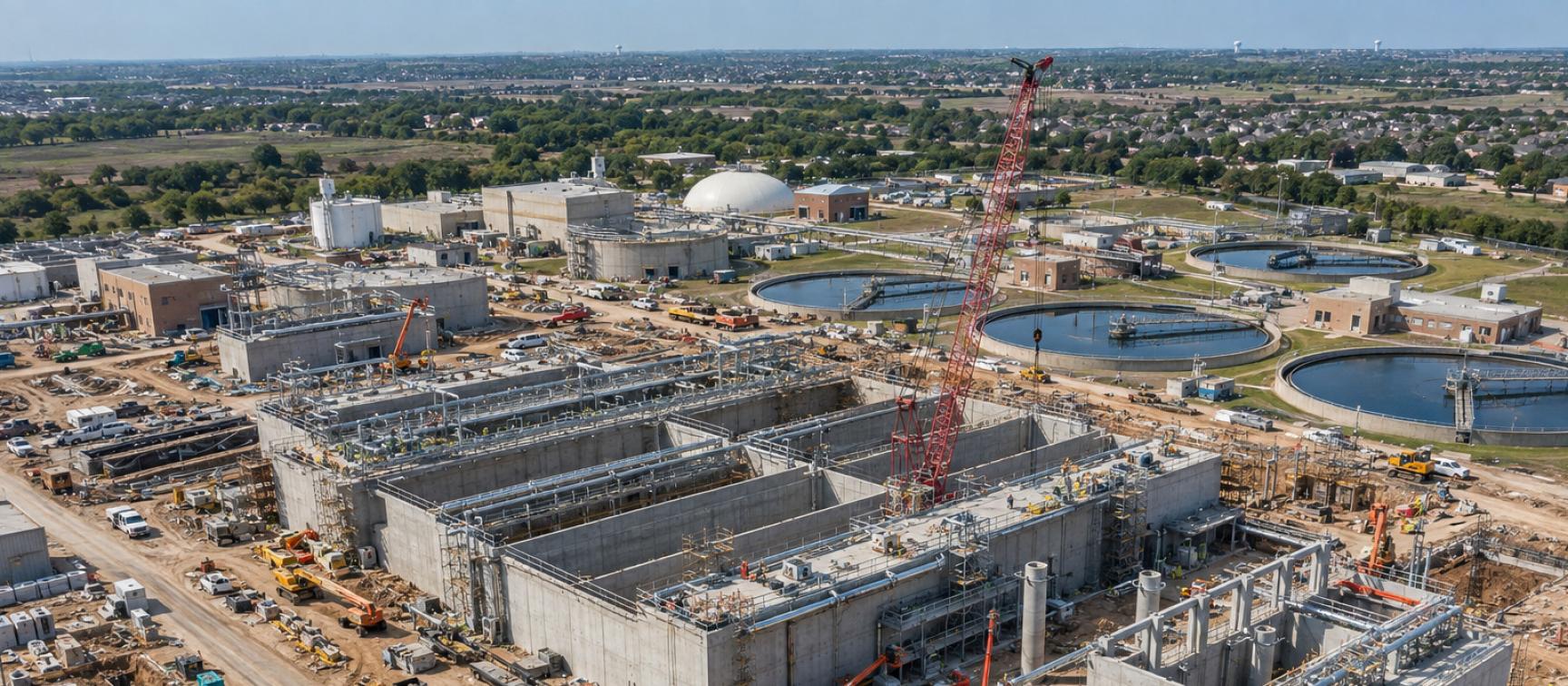
Inside Denton’s Pecan Creek Expansion: Building the Next Generation of Wastewater Treatment
Denton, Texas is growing, and the infrastructure supporting that growth has to grow with it.
On September 22, 2026, construction officially broke ground on a major expansion of the Pecan Creek Water Reclamation Plant, beginning a project that will significantly increase treatment capacity while replacing aging infrastructure and introducing more advanced wastewater treatment technology. Sundt Construction
The existing facility has a treatment capacity of approximately 21 million gallons per day (MGD). Earlier plans considered adding another 5 MGD, but the project has evolved into something considerably more ambitious: a new 30 MGD treatment facility, together with a new 75 MGD headworks facility capable of managing much larger incoming flows. Sundt Construction
For the water and wastewater construction industry, Pecan Creek is particularly interesting because of what Denton is building and how it intends to operate it. The new facility will use membrane bioreactor technology, biological nutrient removal and advanced disinfection, creating a modern treatment plant designed around water quality, reliability and the city's long-term growth. Voice of Denton
Why Denton Needs the Expansion
Denton's original approach was relatively straightforward: increase capacity at the existing 21 MGD plant by approximately 5 MGD.
As planning developed, the project team identified an opportunity to take a more comprehensive approach. Rather than investing heavily in aging systems while adding limited additional capacity, the plan shifted toward replacing much of that infrastructure with a new 30 MGD facility. Sundt Construction
That gives Denton additional capacity while also addressing the reliability and maintenance challenges associated with older wastewater infrastructure.
City documents put the eligible project cost used for its 2026 Clean Water State Revolving Fund application at approximately $326 million. The same documents describe the project as supporting future growth, improving resilience and creating potential future opportunities for water reuse through higher-quality effluent. Voice of Denton
This is therefore more than a straightforward capacity expansion. Denton is effectively repositioning one of its most important wastewater assets for the decades ahead.
What Is Being Built?
The scale of the construction becomes clearer when you look beyond the headline capacity numbers.
Current procurement documents describe a project that includes a new headworks and lift station, equalization and peak-storage ponds, BNR and MBR basins, a blower building, thickening and dewatering facilities, digesters, a heat exchanger building, UV disinfection, a new control and operations building, backup generators and associated medium-voltage electrical infrastructure. BusyBids
The project also involves sewer interceptors, buried utilities, modifications to existing chemical facilities and extensive site improvements.
That creates work across virtually every major discipline associated with wastewater construction: heavy civil, structural concrete, underground utilities, process mechanical, piping, electrical, instrumentation, controls and eventually startup and commissioning.
For construction teams, coordinating those systems is every bit as important as constructing the individual structures.
Why Membrane Bioreactor Technology Matters
One of the most interesting aspects of Pecan Creek is Denton's decision to use membrane bioreactor (MBR) technology.
In a conventional wastewater treatment process, biological treatment is typically followed by settling and additional filtration processes to separate treated water from suspended solids.
An MBR combines biological treatment with membrane filtration. Instead of relying solely on conventional clarification to separate the treated water, very fine membranes provide a physical barrier capable of producing consistently high-quality effluent.
For Denton, the technology forms part of a wider treatment strategy that also includes biological nutrient removal (BNR). City documents specifically identify improved nutrient removal and higher effluent quality among the benefits of the project. Voice of Denton
That is increasingly important as utilities plan for tighter discharge requirements, environmental performance and the possibility of beneficially reusing treated wastewater in the future.
From a construction perspective, MBR facilities also bring their own challenges. Membrane systems, blowers, pumps, process piping, electrical infrastructure, instrumentation and controls all need to be installed and integrated before the plant can operate as intended.
The building might be finished, but the project isn't finished until all of those systems work together.
A 75 MGD Front Door to the Plant
While the finished treatment facility will have a capacity of 30 MGD, the new headworks is being designed for significantly higher flows at 75 MGD. Sundt Construction
Headworks is effectively the front door of a wastewater treatment plant.
Incoming wastewater first needs to be received and managed before it can move through the more advanced treatment processes downstream. Screening, pumping and other preliminary treatment functions protect the rest of the facility from materials that could damage or interfere with equipment.
Building greater hydraulic capacity at this stage provides additional resilience when incoming flows rise significantly above normal operating conditions.
That difference between average treatment capacity and peak hydraulic capacity is an important part of wastewater design. A plant has to be capable of dealing not only with a normal Tuesday afternoon but also the much larger flows that can arrive during challenging operating conditions.
Building a New Facility Inside an Existing Plant
Another significant challenge is location.
Pecan Creek isn't being constructed on an empty greenfield site where the contractor can simply build the new plant without worrying about existing operations. Current project reporting indicates that construction is being carried out within the existing plant footprint and phased around continuing wastewater treatment. globalflowcontrol.com
That changes how the project has to be approached.
Existing utilities need to be understood before excavation begins. Temporary systems and bypasses may be required. New structures have to be fitted around infrastructure that may still be operating, while eventual tie-ins and shutdowns need to be carefully planned with plant operators.
Wastewater will continue arriving throughout construction.
That means sequencing becomes critical. A new system often has to be constructed, tested and proven before the infrastructure it replaces can be taken out of service.
This is one of the reasons experienced water and wastewater construction professionals are so valuable on major treatment projects. Building new infrastructure is one skill; building it safely inside an operating treatment plant without disrupting service requires another level of planning and coordination.
Delivering Pecan Creek Through CMAR
The project is being delivered using a Construction Manager at Risk (CMAR) model, with Sundt Construction leading construction.
Sundt had already been involved during preconstruction, allowing the contractor to work with Denton as the design and construction strategy developed. City records show that Denton originally approved Sundt's CMAR preconstruction contract in February 2024 and subsequently expanded the scope and timeline of those services. denton-tx.legistar.com
In March 2026, Denton approved Sundt's construction-phase CMAR contract, including a first Guaranteed Maximum Price package of approximately $92.3 million. The wider construction is being divided into multiple bid packages rather than released as one single scope. dentontx.new.swagit.com
Engineering is being led by Kimley-Horn. Denton expanded its engineering and construction-phase services agreement in 2025 to approximately $33.8 million, reflecting the growing scope of the program. denton-tx.legistar.com
Early contractor involvement can be particularly useful on a project like this because constructability, sequencing, procurement and continued plant operations all need to influence the final construction approach.
A Project That Needs More Than Concrete and Pipe
Looking across the project scope demonstrates how many different construction disciplines are required to deliver a modern wastewater facility.
There will be major concrete structures and underground utilities, but there will also be complex process mechanical systems, membrane equipment, blowers, pumps, piping, digesters, UV disinfection, electrical distribution, backup power, instrumentation and control systems.
Each discipline has its own schedule, procurement requirements and dependencies.
A concrete basin needs to be completed before certain equipment can be installed. Equipment may need months of manufacturing before it reaches site. Electrical infrastructure has to be ready before equipment can be energized. Controls then need to communicate with the equipment before process testing can begin.
Eventually, commissioning has to bring all of those separate packages together into one functioning treatment plant.
This is where the experience of Project Managers, Superintendents, Project Engineers, Schedulers, mechanical and electrical specialists, Safety professionals, Quality teams and commissioning personnel becomes particularly important.
The People Behind Advanced Wastewater Construction
As wastewater facilities become more technically advanced, contractors increasingly need people who understand more than conventional civil construction.
A Project Manager might be coordinating major equipment procurement while managing cost, schedule, subcontractors and relationships with the owner and engineer.
A Superintendent has to understand how civil, structural, mechanical and electrical work interact in the field, particularly when construction is happening around existing operations.
Project Engineers may be managing hundreds of submittals, RFIs and equipment packages while coordinating design information with field conditions.
Schedulers need to understand not just construction sequencing but the relationship between procurement, equipment installation, energization, startup and commissioning.
And as the project reaches its later stages, experienced startup and commissioning professionals become critical.
The result is a project where specialist wastewater experience can make a significant difference.
Preparing Denton for What Comes Next
Pecan Creek represents something happening across the U.S. water and wastewater market.
Communities are growing at the same time as much of the infrastructure serving them is aging.
Simply repairing existing systems isn't always enough.
Utilities increasingly have to consider how facilities will perform decades into the future, what treatment standards they may need to achieve and how new technology can improve reliability and water quality.
For Denton, that means moving beyond the original proposal for a relatively modest 5 MGD expansion and instead developing a new 30 MGD treatment facility supported by 75 MGD headworks capacity. Sundt Construction
The inclusion of MBR, BNR, UV disinfection, modern solids handling and substantial new electrical and controls infrastructure makes Pecan Creek a good example of just how sophisticated modern wastewater construction has become. BusyBids
With construction now underway following the September 2026 groundbreaking, the next several years will turn that design into working infrastructure. Sundt Construction
And behind every one of those systems will be the contractors, engineers and construction professionals responsible for actually making it work.
At Approach Talent USA, we specialize in connecting contractors across the U.S. water, wastewater and heavy civil markets with experienced construction professionals capable of delivering complex infrastructure projects like Pecan Creek.
Recent News
What Should Your Next Construction Career Move Actually Give You?
From Wastewater to Renewable Energy: Inside Arlington’s $198 Million Re-Gen Project
Inside the South Bay Wastewater Expansion: Tackling San Diego's Cross-Border Sewage Challenge