

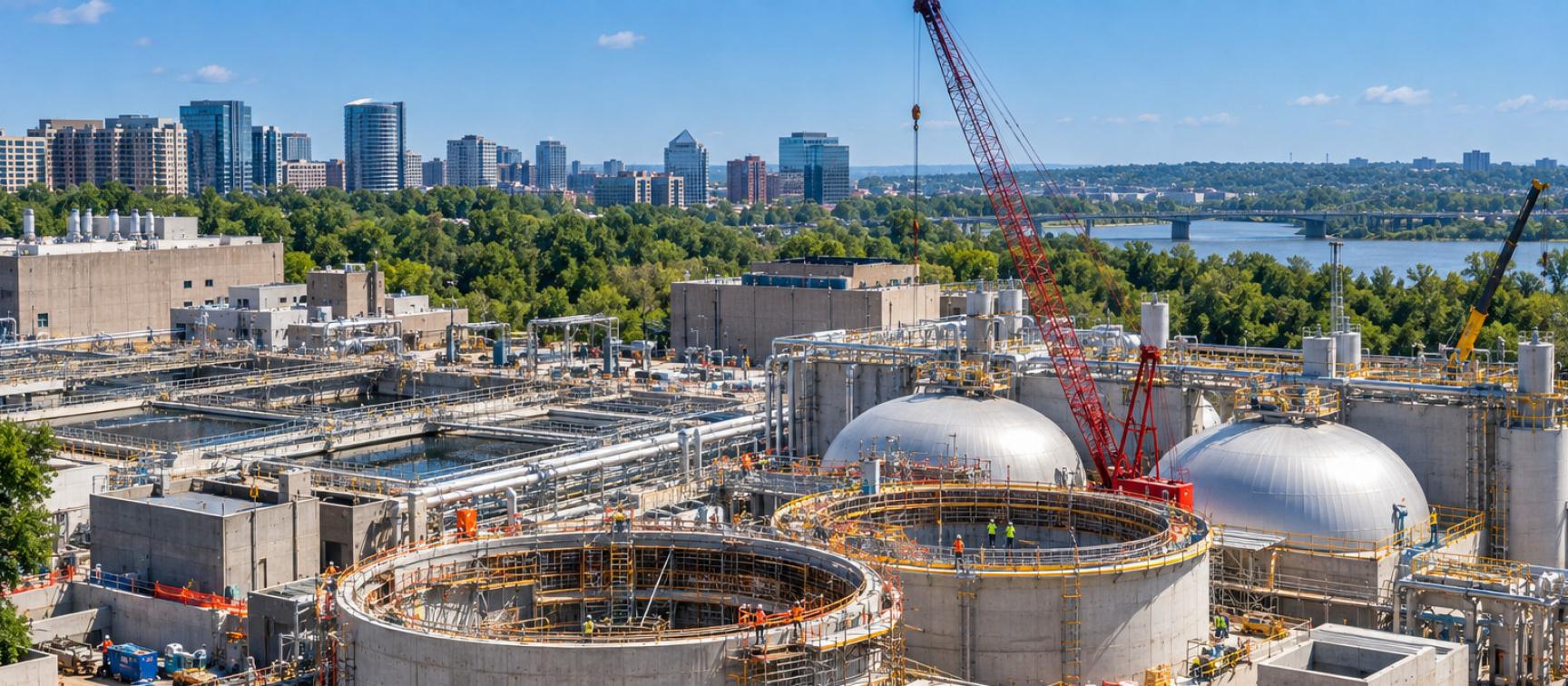
From Wastewater to Renewable Energy: Inside Arlington’s $198 Million Re-Gen Project
Wastewater treatment plants have traditionally been designed around a straightforward objective: treat wastewater safely and return clean water to the environment.
But increasingly, the industry is asking another question:
What else can we recover from the waste we already collect?
In Arlington, Virginia, the answer is taking shape through Arlington Re-Gen, a major modernization of the County’s Water Pollution Control Plant that will transform the way wastewater solids are processed.
The approximately $198.4 million program will introduce thermal hydrolysis, anaerobic digestion and modern solids-handling technology capable of producing Class A biosolids and renewable natural gas. Early construction is already underway, with the main construction phase extending through 2031. arlingtonva.us
For the water and wastewater construction industry, Re-Gen is a strong example of how treatment plants are evolving from waste-processing facilities into resource recovery facilities.
A Major Upgrade to an Operating Treatment Plant
Arlington County’s Water Pollution Control Plant is a critical piece of regional infrastructure.
During fiscal year 2025, the facility treated an average of approximately 21 million gallons of wastewater every day, with almost 20% of its flow coming from neighboring Alexandria, Fairfax County and Falls Church. Treated water eventually reaches the Potomac River and Chesapeake Bay through Four Mile Run. arlingtonva.us
The plant has undergone previous improvements to its liquid treatment systems. Re-Gen turns the focus toward the solids generated during the wastewater treatment process.
The program grew out of Arlington’s 2018 Solids Master Plan, which examined aging infrastructure, potential future regulations, resource recovery opportunities, costs and long-term treatment options. arlingtonva.us
Rather than simply replacing old equipment with newer versions of the same technology, Arlington is changing how the plant processes its solids altogether.
How Do You Turn Wastewater Into Renewable Energy?
At the heart of Re-Gen are two technologies: thermal hydrolysis and anaerobic digestion.
Thermal hydrolysis uses heat and pressure to break down wastewater solids before they enter the digestion process.
The conditioned material then moves into anaerobic digesters, where microorganisms break down the organic matter in an oxygen-free environment.
That process generates biogas containing methane.
Instead of allowing that energy source to go unused, Re-Gen will capture and treat the biogas to produce renewable natural gas (RNG). arlingtonva.us
The remaining material will be dewatered to produce Class A biosolids, a higher-quality product that can be beneficially reused as a nutrient-rich soil amendment.
In simple terms, material that was previously treated primarily as waste becomes two useful resources: renewable energy and a reusable biosolids product.
More Than an Environmental Upgrade
The benefits extend beyond renewable energy.
According to Arlington Re-Gen, the new processes are expected to reduce greenhouse gas emissions by more than 4,000 tons annually. The project is also expected to generate net energy equivalent to the annual electricity requirements of approximately 480 homes. arlingtonregen.com
Truck movements associated with solids handling are expected to fall by approximately 50%, while the need for lime deliveries associated with the existing process will be eliminated. arlingtonregen.com
That has practical benefits for both the plant and surrounding community.
Fewer truck movements mean reduced traffic, fuel consumption and disruption. Improved solids processing and advanced odor-control systems should also improve the long-term operation of the facility.
It's a good illustration of how investment in wastewater infrastructure can deliver benefits well beyond treatment capacity alone.
A Complex Construction Scope
Delivering that transformation requires substantial new infrastructure.
The project includes the design and construction of:
- Thermal hydrolysis systems
- Primary and secondary anaerobic digesters
- Pre- and final-dewatering facilities
- Sludge screening and storage
- Biogas treatment and storage
- Steam generation
- Advanced odor control
- Improved solids loading infrastructure. PC Construction
Existing gravity thickeners are also being rehabilitated as part of the wider solids-treatment program. arlingtonva.us
This creates significant civil, structural, mechanical, electrical, instrumentation and process work within an already developed treatment plant.
And there's another major challenge:
The existing facility needs to keep operating while the new one is built.
Construction Without Interrupting Treatment
Early construction began in December 2025, with visible site activity ramping up during 2026.
The Early Work Package includes site preparation, grading, demolition, utility relocations and foundation work for the future treatment systems. Existing process piping is also being relocated where necessary to allow current operations to continue. arlingtonregen.com
All of this is happening within the existing plant footprint.
Wastewater doesn't stop arriving because construction has started.
That means project teams need to carefully coordinate temporary systems, utility relocations, tie-ins, equipment installation and eventually commissioning around a live treatment operation.
For experienced water and wastewater construction professionals, this is where specialist knowledge becomes particularly important.
Understanding how to construct a digester is valuable.
Understanding how to build, connect and commission new process infrastructure inside an operating treatment facility without disrupting service is another level of experience entirely.
Progressive Design-Build
Re-Gen is being delivered through a progressive design-build model.
PC Construction is the design-builder, with Stantec leading engineering and HDR serving as program manager. PC Construction
For a technically complex project inside an operational facility, progressive design-build allows the contractor, engineer, owner and program team to collaborate earlier on design, constructability, sequencing and cost.
That can be particularly valuable when dealing with existing underground utilities, process piping, restricted site access and equipment that may have long procurement lead times.
It also allows construction knowledge to influence design decisions before they become expensive problems in the field.
From Early Works to Main Construction
The project is being delivered in phases.
The Early Work Package covers much of the enabling work required to prepare the existing plant for construction.
The Main Work Package will deliver the new facilities and resource-recovery processes, followed by testing and phased commissioning in 2031. Arlington County's current project information shows main construction extending from 2027 through 2031, although earlier County material described it as beginning in late 2026, so the precise package schedule remains subject to change. GovDelivery
That creates several years of substantial construction activity at the facility.
As the project progresses from site preparation into major process construction, the mix of people required will change too.
Civil and structural teams will be followed by increasingly significant mechanical, electrical, process and controls activity. Eventually, commissioning specialists will need to bring individual systems together and prove that the completed facility operates as intended.
The People Behind Projects Like Re-Gen
Projects like this demonstrate why experienced water and wastewater construction professionals remain so valuable.
A Project Manager needs to understand schedule, cost, procurement and client expectations while coordinating multiple technical disciplines.
A Superintendent needs to sequence work around existing plant operations and manage numerous trades working in constrained areas.
Project Engineers have to coordinate drawings, submittals, RFIs, equipment packages and field conditions.
Schedulers need to understand how civil construction, process equipment, electrical work and commissioning interact.
Mechanical and process specialists need experience with pumps, piping, digesters, dewatering equipment and treatment systems.
Electrical and controls teams ultimately have to integrate everything into a functioning facility.
Then Safety, Quality and Commissioning professionals need to ensure those systems can be brought online safely and reliably.
On technically advanced wastewater projects, the value of people who have delivered similar infrastructure before can be considerable.
Wastewater Plants Are Becoming Resource Recovery Facilities
Perhaps the most interesting part of Arlington Re-Gen is what it represents for the wider industry.
Wastewater contains resources.
It contains nutrients.
It contains organic material capable of producing energy.
And modern treatment technology is making it increasingly practical to recover those resources rather than simply dispose of them.
Arlington expects its upgraded solids process to be net-energy positive, producing more energy in renewable natural gas than the new solids-handling facilities consume. PC Construction
That changes the conversation around wastewater infrastructure.
Instead of asking only how efficiently a facility can treat waste, utilities can increasingly consider how much value they can recover from it.
Building the Next Generation of Water Infrastructure
Arlington Re-Gen may not be one of America's largest wastewater projects by dollar value, but technically it represents an important direction for the sector.
A live treatment facility is being modernized with thermal hydrolysis, anaerobic digestion, advanced dewatering, biogas treatment and renewable natural gas production.
The result should be lower emissions, fewer truck movements, improved biosolids, renewable energy production and a more sustainable long-term solids-management system.
But delivering those benefits requires years of engineering and construction.
And ultimately, it requires experienced people.
As more U.S. utilities modernize aging treatment infrastructure and move toward resource recovery, contractors with the right technical expertise, and the Project Managers, Superintendents, Project Engineers, Schedulers, Safety, Quality and Commissioning professionals capable of delivering these systems, will have an increasingly important role to play.
At Approach Talent USA, we specialize in connecting contractors across the U.S. water, wastewater and heavy civil sectors with experienced construction professionals capable of delivering complex infrastructure projects like Arlington Re-Gen.
Recent News
Inside the South Bay Wastewater Expansion: Tackling San Diego's Cross-Border Sewage Challenge
Why Speed, Efficiency and Communication Matter When Hiring Top Water & Wastewater Construction Talent
Inside Austin’s $1.5 Billion Wastewater Expansion: Building for a Growing City