

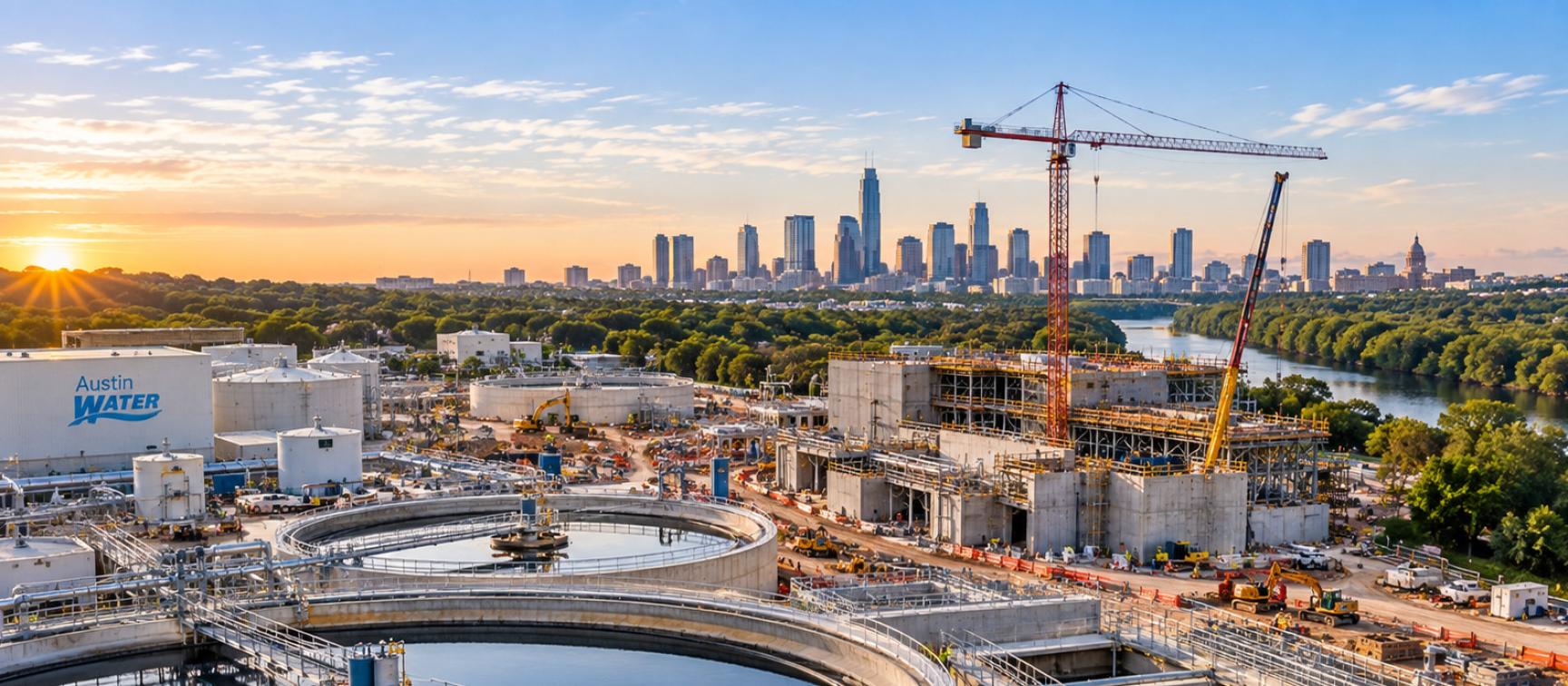
Inside Austin’s $1.5 Billion Wastewater Expansion: Building for a Growing City
Austin, Texas has experienced extraordinary growth over the past several decades, and the infrastructure beneath the city has to grow with it.
One of the clearest examples is now taking shape at the Walnut Creek Wastewater Treatment Plant, where Austin Water is undertaking a $1.5 billion expansion and modernization program.
The project will increase permitted treatment capacity from 75 million gallons per day (MGD) to 100 MGD, modernize much of the existing plant and introduce new treatment technology designed to improve the quality of water discharged into the Colorado River.
Austin Water officially broke ground on the expansion on April 14, 2026, with construction expected to continue for approximately six years and the additional capacity scheduled to come online in 2031.
For the construction industry, however, one aspect of the project makes it particularly interesting.
Throughout that transformation, the existing wastewater treatment plant has to remain operational.
Why Austin Needs More Wastewater Capacity
Walnut Creek has been treating Austin's wastewater since 1977.
Today, the plant is permitted to process an annual average of 75 MGD and is one of the major pieces of wastewater infrastructure serving the Austin area.
But the amount of wastewater arriving at the plant has been steadily increasing.
Flows exceeded 75% of the plant's treatment capacity in 2015. More recently, in 2024, flows surpassed 90% of capacity for three months, triggering state requirements for the facility to be expanded.
The solution is significant.
A completely new 25 MGD treatment train will be constructed alongside extensive upgrades to the existing 75 MGD facility.
Once completed, Walnut Creek will be capable of treating an annual average of 100 MGD, with the wider system designed around peak flows significantly above that level. City procurement documents identify a future two-hour peak flow capability of up to 300 MGD.
Austin Water says the upgraded plant will help provide reliable wastewater service to more than one million people across the Austin area.
Much More Than a Capacity Expansion
Adding another 25 MGD would already make Walnut Creek a substantial construction project.
But Austin isn't simply making the existing plant bigger.
It's changing how the plant treats wastewater.
One of the biggest upgrades is the introduction of Biological Nutrient Removal (BNR).
The new 25 MGD treatment train will use BNR, while the existing 75 MGD treatment trains will also be upgraded to incorporate the process. The objective is to remove more nutrients from treated wastewater before it is discharged into the Colorado River and meet more stringent effluent requirements associated with the expanded facility.
That means significant modifications to an operating treatment plant as well as construction of entirely new infrastructure.
Building a New 25 MGD Treatment Train
The new treatment train is effectively a substantial wastewater facility in its own right.
City engineering documents identify infrastructure including primary clarifiers, fermenters, aeration basins, final clarifiers, return activated sludge and waste activated sludge pump stations, blower systems, filtration, UV disinfection, post-aeration and odor-control systems.
Supporting all of that will be new electrical buildings, substations, controls infrastructure, process piping and site utilities.
This is where modern wastewater construction becomes particularly multidisciplinary.
Civil and structural teams build the tanks and foundations.
Mechanical contractors install pumps, process equipment and extensive piping systems.
Electrical teams deliver substations, switchgear, power distribution and controls.
Instrumentation specialists connect thousands of individual components into systems that operators can monitor and control.
And eventually commissioning teams have to prove that all of those systems work together.
Modernizing the Existing 75 MGD Plant
Alongside the expansion, significant portions of the existing plant will be rehabilitated.
Austin's project documentation identifies work involving existing primary treatment complexes, aeration basins, final clarifiers, sludge systems, filtration, return and waste activated sludge pumping, electrical infrastructure, odor control and water reuse systems.
The existing headworks are also undergoing improvements covering screening and grit removal together with associated mechanical, electrical, HVAC, structural and odor-control work.
This type of work can be considerably more complicated than building on an empty site.
Existing systems can't simply be switched off for months while contractors work around them.
Temporary arrangements, carefully planned shutdowns and construction sequencing become critical.
Moving Away From Chlorine Gas
Another major change involves disinfection.
Walnut Creek currently uses a chemical disinfection process. As part of the modernization, Austin Water will transition the plant to ultraviolet disinfection.
The city says the change will eliminate the use of chlorine gas for disinfection, improving safety for both plant employees and the surrounding community.
UV treatment works by exposing treated wastewater to ultraviolet light, disrupting microorganisms before the water leaves the facility.
Making that transition requires much more than installing UV equipment.
New basins, electrical infrastructure, controls, hydraulic connections and associated process systems all have to be incorporated into the wider treatment process.
And again, that has to happen while the plant continues treating wastewater.
Preparing for Wet Weather
Austin also has to prepare Walnut Creek for something wastewater facilities everywhere have to deal with: sudden increases in flow.
Heavy rainfall can cause wastewater flows reaching treatment facilities to rise rapidly.
The modernization therefore includes new peak-flow treatment infrastructure designed to manage high flows during wet-weather events.
Project procurement documents identify AquaStorm filtration as part of the wet-weather treatment strategy.
The wider hydraulic improvements are substantial too.
Plans include two new 72-inch influent siphons across Walnut Creek and a new 120-inch effluent pipeline and outfall to the Colorado River.
A 120-inch pipe is 10 feet in diameter.
Infrastructure at that scale gives an indication of the volumes of water this facility is being designed to manage.
Protecting the Plant From Flooding
The project isn't only increasing capacity.
It's also designed to improve resilience.
Austin Water plans to construct a flood wall around the plant, together with new site drainage infrastructure, detention areas and stormwater pumping.
For critical infrastructure, that matters.
Wastewater plants can't simply stop operating when severe weather arrives.
The systems have to be designed so they can continue protecting public health and the environment through difficult conditions.
That makes resilience increasingly important within major U.S. water and wastewater capital programs.
Building While the Plant Keeps Running
Perhaps the biggest construction challenge at Walnut Creek isn't any single tank, pipe or treatment process.
It's delivering everything while the existing plant remains fully operational.
Austin Water has specifically stated that improvements will be completed without interrupting plant operations.
That changes the way a project has to be managed.
Construction teams need to understand exactly which existing systems can be taken offline and when.
Tie-ins have to be coordinated with operations staff.
Temporary systems may be required.
Electrical shutdowns have to be carefully planned.
New process equipment needs to be tested before existing infrastructure can be retired.
And construction activity has to avoid interfering with the plant's ability to treat the wastewater arriving every hour of every day.
This is where experienced water and wastewater construction professionals become particularly valuable.
Eight Major Construction Packages
The scale of the work also means Walnut Creek isn't being delivered as one enormous construction sequence.
By early 2026, the project team had developed eight construction packages that together will form the total Guaranteed Maximum Price.
At that stage, four packages were already in construction, two were being bid and two were between 60% and 90% design.
That approach allows design, procurement and construction to overlap.
It also creates an enormous coordination exercise.
Different packages may be at completely different stages while sharing access, utilities, interfaces and operational constraints within the same facility.
Why the Project Has Reached $1.5 Billion
When the Construction Manager at Risk procurement began in 2024, the preliminary Opinion of Probable Construction Cost was approximately $900 million.
As engineering progressed and the team developed more detailed designs, construction constraints and plans for maintaining continuous plant operations, the updated construction estimate reached $1.5 billion.
In March 2026, Austin City Council authorized an amendment increasing the construction contract ceiling with MWH Constructors to an amount not to exceed $1.5 billion.
MWH is delivering the project through a Construction Manager at Risk (CMAR) model.
That allows the contractor to work alongside Austin Water, project management staff and the engineering team during design, providing constructability reviews, value engineering, cost input and detailed planning around maintaining plant operations.
For a live wastewater facility undergoing a six-year transformation, that early contractor involvement can be particularly important.
Major Federal Financing
Austin is also using federal financing to help deliver the program.
In March 2026, City Council authorized increasing the potential Water Infrastructure Finance and Innovation Act (WIFIA) financing for Walnut Creek to as much as $1 billion.
In May, the council authorized the associated revenue bond and direct loan arrangements for up to that amount.
That illustrates the scale of capital now moving through the U.S. water market.
Major wastewater programs increasingly involve hundreds of millions, and sometimes billions, of dollars of investment spread across treatment, conveyance, resilience and environmental improvements.
The Workforce Behind a $1.5 Billion Wastewater Project
Projects of this complexity don't happen simply because funding and engineering designs are available.
They require experienced people to turn those designs into operating infrastructure.
Project Managers need to manage multiple packages, subcontractors, budgets and interfaces with plant operations.
Superintendents have to coordinate civil, concrete, mechanical, electrical and specialty trades across an active industrial facility.
Project Engineers manage RFIs, submittals, procurement, change management and field coordination.
Schedulers have the particularly difficult task of connecting hundreds of activities while incorporating shutdowns, commissioning and operational constraints.
Estimators and Preconstruction professionals are essential when designs continue developing alongside construction.
Then there are Mechanical, Electrical, Process and Controls specialists, together with Safety, Quality and Commissioning professionals.
Finding people who understand large construction projects is one challenge.
Finding people who understand large construction projects inside operating water and wastewater facilities can be another entirely.
Austin Is Building for the Next Generation
Walnut Creek is a good example of what's happening across the U.S. water sector.
A plant originally commissioned nearly 50 years ago now has to support a much larger city while meeting modern environmental, safety and resilience requirements.
The answer isn't simply replacing old equipment.
It's a fundamental modernization.
Capacity will increase from 75 MGD to 100 MGD.
A new treatment train will be constructed.
Existing treatment systems will be converted to Biological Nutrient Removal.
Chlorine gas disinfection will give way to UV.
Wet-weather treatment will be expanded.
New influent and effluent infrastructure will move enormous volumes of water.
And the entire site will receive additional flood protection.
All while wastewater continues arriving and the existing facility remains operational.
That combination is what makes the $1.5 billion Walnut Creek Wastewater Treatment Plant expansion such an interesting construction project.
It's not simply about building more capacity for Austin today.
It's about transforming a critical piece of infrastructure so it can continue serving more than one million people for decades to come.
At Approach Talent USA, we work with contractors and engineering businesses across the U.S. water, wastewater and heavy civil markets, connecting them with experienced Project Managers, Superintendents, Project Engineers, Estimators, Schedulers and construction leaders needed to deliver complex infrastructure programs like Walnut Creek.
Recent News
Why the Right Recruitment Consultant Could Be One of the Best Connections in Your Water Career
From Wastewater to Drinking Water: Inside El Paso's First-of-Its-Kind Pure Water Center
Pure Water Los Angeles: Inside the $21-$26 Billion Plan to Transform the City's Water Supply