

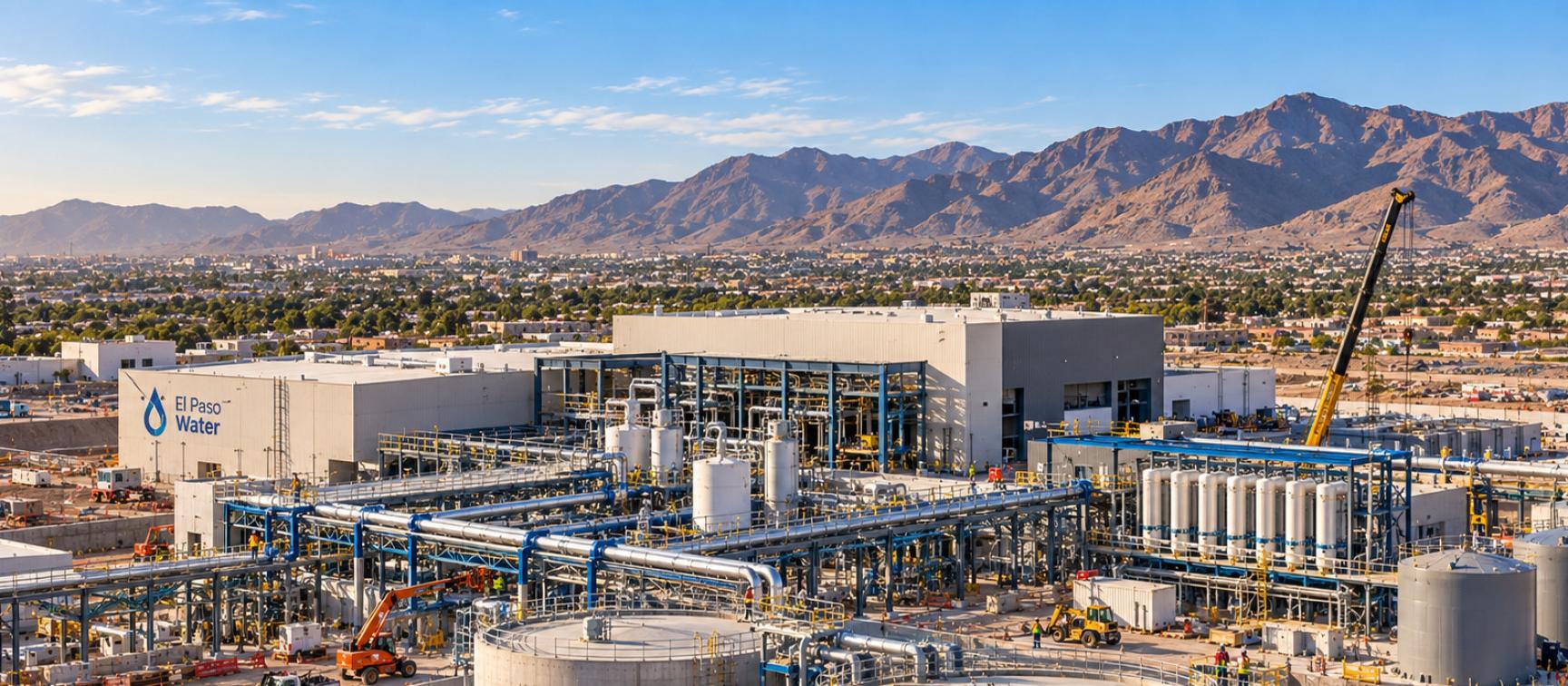
From Wastewater to Drinking Water: Inside El Paso's First-of-Its-Kind Pure Water Center
In the middle of the Chihuahuan Desert, El Paso is building a water facility unlike anything currently operating at this scale in the United States.
The Pure Water Center will take treated wastewater, put it through an advanced multi-stage purification process and ultimately send that water into El Paso's drinking-water distribution system.
It is designed to produce up to 10 million gallons of drinking water every day, creating a new local supply for a city where drought, population growth and pressure on traditional water sources have made long-term water security increasingly important. Construction is underway, with El Paso Water's latest information pointing to completion in late 2028 and opening in 2029.
At an estimated $290 million, the project is significant in its own right. But what makes it particularly interesting is the model it could create for water-stressed communities across the United States.
Why El Paso Needs Another Water Source
Building a major city in a desert creates an obvious challenge: where does the water come from?
El Paso has spent decades developing a diversified answer.
The city's supplies include water from the Rio Grande, groundwater from the Hueco and Mesilla Bolson aquifers, reclaimed water and desalinated brackish groundwater.
Historically, El Paso's production was roughly divided between river water and groundwater. Prolonged drought has disrupted that balance, requiring greater reliance on groundwater during periods when river supplies are limited.
At the same time, El Paso Water is planning decades ahead for population growth.
The utility serves more than 870,000 people across a service area of approximately 250 square miles and also provides a portion of the water requirements at Fort Bliss.
The Pure Water Center gives the city something particularly valuable in that environment: a water source that doesn't depend on rainfall or snowmelt hundreds of miles away.
Instead, it uses water the city already has.
Turning Wastewater Into a Resource
El Paso Water customers generate more than 55 million gallons of wastewater every day.
That wastewater travels through more than 2,300 miles of sewer infrastructure before reaching the utility's treatment plants. Once treated, some reclaimed water is already reused for irrigation and other applications.
The Pure Water Center takes that concept much further.
Treated water from the Roberto R. Bustamante Wastewater Treatment Plant will become the source water for the new facility.
Rather than discharging that treated water to the Rio Grande or using it solely for non-potable purposes, El Paso will purify a portion of it again to create drinking water.
It's a shift in thinking that is becoming increasingly important across the U.S. water sector.
Wastewater isn't simply something to treat and dispose of.
Increasingly, it's becoming part of the water supply.
A Multi-Barrier Treatment Process
Producing drinking water from treated wastewater requires considerably more than conventional wastewater treatment.
The Pure Water Center has therefore been designed around multiple treatment barriers.
Water will pass through membrane microfiltration, followed by reverse osmosis. It will then undergo treatment using ultraviolet light with advanced oxidation, followed by granular activated carbon filtration and chlorine disinfection.
Each process performs a different function.
Membrane filtration removes suspended material and microorganisms.
Reverse osmosis pushes water through extremely fine membranes capable of removing dissolved contaminants.
UV advanced oxidation provides another treatment barrier against trace organic compounds and pathogens.
Granular activated carbon provides further polishing before final disinfection.
Before reaching customers, the purified water will also be stabilized and blended with local groundwater. A new high-service pump station capable of approximately 2,776 gallons per minute will then convey the finished water into the distribution system.
It's a highly engineered process, but El Paso didn't move directly from concept to full-scale construction.
Years of Testing Before Construction
The project has been developing for more than a decade.
El Paso Water opened an advanced water purification pilot facility in 2015 and completed pilot testing in 2016.
Thousands of samples were analyzed at state-certified laboratories as the utility tested whether the proposed treatment process could consistently produce high-quality water.
According to El Paso Water, testing demonstrated that the purified water met and performed better than primary and secondary drinking-water standards.
The project then went through years of engineering and regulatory review.
In late 2024, the Texas Commission on Environmental Quality granted final design approval, clearing the way for full construction.
That background matters because direct potable reuse isn't simply a construction challenge.
It's also a regulatory, operational and public-confidence challenge.
Every part of the treatment process has to demonstrate that it can reliably protect water quality before the system goes into operation.
The First Direct-to-Distribution Facility of Its Kind
Water reuse isn't new.
Communities across the United States already use highly treated wastewater for irrigation, industrial processes, groundwater replenishment and other applications.
What makes El Paso different is where the purified water goes next.
The Pure Water Center is being developed as the country's first large-scale direct-to-distribution potable reuse facility.
Instead of first sending purified water into an environmental buffer such as a reservoir or groundwater basin, the water will be blended with groundwater and introduced into El Paso's drinking-water distribution system.
That distinction makes the project important well beyond Texas.
Utilities in Arizona, California and other water-stressed regions are examining how advanced water reuse can strengthen future supplies.
If El Paso demonstrates that direct-to-distribution reuse can be delivered safely and reliably at scale, the lessons learned here could influence projects elsewhere.
Building the Pure Water Center
The engineering behind the facility is only part of the story.
Someone still has to build it.
The Pure Water Center is being constructed on a 13-acre greenfield site, with Carollo Engineers responsible for design and the PCL/Sundt Joint Venture delivering construction.
The construction scope brings together a wide range of disciplines.
The facility includes low-pressure microfiltration membranes, high-pressure reverse osmosis systems, UV advanced oxidation equipment, granular activated carbon treatment, chlorine disinfection, chemical storage and feed systems, finished-water storage, greensand filters, a main process building, electrical infrastructure, instrumentation and controls.
Recent procurement documents show just how many separate construction packages are involved.
Early packages have covered membrane equipment and utility relocation, followed by electrical, instrumentation and controls, diesel generation, tilt-up concrete, structural steel, HVAC, process equipment, site civil work, process mechanical installation, UV equipment, reverse osmosis systems, blowers, pumps and underground process piping.
That breadth is a good illustration of modern water construction.
These projects aren't simply concrete structures with pipes running between them.
They're sophisticated industrial facilities combining heavy civil construction with highly specialized mechanical, electrical, process and controls systems.
What Happens Underground Matters Too
Some of the most complicated work on a treatment project is never visible once the facility is finished.
One of the more recent Pure Water Center construction packages covers critical underground process yard piping.
That includes influent and effluent lines, chemical systems, potable and process water, sanitary systems and connections running between different areas of the facility.
Some piping has to be installed beneath structures before slabs and buildings can progress. Other connections depend on structural work being completed first.
That makes sequencing critical.
Civil crews, concrete teams, mechanical contractors, electrical contractors and equipment suppliers all have to work around one another while maintaining the construction schedule.
A mistake underground can become extremely expensive once a structure has been built above it.
For Project Managers, Superintendents and Project Engineers, coordination is therefore as important as the physical construction itself.
A Wider Wastewater Construction Story
The Pure Water Center isn't happening in isolation.
The source water will come from the Roberto R. Bustamante Wastewater Treatment Plant, and El Paso Water is simultaneously investing heavily in that facility and the wider wastewater network.
In its FY2026-27 budget, the utility describes the Bustamante expansion and rehabilitation as the largest single project in El Paso Water's history. Wastewater plant improvements form part of approximately $431 million in reliability investment in the current budget.
That creates a much bigger infrastructure story.
The wastewater plant has to reliably treat the city's wastewater.
The Pure Water Center then takes part of that treated water and turns it into a new drinking-water resource.
The distribution system finally delivers it to customers.
Instead of looking at wastewater and drinking water as completely separate systems, El Paso is increasingly connecting the two.
The People Behind Advanced Water Infrastructure
Projects like the Pure Water Center also demonstrate why experienced water and wastewater construction professionals remain so important.
A facility containing membrane systems, high-pressure pumps, structural concrete, underground utilities, process piping, electrical distribution, instrumentation and sophisticated controls requires expertise across numerous disciplines.
Project Managers have to coordinate contractors, procurement, schedule, cost and technical requirements.
Superintendents have to manage multiple trades operating simultaneously across the site.
Project Engineers deal with RFIs, submittals, procurement, field coordination and documentation.
Estimators and Schedulers help contractors understand and control increasingly complex construction packages.
Civil, Mechanical, Electrical, Process and Controls Engineers are needed to integrate systems that ultimately have to operate as one facility.
Then come Safety, Quality and Commissioning professionals who help move the project from construction into reliable operation.
For contractors working in water and wastewater, finding professionals who understand both construction and treatment infrastructure can become one of the biggest challenges on a project.
$290 Million Today, A Much Bigger Market Tomorrow
The Pure Water Center is one project, but the forces driving it aren't unique to El Paso.
Population growth is increasing water demand in many parts of the United States.
Aging treatment plants require modernization.
Drought and changing hydrology are forcing utilities to diversify supplies.
At the same time, advances in membrane technology, treatment processes and automation are making water reuse increasingly practical.
El Paso itself is pursuing several strategies simultaneously.
Alongside the Pure Water Center, the city is expanding desalination capacity and investing in aquifer storage and recharge.
The objective isn't to find one replacement for the city's existing water sources.
It's to build a more diverse system where no single source carries all the risk.
From Wastewater Plant to Water Supply
Perhaps the most significant thing about the Pure Water Center is how it changes the role of wastewater infrastructure.
Traditionally, the job of a wastewater treatment plant ended when water was treated sufficiently to be safely discharged or reused for non-potable applications.
El Paso is extending that process.
Wastewater enters the system.
It's treated at the Bustamante plant.
A portion will then undergo advanced purification at the Pure Water Center.
And ultimately, that water becomes part of the city's drinking-water supply again.
When completed, the facility will produce up to 10 million gallons every day from a resource that El Paso already has.
For a desert city facing long-term pressure on river and groundwater supplies, that's a powerful proposition.
For the construction industry, it's also a glimpse at where the U.S. water market may be heading.
More advanced treatment. More reuse. More integration between wastewater and drinking-water infrastructure. And increasingly technical projects requiring experienced construction professionals to turn ambitious engineering into operating facilities.
At Approach Talent USA, we work with contractors and engineering businesses across the U.S. water, wastewater and heavy civil sectors, connecting them with experienced Project Managers, Superintendents, Project Engineers, Estimators and other professionals needed to deliver complex infrastructure projects.
Recent News
Pure Water Los Angeles: Inside the $21-$26 Billion Plan to Transform the City's Water Supply
Florida's $1.2 Billion One Water Project: Building for the Next Generation of Growth
Suicide Prevention Awareness Month: Why Mental Health Matters in U.S. Construction