

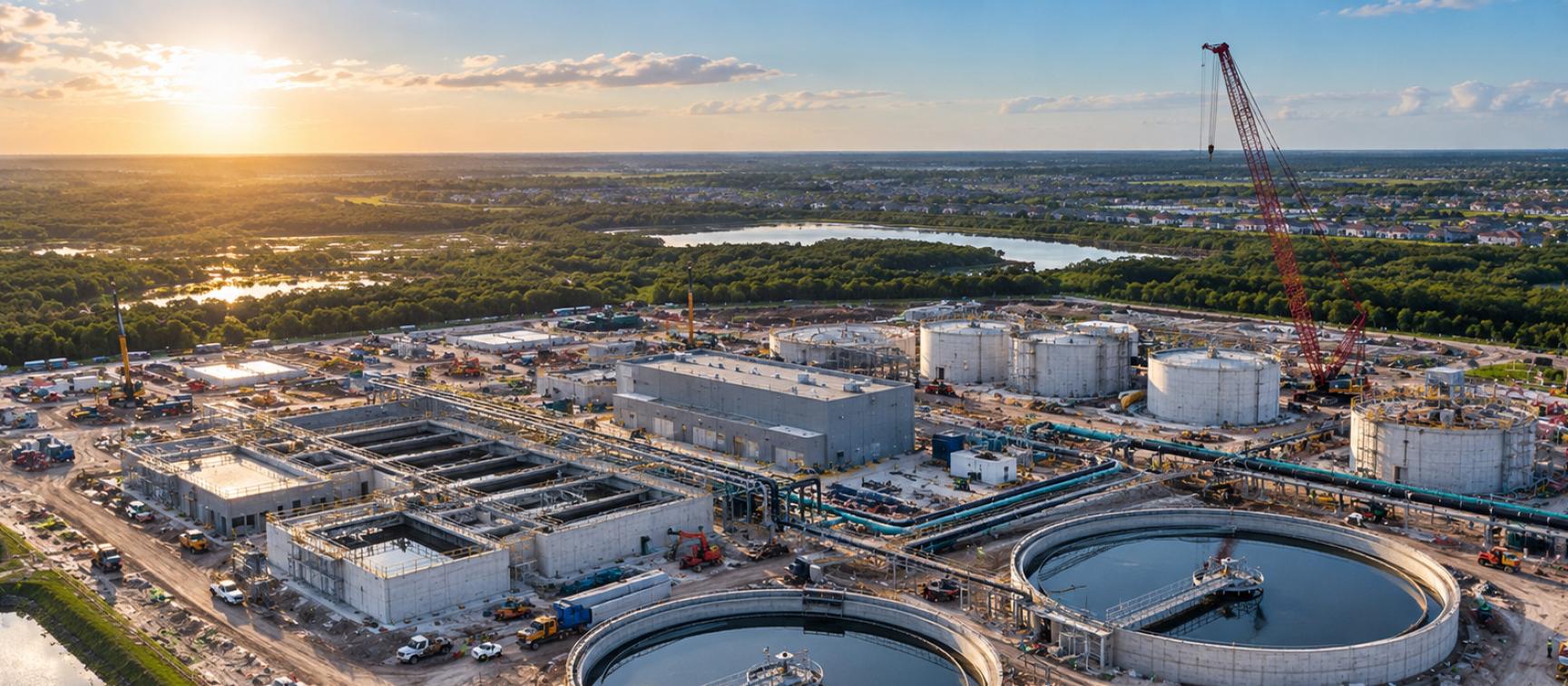
Florida's $1.2 Billion One Water Project: Building for the Next Generation of Growth
Florida's population growth isn't just creating demand for more homes, roads, schools, and commercial development. Behind that growth sits another infrastructure challenge that is far less visible but every bit as important: water.
In southern Hillsborough County, that challenge is now driving one of Florida's most significant wastewater construction projects.
The One Water - South Wastewater Conveyance and Treatment Project broke ground in April 2026. At approximately $1.2 billion, it represents the largest capital improvement project in Hillsborough County's history.
The project combines a new advanced wastewater treatment facility, a major pumping station, and more than 20 miles of wastewater and reclaimed water pipelines.
But the scale of the construction tells only part of the story.
One Water is ultimately about building infrastructure capable of keeping pace with one of Florida's growing regions for decades to come.
Why Hillsborough County Needs One Water
Southern Hillsborough County has experienced significant residential and commercial development, putting increasing pressure on the infrastructure serving communities including Apollo Beach, Brandon, Gibsonton, Riverview, Ruskin, Wimauma, Sun City, and Valrico.
The county says its existing wastewater facilities at Falkenburg, Valrico, and South County have either reached or are approaching their permitted capacities.
That makes expanding infrastructure essential if development is going to continue sustainably.
Rather than treating drinking water, wastewater, and reclaimed water as completely separate challenges, Hillsborough County's wider One Water Program takes an integrated approach.
Water is viewed as one continuous cycle.
The county's wider program represents approximately $1.6 billion of investment in drinking water supply, wastewater treatment, reclaimed water, pipelines, storage, and supporting infrastructure.
The South Wastewater Conveyance and Treatment Project is one of its largest components.
Three Major Projects in One
One Water South isn't simply a new treatment plant.
The project combines three substantial pieces of infrastructure.
The One Water Campus Advanced Wastewater Treatment Facility
At the center of the project is a completely new advanced wastewater treatment facility.
The plant is being constructed as a greenfield facility, creating new treatment capacity rather than simply expanding an existing operation.
Current project reporting indicates that the facility is being designed for approximately 24 million gallons per day (MGD) of treatment capacity, with provisions allowing it to eventually expand to approximately 30 MGD with minimal disruption to operations.
Hillsborough County expects the new facility to support the region's wastewater requirements through at least 2050.
For construction teams, that means delivering infrastructure designed not simply for today's population but for decades of future growth.
The Balm Road Super Pump Station
Getting wastewater to a new treatment facility requires major conveyance infrastructure.
The Balm Road Super Pump Station will form a critical part of that network.
Hillsborough County says the station will have the ability to pump as much as 56 million gallons of wastewater per day to the new treatment facility.
At that scale, a pump station becomes a major heavy civil and mechanical project in its own right.
Construction involves far more than installing pumps. Structures, large-diameter piping, valves, electrical distribution, backup systems, controls, instrumentation, site infrastructure, and commissioning all have to operate as one reliable system.
And reliability matters.
Once infrastructure like this enters service, failure isn't simply an inconvenience. Thousands of homes and businesses depend on it.
More Than 20 Miles of Pipeline
Connecting everything together requires an enormous network of underground infrastructure.
The progressive design-build team has reported plans for more than 54,000 linear feet of 42-inch and 48-inch wastewater force mains, together with approximately 63,000 linear feet of 48-inch reclaimed water main.
Combined, that's more than 22 miles of major pipeline.
These aren't small utility connections.
Installing large-diameter pipelines across an established and rapidly developing region creates challenges around excavation, groundwater, traffic management, existing utilities, easements, environmental permitting, logistics, testing, and restoration.
It also requires extensive coordination between pipeline crews and the teams delivering the treatment plant and pumping infrastructure.
The entire system ultimately has to work together.
Wastewater Becomes a Resource
One of the most interesting aspects of One Water is that the project isn't focused solely on getting rid of wastewater.
It's also about recovering water for another use.
After wastewater has been treated to the required standard, new reclaimed water pipelines will connect the facility with Hillsborough County's reclaimed water system.
That creates an alternative supply for appropriate non-potable uses and reduces the pressure on drinking water resources.
It's an increasingly important concept for fast-growing regions.
Instead of thinking about water as something that is used once and discharged, utilities are looking at the entire water cycle and asking where resources can be recovered and reused.
Hillsborough County describes One Water as an interconnected approach covering drinking water, wastewater, reclaimed water, and ultimately the return of water into the wider supply cycle.
For Florida, where population growth and long-term water availability are closely connected, that thinking is likely to become increasingly important.
Progressive Design-Build on a $1.2 Billion Project
Delivering infrastructure at this scale also requires a different approach to project delivery.
The project is being delivered through progressive design-build, led by Garney as design-builder with Hazen and Sawyer as lead engineer. Ardurra, Stantec, and Wade Trim are also supporting the design team.
Progressive design-build brings the owner, designer, and contractor together earlier in the project.
For something as complex as One Water, that collaboration can be particularly valuable.
Design decisions can be reviewed alongside constructability, sequencing, procurement, cost, risk, and schedule rather than waiting until a completed design reaches the construction team.
That matters when you're coordinating a new treatment facility, major pumping infrastructure, and more than 20 miles of pipeline simultaneously.
Construction Is Underway
The official groundbreaking took place on April 24, 2026, marking the start of one of Hillsborough County's biggest infrastructure construction programs.
Current industry reporting indicates that the facility is expected to begin receiving initial wastewater flows around September 2028, with the overall project scheduled for completion in 2030.
That means several years of substantial construction activity lie ahead.
As the project moves from early earthwork and civil construction into structural work, process installation, mechanical and electrical systems, pipeline construction, testing, and commissioning, the workforce requirements will change with it.
For contractors working in water and wastewater, that's one of the challenges of a multi-year project.
You don't simply need people at groundbreaking.
You need the right expertise at every stage.
The People Behind a Billion-Dollar Water Project
A $1.2 billion water infrastructure project requires a huge range of construction and engineering expertise.
At different points in the project, that can include Project Executives, Project Managers, Superintendents, Project Engineers, Estimators, Schedulers, Civil Engineers, Process Engineers, Mechanical and Electrical Engineers, Safety professionals, Quality teams, Controls specialists, and Commissioning professionals.
But projects like One Water also highlight a wider recruitment challenge facing U.S. infrastructure.
Experience matters.
A Project Manager who has delivered commercial buildings doesn't automatically have the same background as someone who has managed a $100 million wastewater treatment facility.
The same applies to Superintendents and engineers.
Water and wastewater construction involves specialized processes, complex mechanical and electrical packages, underground utilities, large concrete structures, commissioning requirements, environmental regulations, and the challenge of creating systems expected to operate continuously for decades.
Those skills take time to develop.
As investment in U.S. water infrastructure increases, competition for experienced professionals with that background is likely to remain significant.
More Than One Project
It's also important to look at One Water South within the wider investment happening across Hillsborough County.
The county's One Water Program includes 10 separate projects, and current county figures put the program's capital investment at approximately $1.45 billion within its current Water Resources capital plan, alongside hundreds of millions of dollars being invested through other treatment, transmission, resilience, and utility programs.
That wider pipeline demonstrates something important about the U.S. water sector.
Major projects rarely exist in isolation.
Population growth creates demand for drinking water. More homes create additional wastewater. New treatment capacity requires new pipelines. Reclaimed water creates another distribution network. All of it needs pumping, storage, controls, electrical infrastructure, maintenance, and long-term operational support.
One investment creates another.
Infrastructure Has to Arrive With Growth
There is a tendency to measure regional growth by the things we can see.
New subdivisions.
Commercial developments.
Roads.
Schools.
Warehouses.
But none of those developments can function without the infrastructure underneath them.
Hillsborough County's One Water investment is a good example of what has to happen behind the scenes when a region grows rapidly.
A $1.2 billion wastewater project, a new advanced treatment facility, a pump station capable of handling tens of millions of gallons each day, and more than 20 miles of large-diameter pipeline aren't being constructed for the sake of infrastructure alone.
They're being built because communities need them.
And with the facility designed around requirements extending to 2050, this is infrastructure intended to support the next generation of growth, not just the next development cycle.
What One Water Tells Us About the U.S. Water Market
For contractors, engineers, and construction professionals, One Water South represents a much broader opportunity across the United States.
Many utilities are simultaneously dealing with aging assets, expanding populations, environmental requirements, resilience concerns, and the need to make better use of existing water resources.
Addressing those challenges will require enormous investment.
It will also require people who know how to build this infrastructure.
One Water South may be one of the biggest projects currently underway in Florida, but the skills being used to deliver it are increasingly needed across the country.
For the water and wastewater construction sector, that makes the next decade an important one.
At Approach Talent USA, we work with contractors and engineering businesses delivering water, wastewater, heavy civil, and infrastructure projects across the United States, connecting them with experienced construction professionals who understand how complex projects get built.
Recent News
Suicide Prevention Awareness Month: Why Mental Health Matters in U.S. Construction
130 Feet Beneath Alexandria: Inside the RiverRenew Tunnel Project Transforming the Potomac
Inside San Francisco's $2.84 Billion Wastewater Transformation: Turning Waste Into Renewable Energy