

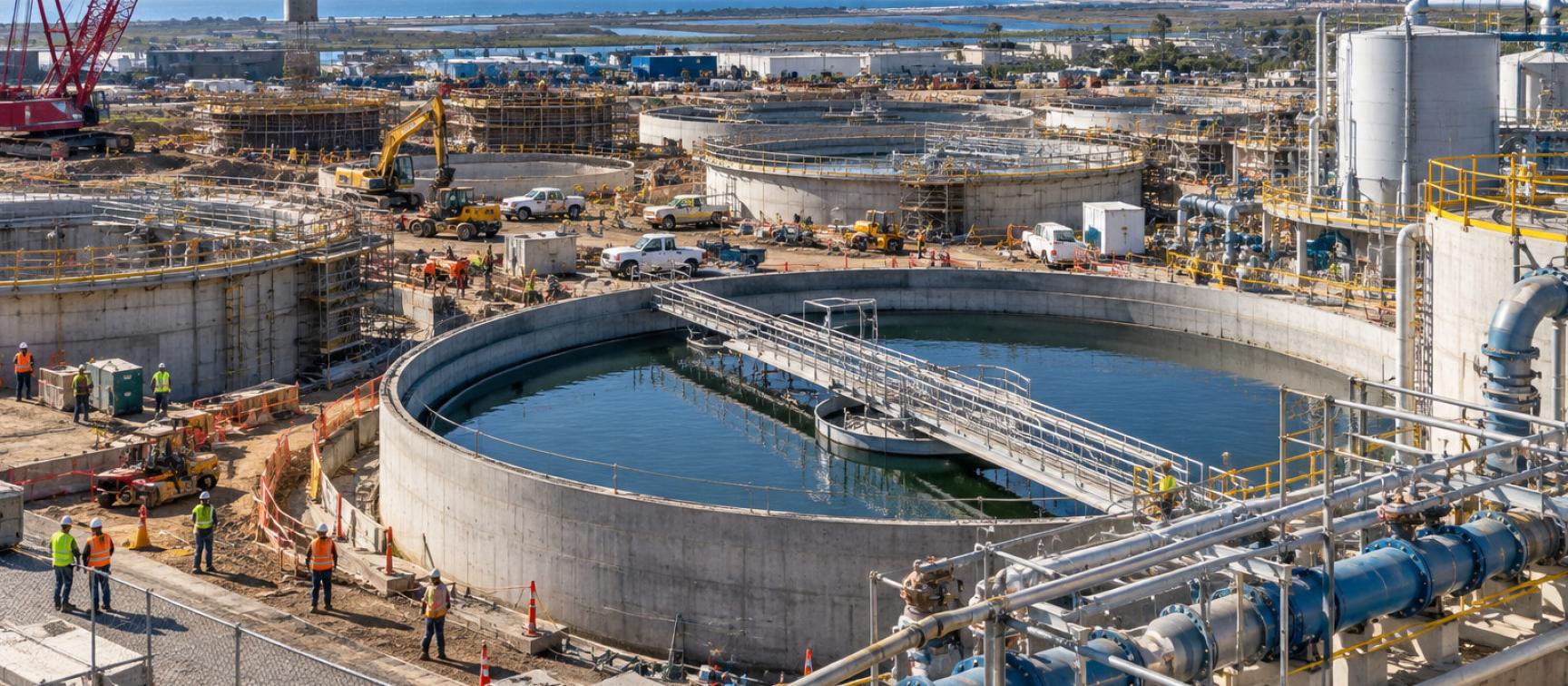
Inside the South Bay Wastewater Expansion: Tackling San Diego's Cross-Border Sewage Challenge
For decades, wastewater crossing the U.S.-Mexico border has created a major environmental challenge for communities around the Tijuana River Valley and southern San Diego County.
Contaminated flows from Mexico can enter the United States through the Tijuana River watershed, affecting water quality, public health and the Pacific coastline. The U.S. Environmental Protection Agency describes it as a decades-old transboundary pollution problem requiring major infrastructure investment on both sides of the border.
At the center of the U.S. response is the South Bay International Wastewater Treatment Plant (SBIWTP) in San Diego.
The facility is now undergoing a major rehabilitation and expansion designed to dramatically increase the amount of wastewater that can be treated before it reaches the surrounding environment.
For the construction industry, it is also becoming one of the most significant active wastewater projects in Southern California.
From 25 MGD to 50 MGD
The long-term project is designed to expand the South Bay plant's secondary treatment capacity from its original 25 million gallons per day (MGD) to 50 MGD, while providing peak hydraulic capacity of 75 MGD.
But the expansion has already taken an important step forward.
In August 2025, an accelerated interim project added 10 MGD of capacity in just 100 days, increasing the plant's operating capability from 25 MGD to 35 MGD.
Attention has now turned to delivering the permanent 50 MGD facility.
As of the EPA's July 2026 update, early work packages were progressing, including site preparation and procurement of long-lead equipment needed for the full expansion.
That makes South Bay particularly interesting as a Project Spotlight. This isn't simply a future infrastructure proposal. Work is actively moving toward a much larger treatment facility.
Why the Project Matters
South Bay isn't a conventional wastewater expansion driven solely by population growth.
The plant forms part of a much larger binational effort to address wastewater entering the Tijuana River watershed.
The U.S. and Mexico have been working on treatment plants, pumping stations, collectors, pipelines and other infrastructure intended to capture and properly treat wastewater before it reaches the river and coastline.
The South Bay expansion, combined with wastewater infrastructure improvements in Mexico, was originally projected to help eliminate up to 90% of untreated wastewater reaching the coast.
That gives the construction project a very tangible purpose.
Every additional gallon that can be reliably captured and treated represents wastewater that has a better chance of being prevented from entering rivers, beaches and coastal waters untreated.
A Major Rehabilitation as Well as an Expansion
Doubling treatment capacity is only part of the job.
Much of the existing facility also requires rehabilitation.
The U.S. International Boundary and Water Commission's project scope combines expansion with upgrades to the infrastructure and treatment processes required to operate the larger facility reliably and meet EPA standards.
Early project activities included establishing bypass systems around primary treatment facilities and carrying out detailed structural assessments of existing concrete structures, followed by concrete repairs.
That creates a different construction challenge from simply building a new greenfield wastewater plant.
Existing assets need to be inspected, repaired and incorporated into the future facility while new treatment capacity is constructed around them.
And throughout that process, the plant needs to keep operating.
Building Around a Live Wastewater Facility
Working inside an operating treatment plant adds another level of complexity to an already substantial project.
Wastewater continues arriving every day regardless of what is happening on the construction site.
Existing processes can't simply be shut down for months while contractors complete new infrastructure.
That means sequencing becomes critical.
Temporary bypass systems may be required before existing infrastructure can be taken offline. New equipment has to be installed and tested before old systems are removed. Tie-ins need to be carefully coordinated with plant operations.
Electrical shutdowns, process interruptions and commissioning activities all need to be planned around the continuing operation of the facility.
For construction teams, understanding how to work safely and efficiently inside an active wastewater environment can be just as important as understanding how to build the new infrastructure itself.
Progressive Design-Build
The rehabilitation and expansion is being delivered using a progressive design-build model.
The U.S. Section of the International Boundary and Water Commission awarded the project to PCL Construction, with Stantec selected to lead design.
When the team was announced, the total program cost was estimated at approximately $600 million.
Progressive design-build is particularly suited to complicated infrastructure projects where design and construction planning need to develop together.
Rather than completing the entire design before contractor involvement, the delivery team can work collaboratively on constructability, sequencing, procurement and cost as the design progresses.
For a live wastewater plant, that early construction input can be particularly valuable.
It allows the team to consider questions such as how an existing process can be bypassed, where temporary infrastructure can be located, how equipment can physically reach the work area and how new systems can be brought online without compromising plant operations.
A Significant Construction Workforce
Projects of this scale require far more than a conventional construction management team.
Civil and structural professionals are needed to deliver concrete structures, foundations, site infrastructure and rehabilitation work.
Mechanical teams are responsible for the pumps, process equipment, piping and treatment systems that allow the facility to function.
Electrical and controls specialists need to integrate power distribution, instrumentation and automation across both existing and new infrastructure.
Then there are the people responsible for planning and coordinating everything.
Project Managers, Superintendents, Project Engineers, Estimators and Schedulers all have important roles to play.
Safety and Quality professionals become particularly important when construction is taking place around operating treatment processes, while commissioning teams eventually need to prove that individual systems can operate together reliably.
This is exactly why specialist water and wastewater construction experience remains so valuable.
Building a concrete structure is one thing.
Building it inside an operating treatment facility, connecting it to existing processes and bringing it online without interrupting treatment is another.
The Infrastructure Doesn't Stop at the U.S. Border
Perhaps the most interesting aspect of the South Bay project is that expanding the plant alone won't solve the wider problem.
Wastewater has to be successfully collected and transported before it can be treated.
That is why significant infrastructure work is also taking place in Mexico.
One example is the PB-1 pumping project, where construction began in April 2026. The project is intended to increase pumping capacity to 80 MGD while improving reliability and reducing the risk of major wastewater discharges. Completion is currently expected in November 2027.
Work has also included the Tijuana River Gates, rehabilitation of major collectors and gravity infrastructure, and projects intended to prevent treated effluent from being discharged into the Tijuana River.
The result is effectively an interconnected network of infrastructure improvements.
Pumping capacity has to increase.
Collection systems need to become more reliable.
Treatment capacity needs to expand.
And the different components have to work together if the overall objective is going to be achieved.
Moving Toward 50 MGD
The immediate priority on the U.S. side is now the permanent expansion of South Bay to 50 MGD.
The EPA's 2026 updates show the project moving through design and early construction activities. A 60% design submission was received in December 2025, with the 90% submission scheduled for April 2026. Subsequent updates reported site preparation and long-lead equipment procurement progressing to support the expansion.
That progression is important.
Large treatment projects depend heavily on equipment with substantial manufacturing and delivery periods. Procurement decisions made well before major structures are complete can have a significant effect on the overall construction schedule.
It also means demand for experienced construction professionals can begin long before a project reaches peak field activity.
Construction With a Visible Impact
Water and wastewater projects don't always receive the attention given to airports, highways or skyscrapers.
But South Bay demonstrates why this infrastructure matters.
The project isn't simply adding treatment capacity to a plant.
It is part of a much wider effort to address a cross-border wastewater problem that has affected communities and the environment for decades.
The engineering challenge is significant: rehabilitate an existing federal wastewater facility, expand its permanent treatment capacity to 50 MGD, provide the ability to manage peak flows of 75 MGD, and keep the plant operating throughout construction.
At the same time, major infrastructure improvements have to continue elsewhere in the watershed so that wastewater can be reliably collected, transported and treated.
Delivering that requires funding and engineering.
But ultimately, it also requires people.
Experienced Project Managers, Superintendents, Project Engineers, Estimators, Schedulers, Safety professionals, Quality specialists and commissioning teams will be responsible for turning those plans into working infrastructure.
For professionals working in the U.S. water and wastewater construction market, South Bay is another example of just how complex, important and technically challenging the next generation of infrastructure projects is becoming.
At Approach Talent USA, we specialize in connecting contractors across the U.S. water, wastewater and heavy civil sectors with the experienced construction professionals needed to deliver projects like these.
Recent News
Why Speed, Efficiency and Communication Matter When Hiring Top Water & Wastewater Construction Talent
Inside Austin’s $1.5 Billion Wastewater Expansion: Building for a Growing City
Why the Right Recruitment Consultant Could Be One of the Best Connections in Your Water Career