

Inside Illinois' $1.45 Billion Water Infrastructure Program: Building a New Regional Water Supply
Across the southwestern suburbs of Chicago, one of Illinois' most significant water infrastructure programs is taking shape. The Grand Prairie Water Commission's Alternative Water Source Program will create an entirely new regional water supply network, connecting six communities to treated Lake Michigan water through more than 60 miles of transmission pipeline, new pumping infrastructure and storage facilities.
With an estimated program cost of approximately $1.45 billion, the investment is being driven by a long-term problem facing communities across the region: declining groundwater availability.
Construction began in 2025, with the new system targeted to begin delivering water in 2030. For the heavy civil construction industry, the project represents a substantial undertaking involving large-diameter pipeline installation, complex utility crossings, major pumping infrastructure and multiple construction packages that must eventually operate as one integrated system.
Unlike a conventional wastewater treatment plant expansion, Grand Prairie is about building an entirely new water supply network across an established metropolitan region.
Why Six Illinois Communities Need a New Water Supply
The Grand Prairie Water Commission was established to develop a sustainable, long-term drinking water solution for six communities: Crest Hill, Channahon, Joliet, Minooka, Romeoville and Shorewood.
Historically, these communities have relied heavily on groundwater, including supplies drawn from deep sandstone aquifers. However, groundwater levels have declined over time, creating concerns about the long-term reliability of that supply.
Rather than continuing to depend on an increasingly stressed resource, the communities are investing in a regional system that will bring treated Lake Michigan water to their residents and businesses.
The project involves far more than changing the source of drinking water. The new supply needs to be transported across a substantial distance, pumped through large transmission mains, stored, monitored and delivered reliably to individual communities.
That requires an entirely new network of infrastructure, much of which must be constructed through developed areas while existing roads, utilities and communities continue operating around it.
More Than 60 Miles of Pipeline Across the Chicago Region
The scale of the proposed network is considerable. According to the Grand Prairie Water Commission, the system will transport treated water purchased from the City of Chicago more than 35 miles toward the southwestern suburbs, followed by approximately another 30 miles of regional transmission infrastructure serving the participating municipalities. The EPA describes the overall network as approximately 62 miles of water transmission mains.
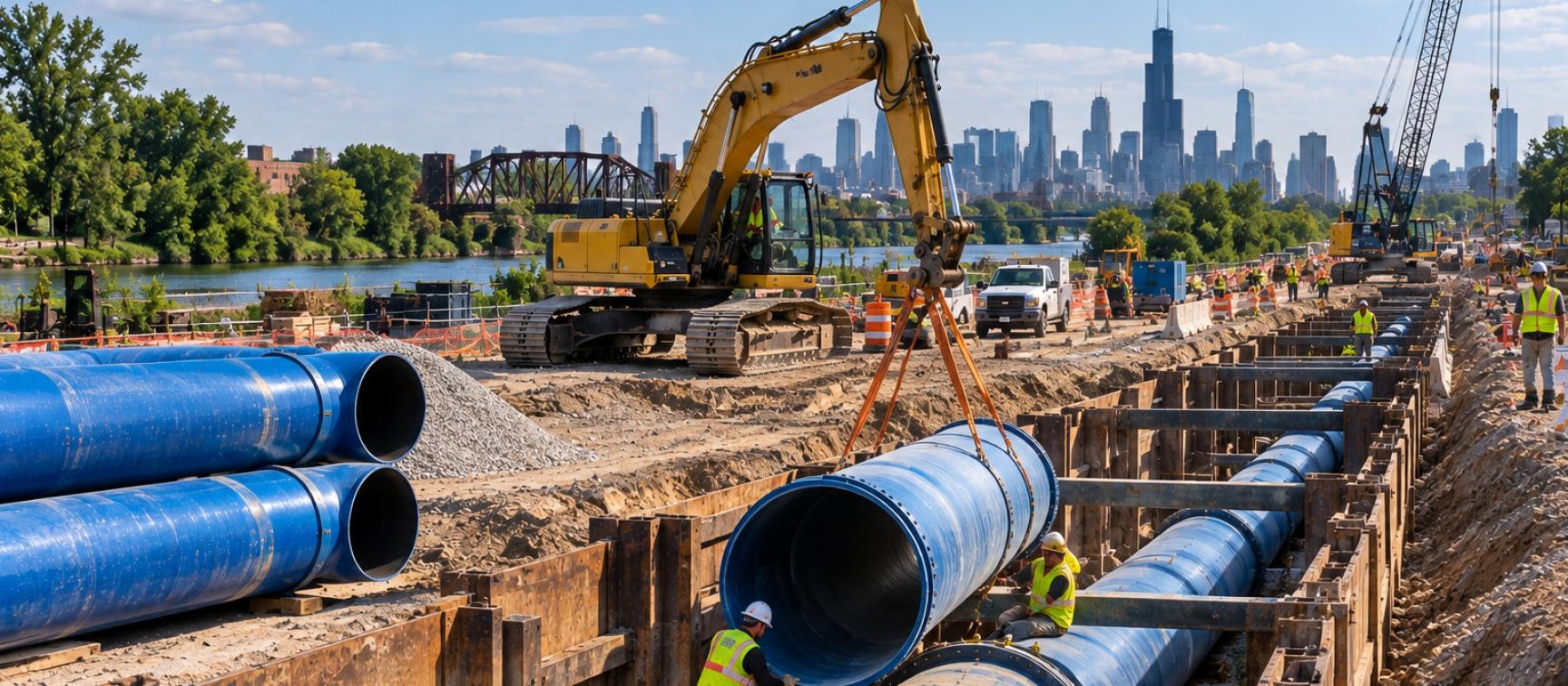
Some sections will involve pipes measuring up to 66 inches in diameter, creating substantial heavy civil construction requirements. These are major underground infrastructure projects, involving excavation, trench support, pipe installation, backfilling, testing and reinstatement over long distances.
Installing a pipeline of this size is considerably more complicated than simply excavating a trench and laying pipe. Contractors must work around existing utilities, road networks, property boundaries and other infrastructure, often in locations where there is limited space to establish a construction corridor.
Large-diameter pipe also introduces significant logistical challenges. Individual pipe sections need to be transported, handled and installed safely, while alignment, jointing, bedding and testing must meet strict engineering requirements.
With construction divided into separate sections, the project will require careful coordination between contractors working along different parts of the route.
Major River and Canal Crossings
One of the most technically interesting elements of the program involves getting the new transmission mains beneath existing waterways.
The Commission's construction planning identifies a crossing of the Cal-Sag Channel involving approximately 500 to 600 feet of 66-inch transmission main installed in a tunnel. A separate crossing beneath the Des Plaines River involves a much longer tunnel, approximately 4,500 to 5,000 feet in the earlier procurement planning documents.
These crossings are particularly significant because conventional open-cut construction may not be practical beneath major waterways.
Underground crossings require specialist engineering and construction techniques, including shaft construction, tunneling operations, groundwater management, structural support and precise installation of the transmission pipeline.
Unlike more straightforward sections of pipeline construction, tunneling packages carry their own geological, technical and logistical risks. Ground conditions, groundwater pressures, equipment selection and alignment all influence how the work is planned and delivered.
The interfaces between tunnel construction and the adjoining open-cut pipeline sections are equally important. Once installed, the system must operate as a continuous transmission main, regardless of the different construction methods used along its route.
Pumping Millions of Gallons Across the Region
Building the pipeline network is only one part of the program. The new water supply also needs substantial pumping infrastructure to transport water reliably across the region.
One of the Commission's major construction packages includes a 4-million-gallon below-grade storage facility and two pumping stations, each rated at 55 MGD.
Facilities of this scale require significant civil, structural, mechanical and electrical construction.
Below-grade storage structures need substantial excavation and reinforced concrete work, while the pumping stations require large pumps, valves, pipework, electrical distribution equipment, controls and associated mechanical systems.
The construction team must also account for the operational requirements of the finished system. Pumping equipment has to deliver the required flows and pressures, and the electrical and controls infrastructure must allow operators to manage the network safely and reliably.
For Project Managers and Superintendents, the challenge is coordinating the different disciplines so that major equipment, structures and systems are ready in the correct sequence.
Long-lead equipment procurement, installation tolerances, energization and commissioning all become important considerations well before the facilities are ready to operate.
Connecting Six Communities to One Regional System
Although the main transmission pipeline will carry water across the region, the system also needs to deliver that water to the individual communities.
The program includes 13 water delivery structures, creating the connections between the regional network and the participating municipalities.
These are substantial infrastructure components in their own right. One construction package, for example, includes four below-grade, cast-in-place concrete delivery structures, with individual structures measuring approximately 22 by 19 feet or 33 by 22 feet.
The delivery facilities must be integrated with the broader transmission system, including the associated piping, valves, monitoring equipment and controls needed to manage the supply.
This introduces another level of coordination. The Commission is responsible for creating the regional network, while individual municipalities must be ready to receive and distribute the new supply through their local systems.
The transition from groundwater to Lake Michigan water therefore depends on more than completing the main pipeline. Every part of the network needs to be ready before the new system can begin operating as intended.
A $610 Million Federal Loan Supports the Program
Financing an infrastructure program of this scale is another major part of the story.
On March 26, 2026, the Grand Prairie Water Commission closed a $610 million Water Infrastructure Finance and Innovation Act (WIFIA) loan through the U.S. Environmental Protection Agency.
The financing supports the transition of almost 300,000 residents to a more reliable drinking water supply. According to the EPA, the loan's repayment flexibility and interest terms are expected to save the Commission nearly $300 million over the life of the loan.
The program is also being supported through other financing mechanisms, including state revolving fund loans and revenue bonds.
These financial arrangements are important because major water infrastructure projects require substantial investment years before the finished facilities begin delivering water. Funding must support design, land acquisition, construction, specialist equipment and commissioning across a program extending over several years.
Construction Is Underway, but the Biggest Packages Are Still Ahead
The Alternative Water Source Program is being delivered in phases, with construction activity beginning in May 2025 on a tunnel extension near the connection to Chicago's water supply.
According to the Commission's published schedule, construction within the six participating communities is anticipated to begin around mid-2027, with the completed regional system targeted for operation in 2030.
As of September 2026, some pipeline sections were still progressing through detailed design. For example, an eight-mile regional transmission main in the Minooka area, involving pipes between 18 and 30 inches in diameter, had reached the 90% design review stage. Its published schedule anticipated construction beginning in the third quarter of 2027 and completion in 2029.
That distinction matters. Although construction has started on the overall program, much of the network is still progressing through design, procurement and preparation for future construction packages.
For contractors and construction professionals, this creates a sustained pipeline of work rather than one short construction period.
The program is expected to require teams across different locations and disciplines as the individual packages move from design into active construction.
Coordinating a Program of This Scale
The Commission has appointed Stantec to lead a multidisciplinary team supporting the program's development, engineering, construction-related services, financing and public outreach.
The complexity of coordinating such a large program should not be underestimated.
Individual pipeline packages may be constructed by different contractors, but they still need to connect at the correct locations, elevations and interfaces. Pumping stations must be completed in time to support system testing, and delivery structures need to be ready before water can be supplied to the individual municipalities.
There are also challenges associated with land access, permits, existing underground utilities, traffic management and maintaining public access during construction.
The Commission's wider scope includes fiber and network installation, SCADA programming, security systems and systemwide startup and commissioning.
All of these activities need to be coordinated around the same operational deadline.
On a program involving more than 60 miles of transmission mains, relatively small delays at critical interfaces can affect work elsewhere. That makes planning, scheduling, procurement management and communication between project teams especially important.
The Construction Professionals Behind the Program
Grand Prairie highlights a different side of the water infrastructure market from the treatment plant projects we've recently covered.
While wastewater treatment expansions require significant process mechanical expertise, a regional transmission program places particularly heavy demands on underground utility construction, large-diameter piping, tunneling, major civil structures and pumping infrastructure.
Experienced Project Managers will be needed to oversee individual construction packages, manage subcontractors and coordinate with engineers, owners and other contractors working across the program.
Superintendents with backgrounds in underground utilities, pipeline construction and heavy civil infrastructure will play an important role in managing field operations, particularly where excavation, pipe installation and complex crossings are involved.
Project Engineers will support procurement, technical coordination, RFIs, submittals and construction documentation, while Schedulers will need to manage dependencies across projects that may be separated geographically but connected operationally.
The pumping and storage facilities will also require mechanical, electrical, instrumentation and controls expertise, followed by experienced startup and commissioning teams as the program approaches completion.
For construction professionals looking to broaden their experience, major regional infrastructure programs can provide exposure to a different scale of project delivery, particularly when multiple contracts, specialist disciplines and public stakeholders are involved.
Building a Water Supply for the Next Generation
The Grand Prairie Alternative Water Source Program is ultimately about providing six Illinois communities with greater certainty over their future drinking water supply.
By replacing their reliance on declining groundwater resources with treated Lake Michigan water, the communities are making a long-term investment in the infrastructure required to support their residents, businesses and future development.
Delivering that transition requires a substantial construction effort. More than 60 miles of transmission mains, major underground crossings, pumping stations, storage facilities and delivery structures must be designed, constructed, connected and commissioned before the new system can begin operating.
With an estimated investment of approximately $1.45 billion and a target operational date of 2030, Grand Prairie is a significant example of the scale of work taking place across the U.S. water infrastructure market.
It also demonstrates that some of the country's most important water projects are not necessarily new treatment plants. They are the extensive networks of underground infrastructure that make reliable water delivery possible.
For the heavy civil construction industry, programs like Grand Prairie represent years of complex engineering, specialist construction and coordination, with experienced professionals playing a central role in bringing the new system into operation.
At Approach Talent USA, we specialize in recruitment across the U.S. water, wastewater and heavy civil construction markets. We work with contractors seeking experienced Project Managers, Superintendents, Project Engineers, Estimators and other key construction professionals to deliver major infrastructure programs across the country.