

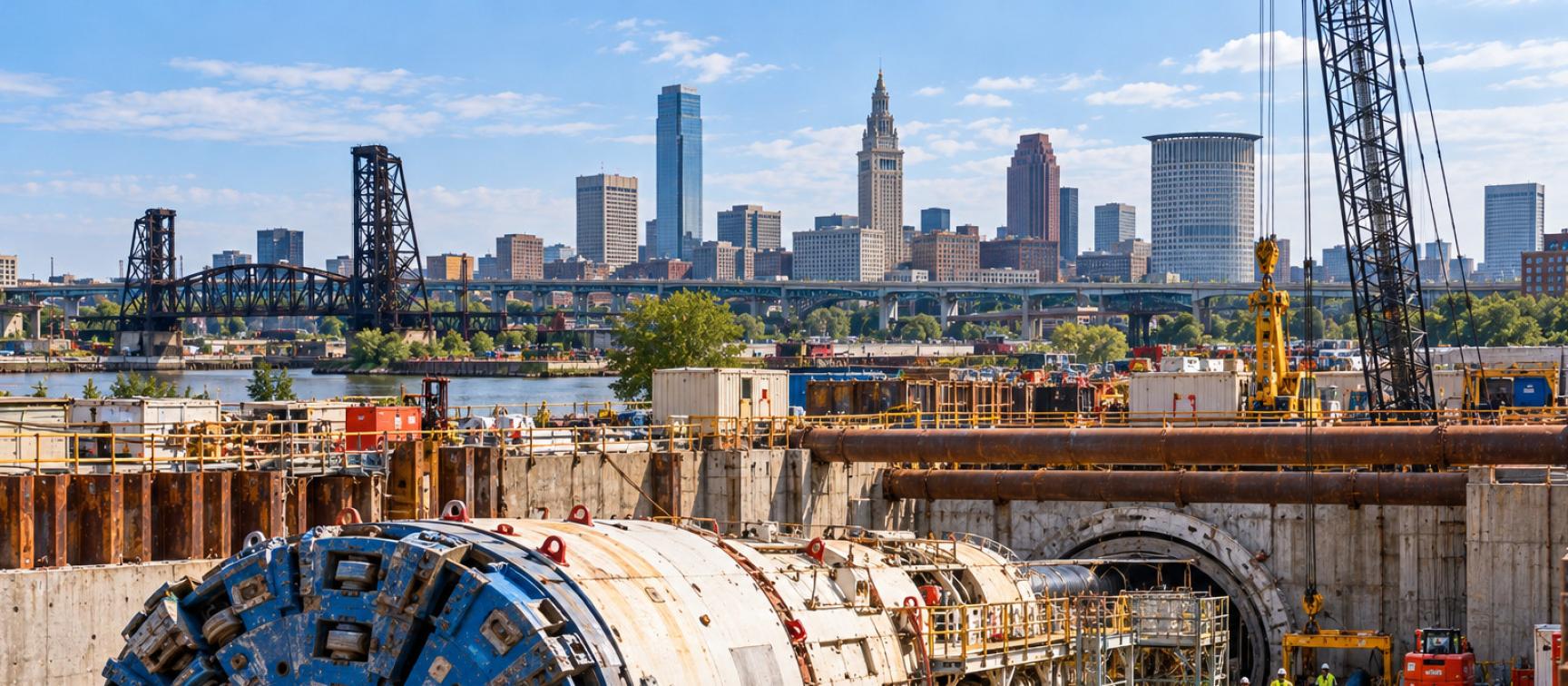
Inside Cleveland's $3 Billion Project Clean Lake: The Underground Tunnels Transforming Wastewater Infrastructure
Beneath Cleveland, Ohio, one of the country's largest wastewater infrastructure programs is reshaping how the region manages sewage during heavy rainfall.
The Northeast Ohio Regional Sewer District's Project Clean Lake is a $3 billion investment involving seven large-diameter storage tunnels, wastewater treatment plant improvements and additional infrastructure designed to prevent billions of gallons of combined sewage from entering Lake Erie and its surrounding waterways.
The program reached another significant milestone in October 2026 when a joint venture between Granite Construction and Super Excavators secured a $324.8 million contract to deliver the Big Creek Tunnel, the seventh and final major storage tunnel in the program.
With construction scheduled to begin in fall 2026, the contract involves more than four miles of underground tunneling, extensive shaft construction and new sewer infrastructure beneath established communities.
For the U.S. heavy civil construction industry, Project Clean Lake is a particularly interesting example of the engineering, specialist equipment and experienced construction teams required to deliver major infrastructure almost entirely out of public view.
Why Cleveland Is Investing $3 Billion Underground
Like many older American cities, Cleveland operates a combined sewer system in parts of its service area. These systems were designed to carry both wastewater from homes and businesses and stormwater collected during rainfall through the same network.
During normal conditions, that wastewater can be transported to treatment facilities. However, during heavy rainfall, the volume entering the system can exceed the capacity available for collection and treatment.
When that happens, combined sewer overflows can discharge a mixture of stormwater and untreated sewage into local rivers, streams and Lake Erie.
Project Clean Lake was developed to address this long-standing problem following a federal consent decree that became effective in 2011.
The program's objective is substantial. The Sewer District aims to reduce annual combined sewer overflows from approximately 4.5 billion gallons to 494 million gallons, capturing and treating more than 98% of wet-weather flows in the combined sewer system by 2036.
This isn't simply an environmental improvement project. It requires fundamental changes to how Cleveland stores, transports and treats wastewater during periods of intense rainfall.
Seven Major Tunnels Beneath the City
At the center of Project Clean Lake is a network of seven large-diameter underground storage tunnels.
The tunnels range from approximately two to five miles in length, with some reaching depths of up to 300 feet and diameters of up to 24 feet.
Rather than allowing excess wastewater to discharge directly into waterways during storms, these tunnels provide underground storage capacity. The captured flows can subsequently be conveyed to wastewater treatment facilities when capacity becomes available.
The scale of the construction is significant, particularly given that much of the work takes place beneath established neighborhoods, roads, utilities and other infrastructure.
By the beginning of 2026, four of the seven tunnels were already operational: Euclid Creek, Dugway, Doan Valley and Westerly. The Shoreline and Southerly tunnels were under construction, while Big Creek was approaching the construction phase.
The Sewer District reported that work completed under the program had already prevented approximately 2 billion gallons of combined sewer overflow annually from entering the environment.
With the final major tunnel contract now awarded, the program is moving closer to completing the underground infrastructure needed to achieve its long-term environmental targets.
The $324.8 Million Big Creek Tunnel
The newly awarded Big Creek Tunnel is one of the most significant remaining construction packages within Project Clean Lake.
The main tunnel will extend approximately 22,300 feet, or just over four miles, with an internal diameter of 20 feet. It will be constructed in rock between approximately 50 and 100 feet below Cleveland, Linndale and Brooklyn, Ohio.
The contract also includes another 3,115 feet of ancillary tunnels, including connecting, overflow and dewatering tunnels.
Once operational, the system is expected to capture combined sewer flows from 11 overflow locations and prevent approximately 550 million gallons of sewage releases annually into Big Creek and its tributaries.
The construction scope extends well beyond the main tunnel itself. It includes multiple shafts, diversion structures, screening facilities, gate control vaults, consolidation sewers, an overflow box culvert and associated utility works.
Construction is scheduled to begin in fall 2026, with the contractor targeting completion in winter 2030. The Sewer District's broader schedule allows for work to continue into 2031.
Tunneling Through Rock Beneath Cleveland
The Big Creek Tunnel will be constructed primarily using a tunnel boring machine (TBM), allowing the contractor to excavate a continuous underground route without opening a trench along the entire alignment.
This approach is essential when constructing major infrastructure beneath developed urban areas. Although access shafts and supporting facilities are still required at the surface, the majority of the tunnel can be excavated underground, reducing disruption to roads, properties and existing infrastructure.
For Big Creek, the main tunnel will be excavated through rock, introducing different engineering considerations from the soft-ground conditions encountered on some other Project Clean Lake tunnels.
Ground conditions influence the selection of tunneling equipment, excavation methods, temporary support, groundwater management and the design of the finished tunnel lining.
The TBM must also be supported by a substantial operation above ground. Excavated material needs to be removed, equipment and materials transported into the tunnel, and ventilation, power, communications and safety systems maintained throughout construction.
With more than four miles of excavation required, production rates and equipment reliability will have a major influence on the construction schedule.
The Engineering Behind Deep Tunnel Construction
A project like Big Creek involves considerably more than operating a tunnel boring machine.
The seven planned shaft locations will provide access for construction and connections to the existing sewer network. These structures are significant engineering projects themselves, requiring excavation, ground support, reinforced concrete, temporary works and careful management of surrounding infrastructure.
Shaft construction is particularly important because it creates the connection between surface operations and the underground work. Depending on the construction sequence, shafts may be used to launch or retrieve tunneling equipment, remove excavated material, lower materials and eventually connect the completed tunnel to the sewer system.
The tunnel lining is another critical element.
On earlier Project Clean Lake tunnels, contractors have used precast concrete segmental linings installed behind the tunnel boring machine. These segments form the permanent structure as excavation advances, providing the strength and durability required for long-term underground wastewater storage.
The Northeast Ohio Regional Sewer District has also explored different concrete reinforcement approaches and lining designs across the program, demonstrating how experience from earlier contracts can influence later tunnel construction.
For construction teams, successfully delivering these structures requires close coordination between geotechnical engineers, tunneling specialists, concrete contractors, surveyors and underground construction crews.
Connecting the Tunnels to Cleveland's Existing Sewer Network
Completing the tunnel excavation is only part of the challenge. The new underground storage system must also be connected to the existing sewer network so that excess wastewater can be diverted into it during storms.
Big Creek includes new diversion structures, screening facilities, gate control systems and consolidation sewers designed to collect flows from existing overflow locations.
These connections require careful engineering because the existing sewer network must continue functioning while construction takes place.
Contractors may need to coordinate temporary bypass systems, manage existing wastewater flows and undertake carefully planned connections to live infrastructure.
The completed system also needs to be capable of operating reliably under changing hydraulic conditions, including periods of heavy rainfall when flows increase rapidly.
Once the tunnel is ready, its connections, gates, instrumentation and associated systems must be tested and commissioned before the infrastructure can be brought into operation.
This is one of the reasons large sewer tunnel projects require experience across both heavy civil construction and wastewater infrastructure.
Granite and Super Excavators Secure the Final Major Tunnel Contract
The October 2026 award represents a significant contract for the joint venture between Granite Construction and Super Excavators.
The $324.8 million contract was awarded following a competitive bidding process, with the joint venture submitting the lowest of four bids. The winning price was approximately 8% above the Sewer District's engineering estimate of $300 million.
Engineering firm Wade Trim is the project's lead designer, with KS Associates providing surveying services.
The project brings together organizations with experience in large-diameter tunneling, underground construction and major civil infrastructure, all of which will be essential to delivering the tunnel through challenging urban conditions.
The contract is particularly significant because Big Creek represents the final large-diameter storage tunnel planned under Project Clean Lake, although other program activities will continue beyond its completion.
More Than Tunnels: A Wider Wastewater Modernization Program
Although the storage tunnels are the most visible engineering achievements within Project Clean Lake, the program also involves substantial improvements to Cleveland's wastewater treatment infrastructure.
The Sewer District operates three major treatment plants and is increasing treatment capacity as part of the wider program.
This is an important part of the overall strategy. Capturing wastewater during heavy rainfall provides an environmental benefit, but that water must ultimately be conveyed to a treatment facility and processed before discharge.
The program also includes green infrastructure designed to manage stormwater before it enters the combined sewer network.
These measures can include systems that capture, store or allow stormwater to infiltrate into the ground, reducing pressure on the sewer network during rainfall.
By combining major underground storage tunnels with treatment plant improvements and stormwater management, Project Clean Lake is addressing the problem across the wider wastewater system rather than relying on one solution alone.
The Construction Professionals Behind Project Clean Lake
Large underground infrastructure programs create specialist staffing requirements that differ from conventional commercial construction or even many treatment plant projects.
Project Managers overseeing major tunneling contracts must understand underground construction methods, subcontractor coordination, equipment procurement, geotechnical risk and complex construction schedules.
Superintendents need experience managing tunneling operations, deep excavations, shaft construction and heavy civil works, often involving multiple crews operating above and below ground.
Project Engineers play an important role in technical coordination, submittals, RFIs, survey information, temporary works and managing interfaces between tunneling operations and permanent structures.
Schedulers must account for the dependencies between shaft construction, equipment assembly, excavation, tunnel lining, underground connections and commissioning.
Safety management is particularly important on underground construction projects, where confined working environments, ventilation, equipment movement, lifting operations and emergency access require careful planning.
The program also creates opportunities for experienced tunnel engineers, geotechnical specialists, quality professionals and mechanical and electrical personnel.
As major water and wastewater infrastructure investment continues across the United States, contractors delivering technically demanding projects like Big Creek need teams with the specialist experience required to manage these risks and keep construction progressing.
Protecting Lake Erie for the Future
Project Clean Lake is a long-term investment, but its environmental benefits are already becoming measurable.
According to the Northeast Ohio Regional Sewer District, the work completed to date has eliminated approximately 2 billion gallons of annual combined sewer overflows, with more than $2.4 billion spent or awarded across the program.
The District has also reported nearly $600 million in savings through value engineering, demonstrating the importance of design development and construction planning across such a substantial investment.
The Big Creek Tunnel will add another important component to that progress, preventing an estimated 550 million gallons of combined sewer releases annually once operational.
The wider program is scheduled to continue through 2036, when the Sewer District aims to capture and treat more than 98% of wet-weather flows within its combined sewer system.
For Cleveland, the result will be cleaner waterways and a wastewater network better equipped to manage the demands placed on it during heavy rainfall.
For the construction industry, Project Clean Lake demonstrates the scale of engineering required to modernize aging urban infrastructure, particularly when much of the work must take place deep underground while the city above continues operating.
With the final major tunnel contract now awarded, the next phase will depend on the specialist contractors, engineers and construction professionals responsible for turning an ambitious underground infrastructure program into a functioning wastewater system.
At Approach Talent USA, we specialize in recruitment across the U.S. water, wastewater and heavy civil construction markets. We work with contractors seeking experienced Project Managers, Superintendents, Project Engineers, Estimators and other construction professionals capable of delivering complex infrastructure projects across the country.
Recent News
Inside Illinois' $1.45 Billion Water Infrastructure Program: Building a New Regional Water Supply
Inside Cartersville’s Wastewater Expansion: Building Capacity for Georgia’s Growth
Inside Denton’s Pecan Creek Expansion: Building the Next Generation of Wastewater Treatment