

Inside California's $6 Billion Sites Reservoir: Building One of America's Largest New Water Storage Projects
Inside California's $6 Billion Sites Reservoir: Building One of America's Largest New Water Storage Projects
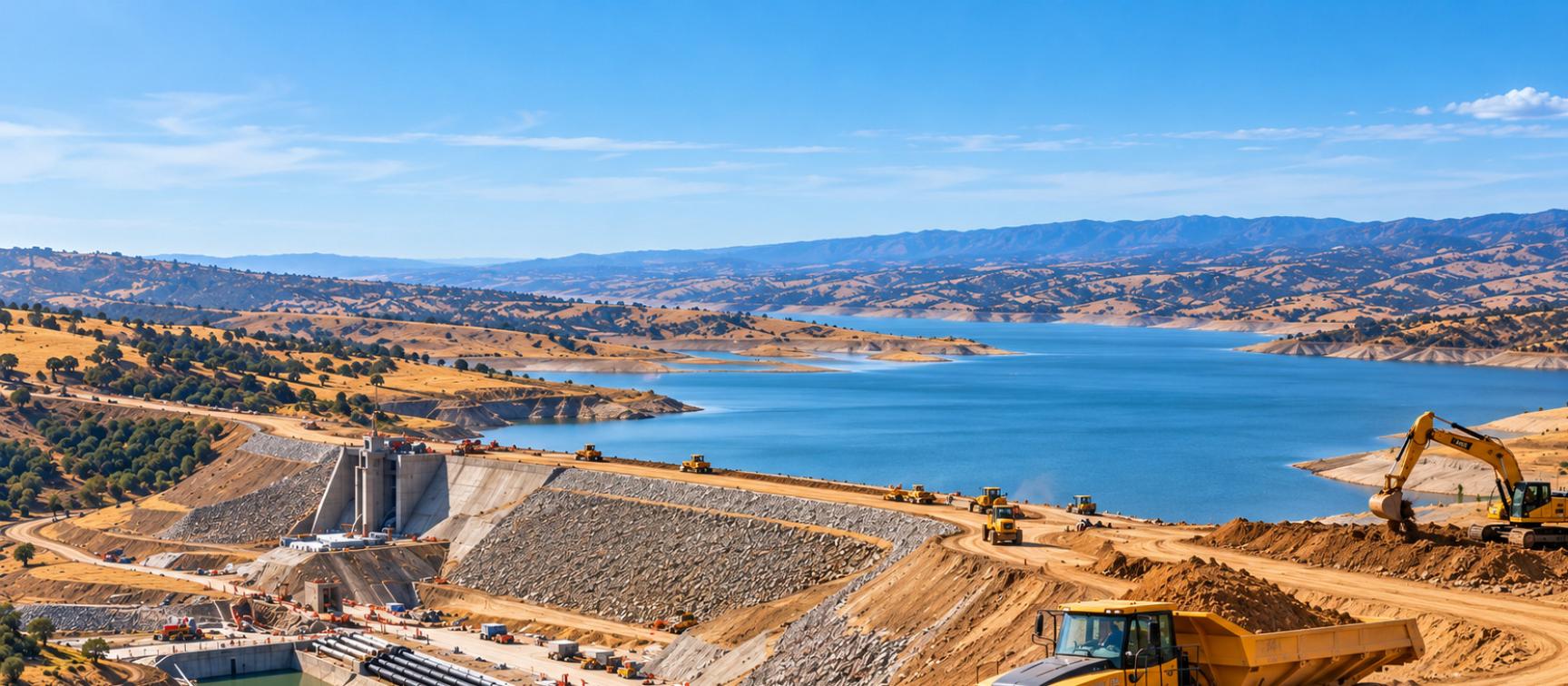
California is preparing for one of its most ambitious water infrastructure construction programs in decades. In the Sacramento Valley, approximately 10 miles west of Maxwell, the proposed Sites Reservoir will create a major new water storage facility designed to improve the state's ability to manage drought, capture water during wetter periods and support long-term water supply reliability.
With an estimated investment of $6.2 billion to $6.8 billion, the project will involve the construction of major embankment dams, extensive earthworks, pumping facilities, pipelines and supporting infrastructure. Once operational, the reservoir will have the capacity to store approximately 1.5 million acre-feet of water, making it one of the largest new water storage developments proposed in California in recent decades.
The project reached another important milestone in September 2026 when it received state water quality certification, moving it closer to the construction phase. Barnard Construction has already been selected to support the reservoir and roads package, with limited construction anticipated in 2027 and the main construction program expected to increase significantly from 2028.
For the U.S. heavy civil construction industry, Sites Reservoir represents a substantial opportunity involving large-scale earthmoving, dam construction, concrete works, underground infrastructure and complex project delivery across several years.
Why California Needs More Water Storage
California's water supply challenges are not simply a matter of insufficient rainfall. The state experiences considerable variation in precipitation, with periods of heavy storms often followed by prolonged dry conditions.
Historically, California has relied heavily on mountain snowpack to store water naturally through winter before releasing it into rivers and reservoirs during spring and summer. However, changing weather patterns, higher temperatures and greater variability in precipitation are increasing the importance of infrastructure capable of capturing and storing water when it becomes available.
Sites Reservoir is intended to provide additional flexibility within California's existing water management system.
Unlike conventional reservoirs constructed directly across major rivers, Sites will be an offstream reservoir. Water will be diverted from the Sacramento River during eligible periods of higher flows and transported into the new storage facility.
The stored water can then be released when required, helping support agricultural irrigation, municipal water supplies and environmental needs during periods when natural water availability is lower.
The project is designed to operate alongside California's existing State Water Project and Central Valley Project infrastructure, adding storage capacity rather than replacing established systems.
For a state where water availability influences agriculture, urban development and environmental management, that additional flexibility is a major part of the project's justification.
What Is Being Built at Sites Reservoir?
The scale of the construction program is considerable. The proposed reservoir will cover approximately 13,200 acres when full, with water retained by a combination of major dams and smaller embankment structures.
The principal construction works include two major dams, seven saddle dams and two saddle dikes, alongside pumping facilities, pipelines, road improvements and associated infrastructure.
The two primary dams, Golden Gate Dam and Sites Dam, will create the main barriers needed to retain water within the reservoir basin. Additional saddle dams and dikes will close lower sections of the surrounding terrain, allowing the reservoir to reach its planned storage capacity.
Constructing these structures will involve substantial excavation, foundation preparation, earthmoving and placement of engineered fill materials.
The project also requires a new conveyance system capable of transferring water between existing canals, the reservoir and the wider California water network.
Additional works include new access roads, modifications to existing roads, electrical infrastructure and facilities required to operate and maintain the reservoir once construction is complete.
Unlike a treatment plant expansion, where construction is concentrated within an existing industrial facility, Sites Reservoir will involve major construction activity spread across a large rural area. That creates a different set of engineering, logistical and workforce challenges.
The Engineering Behind Major Dam Construction
One of the most demanding elements of Sites Reservoir will be the construction of its large embankment dams.
These structures must be designed and constructed to safely retain substantial volumes of water over many decades, while meeting California's demanding seismic and dam safety requirements.
Before major embankment construction can begin, contractors must undertake extensive ground investigations, excavation and foundation preparation. The underlying rock and soil conditions need to be assessed and treated appropriately to provide a stable foundation and control seepage beneath the completed structures.
The dams themselves will require enormous quantities of engineered materials, placed and compacted in carefully controlled layers.
Material quality, moisture content, compaction standards and construction sequencing will all be critical to achieving the required performance.
Unlike many conventional civil construction projects, where substantial quantities of concrete may form the primary structure, large embankment dam construction relies heavily on earthworks engineering and the management of different soil and rock materials.
This places considerable importance on equipment selection, material processing, haul road design and the coordination of large earthmoving fleets.
Contractors will also need to account for seasonal weather conditions, including periods when rainfall may affect excavation, material handling and compaction activities.
With construction expected to continue over several years, maintaining productivity while meeting strict quality requirements will be central to the successful delivery of the dams.
Managing One of California's Largest Earthmoving Operations
The volume of material that must be excavated, transported and placed makes Sites Reservoir a significant heavy civil construction undertaking.
The project will require extensive site preparation, including access roads, excavation areas, material processing facilities and temporary construction infrastructure.
Large fleets of excavators, articulated haul trucks, dozers, graders, compactors and other heavy equipment will be needed to move and place materials across the site.
For construction teams, one of the biggest challenges will be maintaining efficient movement between excavation areas, processing facilities and embankment placement locations.
Poorly planned haul routes can significantly affect productivity, particularly when large numbers of machines are operating simultaneously.
Material management is equally important. Different sections of an embankment may require materials with specific engineering properties, meaning excavation and processing activities must be coordinated with placement requirements.
Quality assurance teams will play a major role throughout construction, monitoring material characteristics, compaction results and compliance with the approved design.
The work will require experienced Earthworks Superintendents, Heavy Civil Project Managers, Field Engineers, Equipment Managers and Quality Control professionals capable of managing large operations safely and efficiently.
Pumping Infrastructure and Water Conveyance
Although the dams will be the most prominent structures, Sites Reservoir also requires substantial water conveyance infrastructure.
The project will make use of existing diversion and canal facilities, including infrastructure associated with the Tehama-Colusa Canal and Glenn-Colusa Irrigation District.
New pumping and pipeline infrastructure will be constructed to move water into the reservoir and return it to the wider water supply network when required.
These facilities must be designed to manage substantial flows while operating reliably across different water supply conditions.
Construction will involve reinforced concrete structures, large-diameter pipework, pumping equipment, valves, electrical systems and instrumentation.
The project also includes modifications to existing pumping facilities and connections to established water infrastructure.
For contractors, these interfaces can be particularly challenging. New structures and equipment must connect to existing facilities while accounting for operational requirements, hydraulic performance and long-term maintenance.
As construction progresses, mechanical, electrical and instrumentation specialists will become increasingly important, particularly during equipment installation, testing and commissioning.
The finished system will need to operate as an integrated network, allowing water to be transferred safely and efficiently between the Sacramento River system, the reservoir and participating water agencies.
Barnard Construction Selected for the Reservoir and Roads Package
The Sites Project Authority has selected Barnard Construction as Construction Manager at Risk (CMAR) for the reservoir and roads portion of the project.
The contract covers the preconstruction planning phase, allowing the contractor to contribute construction expertise while engineering, permitting and project preparation continue.
Barnard's involvement is particularly significant given the scale and complexity of the proposed earthworks and dam construction.
The CMAR delivery approach allows the project owner, engineers and contractor to collaborate before the main construction phase, helping identify potential risks, improve constructability and develop more reliable construction schedules and cost estimates.
On a project of this size, early contractor involvement can provide considerable value.
Decisions involving material sources, haul routes, construction equipment, temporary facilities and sequencing can have major consequences for cost and delivery.
The Sites Project Authority also intends to procure additional contractors for other elements of the program, including water conveyance infrastructure.
This means the overall project will involve multiple major construction packages, requiring careful coordination between different contractors and specialist teams.
Construction Schedule and the Road to 2033
Although Sites Reservoir has been discussed and developed over many years, the project is now progressing through the final stages of preparation for major construction.
In September 2026, the California State Water Resources Control Board issued the project's water quality certification, an important regulatory milestone.
A final water rights decision is scheduled for consideration in November 2026, while other permitting, financing and land acquisition activities continue.
The Sites Project Authority's contractor information indicates that limited construction is expected to begin in 2027, with activity increasing in 2028 as the project moves further into the main construction phase.
Construction is anticipated to continue through 2033, with peak activity expected around 2030.
These dates remain dependent on the necessary approvals, funding arrangements and final construction planning.
The extended construction period reflects the scale of the work involved. Major dam structures, pipelines, pumping facilities, roads and supporting infrastructure must all be completed before the reservoir can begin operating.
For contractors and construction professionals, the program represents a potentially significant pipeline of work extending across several years.
Environmental Considerations and Project Challenges
As with most major water infrastructure developments in California, Sites Reservoir has generated considerable discussion about its environmental implications.
Supporters argue that the reservoir will improve drought resilience by capturing water during periods when it is more plentiful, providing additional supply for communities, agriculture and environmental purposes.
The project also includes dedicated storage capacity intended to support environmental water management, including wildlife refuges and other ecosystems during dry periods.
However, environmental organizations have raised concerns about the potential effects of diverting water from the Sacramento River, particularly on fish populations, river flows and downstream ecosystems.
These concerns have contributed to extensive environmental reviews, permitting requirements and legal challenges.
The project has undergone state and federal environmental assessments, and construction will be subject to mitigation measures and regulatory conditions intended to manage its impacts.
For the construction industry, these requirements add another layer of complexity.
Environmental compliance must be incorporated into construction planning, particularly where work involves waterways, sensitive habitats, land disturbance and substantial earthmoving operations.
Contractors will need to coordinate closely with environmental specialists, regulators and the project owner to ensure construction activities comply with applicable permits and mitigation commitments.
Balancing construction progress with these obligations will be an important part of delivering the project successfully.
The Construction Professionals Behind Sites Reservoir
Major infrastructure programs like Sites Reservoir require experienced professionals across a broad range of heavy civil construction disciplines.
Project Managers will be responsible for overseeing construction packages, managing budgets, coordinating subcontractors and maintaining progress against complex schedules.
Superintendents with backgrounds in dam construction, earthworks and major civil infrastructure will play a central role in organizing field operations and managing substantial equipment fleets.
Project Engineers will support technical coordination, construction documentation, quality requirements and the interfaces between design and field operations.
Estimators and Schedulers will be particularly important as construction packages develop, helping contractors plan resources, assess costs and manage activities across a multiyear program.
The project will also require experienced geotechnical engineers, surveyors, quality professionals, safety managers and specialists in mechanical and electrical infrastructure.
As the pumping and conveyance systems progress, additional expertise will be needed in equipment installation, controls integration, testing and commissioning.
For professionals working in U.S. heavy civil construction, Sites Reservoir offers the prospect of gaining experience on a major infrastructure program involving some of the most technically demanding aspects of earthworks and dam construction.
Building California's Future Water Resilience
Sites Reservoir represents a substantial investment in California's ability to manage its water resources through increasingly variable weather conditions.
By creating approximately 1.5 million acre-feet of additional offstream storage, the project aims to capture water during wetter periods and make it available when supplies are more limited.
Delivering that capability will require an extraordinary construction effort, involving major embankment dams, extensive earthmoving, pumping stations, pipelines and supporting infrastructure.
With an estimated investment of $6.2 billion to $6.8 billion, the program is among the largest proposed water infrastructure developments in the United States.
The appointment of Barnard Construction, progress through environmental permitting and the planned transition toward construction demonstrate how the project is moving from long-term planning into delivery preparation.
However, the coming years will be decisive, with final approvals, construction planning and major contract packages determining how the project progresses toward its targeted 2033 operational date.
For the U.S. construction industry, Sites Reservoir highlights the scale of investment required to develop major water storage infrastructure and the importance of experienced contractors, engineers and construction professionals in delivering these complex projects.
At Approach Talent USA, we specialize in recruitment across the U.S. water, wastewater and heavy civil construction sectors. We work with contractors seeking experienced Project Managers, Superintendents, Project Engineers, Estimators and construction leaders to deliver major infrastructure projects throughout the United States.
Recent News
Expert Advice to Prepare for a Construction Job Interview: Building Your Career in the U.S.
Inside Tampa Bay's $181 Million Water Treatment Expansion: Building for Florida's Future
Inside Cleveland's $3 Billion Project Clean Lake: The Underground Tunnels Transforming Wastewater Infrastructure