

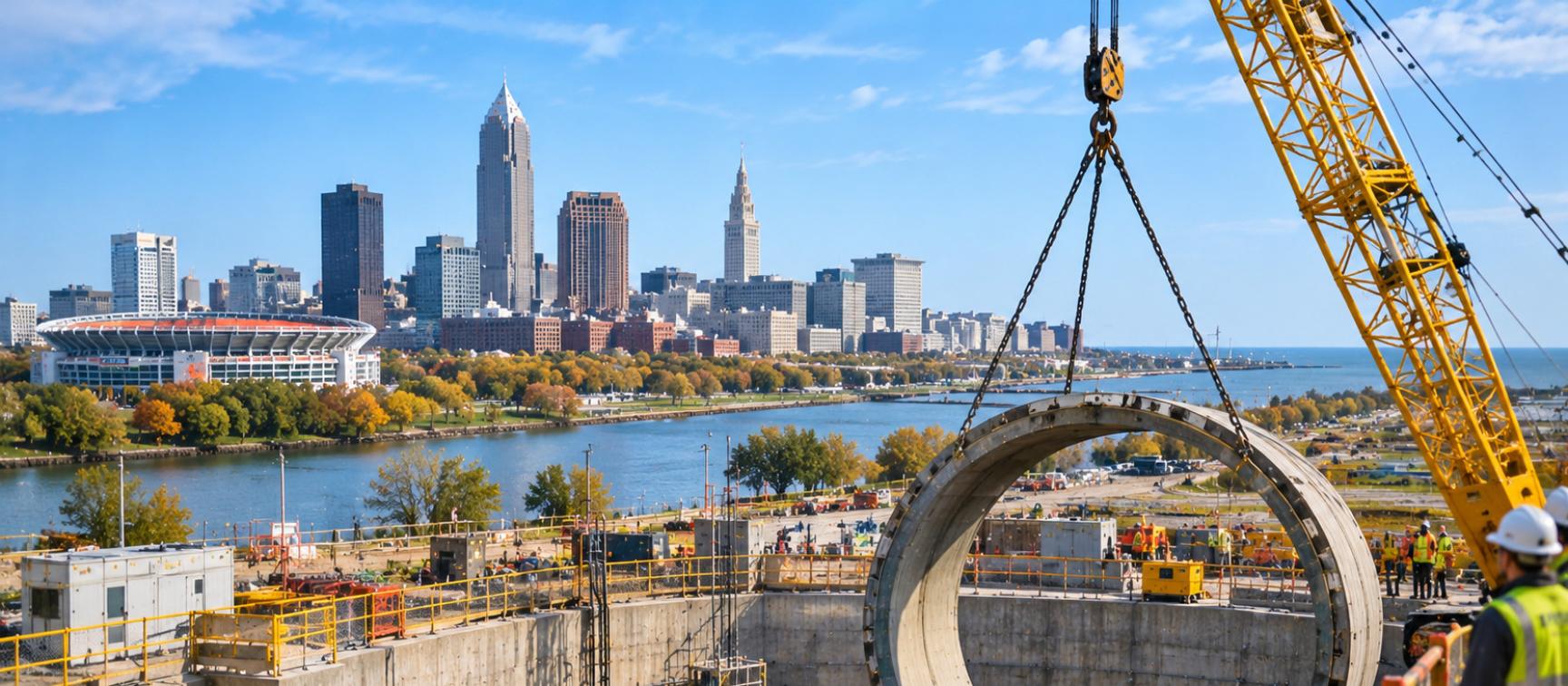
Inside Cleveland's $325 Million Big Creek Tunnel: Protecting the Future of Lake Erie
One of Northeast Ohio's most significant wastewater infrastructure programs is entering another major phase with the construction of the Big Creek Tunnel in Cleveland.
In October 2026, Granite Construction and its joint venture partner, Super Excavators, announced the award of a $324.8 million construction contract from the Northeast Ohio Regional Sewer District (NEORSD).
The project will deliver more than four miles of large-diameter underground wastewater tunnel, supported by connecting tunnels, deep shafts and associated infrastructure.
Once operational, the Big Creek Tunnel is expected to help prevent approximately 550 million gallons of combined sewer overflows from entering local waterways annually.
The development forms part of Project Clean Lake, a $3 billion infrastructure program launched in 2011 to improve wastewater management and protect Lake Erie.
For the U.S. heavy civil construction industry, the Big Creek Tunnel represents another substantial investment in underground infrastructure, requiring specialist tunneling expertise, deep excavation, geotechnical engineering and experienced construction management teams.
Why Cleveland Is Investing in Underground Wastewater Infrastructure
Lake Erie is one of North America's five Great Lakes and an essential freshwater resource for millions of people across the United States and Canada.
It supports drinking water supplies, commercial activity, recreation and a diverse aquatic ecosystem.
However, protecting water quality requires continued investment in the wastewater infrastructure serving the communities surrounding the lake.
Like many established American cities, Cleveland has areas served by combined sewer systems that collect both wastewater and stormwater through the same network.
During normal weather conditions, these systems transport wastewater to treatment facilities.
During heavy rainfall, the volume entering the sewer network can exceed its available capacity, resulting in combined sewer overflows that discharge a mixture of untreated wastewater and stormwater into local rivers and streams.
These waterways ultimately connect to Lake Erie.
Addressing the problem requires more than simply replacing aging sewer pipes. It requires additional capacity to capture, store and transport large volumes of wastewater during significant rainfall events.
Deep underground storage tunnels provide an effective solution, allowing excess flows to be captured temporarily before being transferred to treatment facilities.
The Big Creek Tunnel will expand this capacity across part of Cleveland's regional wastewater network.
The Scale of the Big Creek Tunnel Project
The construction contract includes several substantial elements:
-
A $324.8 million construction contract.
-
Approximately 22,300 linear feet of main tunnel.
-
A main tunnel diameter of 20 feet.
-
Approximately 3,115 linear feet of additional connecting tunnels.
-
Seven shaft locations supporting construction and operation.
-
An anticipated reduction of approximately 550 million gallons of combined sewer overflows annually.
The main tunnel alone will extend more than 4.2 miles.
With a diameter of 20 feet, the underground structure will provide substantial capacity for capturing wet-weather flows.
The connecting tunnels and associated infrastructure will allow wastewater to enter the new system from different locations across the existing sewer network.
Construction is scheduled to begin in fall 2026, with the contractor targeting completion in winter 2030. Some wider project activities may extend into 2031.
The project will require several years of coordinated underground construction, structural engineering and integration with existing wastewater infrastructure.
How Underground Storage Tunnels Work
The fundamental principle behind wastewater storage tunnels is relatively straightforward, although the engineering required to deliver them is considerably more complex.
During periods of heavy rainfall, combined sewer networks can experience rapid increases in flow.
Instead of allowing the excess wastewater to discharge directly into surrounding waterways, diversion structures redirect flows into large underground tunnels.
These tunnels provide temporary storage until the downstream wastewater treatment system has sufficient capacity to process the additional volume.
Once rainfall subsides, the stored wastewater can be conveyed to treatment facilities.
This approach allows utilities to improve the environmental performance of existing sewer networks without necessarily replacing every combined sewer across an established metropolitan area.
For Cleveland, the Big Creek Tunnel will become another important component of an interconnected wastewater management system.
Its effectiveness will depend not only on the tunnel itself, but also on the successful integration of connecting sewers, flow control structures and existing treatment infrastructure.
Excavating More Than Four Miles Beneath Cleveland
Constructing a tunnel of this size requires specialist underground engineering and substantial investment in excavation equipment.
Large-diameter tunnel projects typically rely on tunnel boring machines capable of excavating through rock or other geological formations while maintaining stability within the surrounding ground.
The equipment must be selected and configured to suit the anticipated geology, groundwater conditions and tunnel design.
Before the main excavation can begin, contractors must establish the surface construction sites and develop the access infrastructure required to support underground operations.
This includes providing space for equipment assembly, material handling, construction personnel and the removal of excavated material.
Once excavation begins, maintaining consistent progress becomes a major operational objective.
The tunneling team must coordinate machine maintenance, material removal, structural support, surveying and the delivery of construction materials.
Any interruption to one of these activities can affect the productivity of the entire underground operation.
For Tunnel Superintendents and Heavy Civil Project Managers, managing these interconnected activities requires detailed planning and considerable experience.
Unlike conventional construction sites, underground projects provide limited opportunities to create alternative access routes or reorganize work areas.
Equipment reliability, construction sequencing and workforce coordination become particularly important when excavation advances several miles underground.
The Importance of Deep Shaft Construction
The Big Creek Tunnel will feature seven shaft locations, each supporting different aspects of construction or the permanent wastewater system.
Shafts provide the essential connection between the surface and underground infrastructure.
During construction, they can be used to transport personnel, equipment and materials, as well as remove excavated material.
Depending on their intended function, permanent shafts may also provide access for inspections, maintenance and connections to existing sewer networks.
Constructing these structures requires a different set of engineering skills from the main horizontal tunnel excavation.
Contractors must manage vertical excavation, ground support, groundwater conditions and substantial lifting operations.
The construction methodology will depend on the specific geology and design requirements at each location.
Reinforced concrete construction, temporary support systems and specialist foundation techniques may all form part of the work.
The shafts must also be constructed to precise tolerances, particularly where they connect with underground tunnels and hydraulic structures.
For Project Engineers, Geotechnical Engineers and Shaft Construction Superintendents, these interfaces represent some of the most technically demanding aspects of the project.
Managing Geological Conditions and Groundwater
One of the defining challenges of underground construction is that contractors cannot always observe the conditions ahead of excavation directly.
Geotechnical investigations provide essential information about rock formations, soil characteristics, groundwater levels and potential geological variations.
However, actual conditions encountered during construction can differ from those anticipated during design.
Changes in rock strength, fractures or groundwater inflows can affect excavation productivity and influence the support measures required.
For a tunnel extending more than four miles, understanding and managing these conditions is central to successful delivery.
Groundwater presents another significant consideration.
Construction teams must control water entering excavation areas while protecting surrounding ground and infrastructure.
The completed tunnel must also be designed to withstand the hydraulic and structural conditions it will experience throughout its operational life.
This places considerable importance on excavation monitoring, structural design, waterproofing and quality assurance.
Experienced underground construction professionals are essential to interpreting changing site conditions and coordinating appropriate engineering responses.
Delivering Heavy Civil Construction in an Urban Environment
Although the majority of the Big Creek Tunnel will be constructed underground, a considerable amount of activity will take place at the surface.
Construction sites associated with shaft excavation and tunneling operations must accommodate heavy equipment, cranes, material storage, personnel facilities and excavation spoil handling.
These activities need to be coordinated within established communities and existing transportation networks.
Moving excavated material away from construction sites requires carefully planned haulage operations.
The delivery of large equipment and construction materials must also be scheduled around access restrictions and local traffic conditions.
Noise, vibration, dust and the protection of existing utilities are important considerations throughout the construction program.
The underground alignment must account for existing infrastructure, while construction teams need to monitor potential impacts on surrounding properties.
For contractors, successful delivery depends on maintaining efficient construction operations while minimizing disruption to residents and businesses.
These challenges illustrate why urban tunneling requires a particularly strong combination of technical expertise, operational planning and stakeholder management.
Granite Construction and Super Excavators
The Big Creek Tunnel will be delivered through a joint venture between Granite Construction and Super Excavators.
Granite Construction is one of America's established heavy civil contractors, with experience across transportation, underground construction, water infrastructure and major public works.
Its tunneling capabilities include large-diameter underground excavation, shaft construction and complex infrastructure delivery.
Wisconsin-based Super Excavators brings specialist experience in underground construction, tunneling and deep sewer infrastructure.
The combination of these capabilities will be particularly valuable given the scale and technical complexity of the Big Creek Tunnel.
The project will also require coordination with specialist subcontractors, equipment suppliers, engineering consultants and the Northeast Ohio Regional Sewer District.
Managing the interfaces between underground excavation, shaft construction, structural works and permanent wastewater infrastructure will be essential to maintaining progress.
The October 2026 contract award provides both businesses with a substantial multiyear construction program in the Midwest.
Part of Cleveland's $3 Billion Project Clean Lake
The Big Creek Tunnel is not an isolated infrastructure development.
It represents the final large-diameter storage tunnel planned under Project Clean Lake, a long-term wastewater improvement program established by the Northeast Ohio Regional Sewer District.
The $3 billion program was launched in 2011 and includes a combination of underground storage tunnels, sewer network improvements, treatment infrastructure and other measures designed to reduce combined sewer overflows.
Other major tunnels delivered or developed through the program include:
-
Euclid Creek Tunnel.
-
Dugway Storage Tunnel.
-
Doan Valley Tunnel.
-
Westerly Storage Tunnel.
-
Shoreline Storage Tunnel.
-
Southerly Storage Tunnel.
Each contributes to the wider objective of improving the regional wastewater network's ability to manage rainfall-related flows.
Once the complete program is delivered, the district expects to prevent approximately 4.5 billion gallons of combined sewer overflows from entering Lake Erie and other regional waterways annually.
The scale of this environmental improvement demonstrates the importance of sustained investment in wastewater infrastructure.
Rather than relying on a single facility or construction project, Cleveland is developing an integrated network of underground storage and conveyance systems.
The Big Creek Tunnel will provide another essential connection within that network.
A Growing Market for Underground Water Infrastructure
Cleveland's continued investment reflects a wider trend across the United States.
Many major cities operate sewer networks originally developed decades, or even more than a century, ago.
Increasing environmental requirements, changing rainfall patterns and the need to improve infrastructure reliability are driving substantial investment in modern wastewater systems.
Major underground tunnel programs are being delivered across cities including Pittsburgh, Washington, D.C., Indianapolis and St. Louis.
These developments are creating sustained demand for contractors with specialist tunneling and heavy civil construction capabilities.
However, underground infrastructure requires a workforce with experience that is not always readily transferable from other construction sectors.
Professionals must understand the relationship between geology, excavation equipment, structural engineering and underground logistics.
Project management teams must also be capable of coordinating construction programs where progress is heavily dependent on specialist equipment and complex engineering interfaces.
As investment in water and wastewater infrastructure continues, attracting experienced professionals will remain an important consideration for contractors delivering these projects.
The Construction Professionals Behind the Big Creek Tunnel
Delivering a project of this scale requires experienced construction professionals across several specialist disciplines.
Heavy Civil Project Managers will oversee construction packages, financial performance, subcontractor coordination and overall project delivery.
Tunnel Superintendents will be responsible for managing underground operations, coordinating excavation teams and maintaining productivity throughout the tunneling program.
Shaft Construction Superintendents will oversee vertical excavation, structural support and the construction of access infrastructure.
Project Engineers will support technical coordination, construction documentation, quality control and communication between design and field teams.
Estimators and Schedulers will play an important role in managing construction costs, equipment resources and the complex dependencies between different construction activities.
The project will also require experienced professionals across geotechnical engineering, surveying, structural concrete construction, safety management and quality control.
Mechanical and electrical specialists will become increasingly important as the permanent wastewater infrastructure is installed and prepared for operation.
For construction professionals looking to develop their careers within heavy civil and underground infrastructure, projects such as the Big Creek Tunnel offer valuable experience in technically demanding, large-scale construction.
Protecting Lake Erie Through Long-Term Infrastructure Investment
The Big Creek Tunnel represents a significant milestone in Cleveland's ongoing efforts to modernize its wastewater infrastructure and improve the environmental condition of Lake Erie.
With a construction contract valued at nearly $325 million, more than four miles of main tunnel and the potential to prevent approximately 550 million gallons of combined sewer overflows annually, the project demonstrates the scale of investment required to address the challenges facing established urban sewer networks.
It also highlights the specialist expertise required to deliver major underground infrastructure.
Contractors must combine tunneling technology, geotechnical engineering, structural construction and experienced field leadership to deliver an asset designed to operate for generations.
As Project Clean Lake progresses toward completion, Cleveland provides an important example of how sustained infrastructure investment can deliver long-term environmental and community benefits.
For the U.S. heavy civil construction industry, the Big Creek Tunnel is another indication of the substantial opportunities associated with modernizing America's water and wastewater infrastructure.
At Approach Talent USA, we specialize in recruitment across the U.S. heavy civil, tunneling, water and wastewater construction sectors.
We partner with contractors seeking experienced Project Managers, Superintendents, Project Engineers, Estimators, Schedulers and construction leaders to deliver major infrastructure projects throughout the United States.
Recent News
Inside Pittsburgh's $1 Billion Ohio River Tunnel: Building a Major Underground Wastewater System
Inside the $3.2 Billion Fargo-Moorhead Flood Diversion: Building One of America's Largest Flood Protection Projects
Inside the $16 Billion Hudson Tunnel Project: Building a New Rail Connection Beneath the Hudson River