

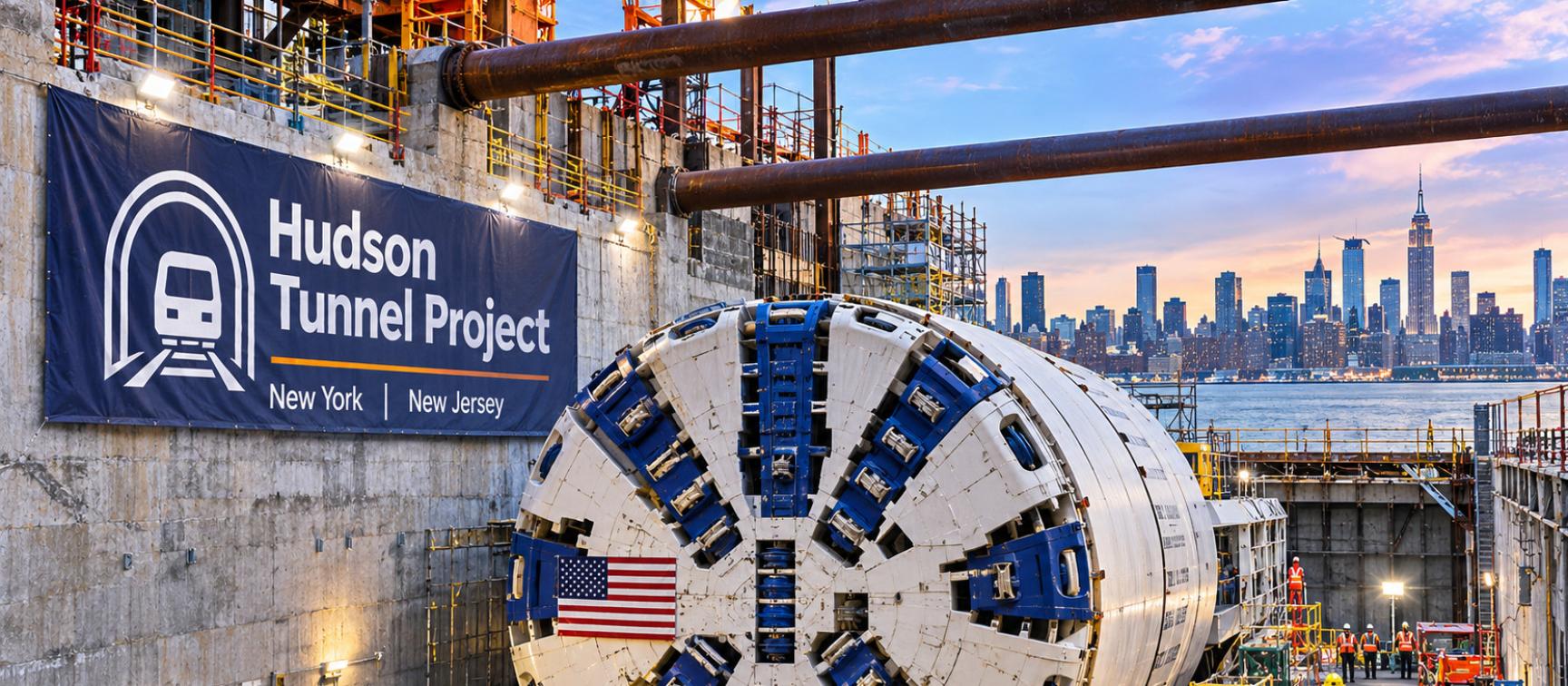
Inside the $16 Billion Hudson Tunnel Project: Building a New Rail Connection Beneath the Hudson River
Beneath the Hudson River, between New York and New Jersey, one of America's most significant transportation infrastructure projects is moving into a major new phase of construction.
The $16 billion Hudson Tunnel Project will deliver two new passenger rail tunnel tubes beneath the river, providing an additional connection between New Jersey and New York Penn Station. The project also includes the rehabilitation of the existing North River Tunnel, which has been operating for more than a century and remains one of the busiest rail connections in the United States.
In September 2026, the project reached a major milestone when the Gateway Development Commission celebrated the launch of its first tunnel boring machine in North Bergen, New Jersey. The machine subsequently began excavation in October, marking the start of the project's first major tunnel boring operation.
The construction program involves extensive underground excavation, ground stabilization, reinforced concrete structures, railway infrastructure and complex engineering works beneath densely developed urban areas.
For the U.S. heavy civil construction industry, the Hudson Tunnel Project represents an extraordinary undertaking, requiring specialist tunneling contractors, experienced construction management teams and years of coordinated work across multiple major construction packages.
Why the Hudson Tunnel Project Is So Important
The rail connection between New York and New Jersey is one of the most important transportation links in the northeastern United States.
Every weekday, hundreds of thousands of passengers depend on trains traveling through the existing North River Tunnel, which connects New Jersey to Manhattan beneath the Hudson River.
The tunnel opened in 1910 and continues to carry both Amtrak and NJ TRANSIT services along the Northeast Corridor.
Despite its importance, the infrastructure is showing its age.
The existing tunnel consists of two separate tubes, each containing a single railway track. This creates a significant operational constraint because there is limited flexibility when maintenance, equipment failures or other incidents affect either track.
The situation became more challenging in 2012 when Hurricane Sandy flooded the tunnel with saltwater.
The flooding damaged electrical systems and other infrastructure, leaving deterioration that has contributed to maintenance requirements and service disruptions.
Although repairs have allowed the tunnel to remain operational, a comprehensive rehabilitation is needed to address its long-term condition.
However, taking one of the existing tubes out of service for major repairs would significantly reduce the number of trains able to travel between New Jersey and New York.
The Hudson Tunnel Project provides a solution.
By constructing a new two-tube tunnel first, the project will allow rail services to continue operating while the existing North River Tunnel undergoes rehabilitation.
Once both elements are complete, the crossing will have four railway tracks rather than the current two, improving operational flexibility and resilience.
The project is therefore not simply about constructing additional infrastructure. It is about protecting one of America's most important passenger rail connections for future generations.
What Is Being Built?
The Hudson Tunnel Project is the centerpiece of the wider Gateway Program, a series of rail infrastructure improvements intended to modernize and expand the Northeast Corridor between Newark and New York.
The project includes the construction of two new tunnel tubes extending approximately nine miles in total when both tracks are considered.
The new railway alignment will run from New Jersey, beneath the Palisades rock formation and the Hudson River, before connecting with existing rail infrastructure near New York Penn Station.
Major construction elements include:
-
Two new single-track rail tunnel tubes connecting New Jersey and Manhattan.
-
Underground excavation through hard rock, soft soil and mixed geological conditions.
-
New tunnel portals, access shafts and ventilation facilities.
-
Precast concrete tunnel linings and underground cross-passages.
-
New railway tracks, electrical systems, communications and safety infrastructure.
-
Surface rail connections and associated bridge and civil engineering works.
-
Rehabilitation of the existing North River Tunnel once the new connection is operational.
The project has been divided into several major construction packages, allowing specialist contractors to deliver different sections of the infrastructure.
This approach enables construction to progress simultaneously at multiple locations, although it also creates substantial requirements for coordination between contractors, engineers and the project owner.
Tunnel Boring Begins Beneath the Palisades
One of the most important milestones occurred in September 2026, when the first tunnel boring machine was formally launched at the project's Tonnelle Avenue construction site in North Bergen.
The machine began mining in October, starting its journey through the Palisades rock formation toward the Hudson County Access Shaft near Weehawken and Hoboken.
This initial phase involves constructing approximately 5,100 feet of twin tunnel tubes through the hard rock beneath the Palisades.
The work is being delivered by a joint venture involving Schiavone Construction, Dragados and Lane Construction.
Two specially designed tunnel boring machines will be used, each excavating one of the parallel tunnel tubes.
The machines are approximately 500 feet long when their trailing support equipment is included, with cutting heads measuring 28 feet and 8 inches in diameter.
Each weighs more than 1,680 tons.
Unlike conventional excavation equipment, these machines operate as underground construction factories.
At the front, a rotating cutting head fitted with specialized disc cutters breaks through the rock. Excavated material is transported away through conveyor systems, while precast concrete segments are installed behind the machine to create the permanent tunnel lining.
Hydraulic systems then push the machine forward against the completed lining, allowing the excavation process to continue.
The machinery must operate with considerable precision to maintain the correct alignment, control ground movement and ensure the finished tunnel meets the required engineering standards.
For the contractors involved, the launch represents the culmination of years of preparation, including site development, shaft construction, equipment manufacturing, transportation and assembly.
The Engineering Challenges of Building Beneath the Hudson River
Although the Palisades section presents demanding hard rock excavation conditions, the eventual crossing beneath the Hudson River introduces another level of complexity.
The river section will extend approximately 7,250 feet between the Hudson County Access Shaft in New Jersey and the 12th Avenue Shaft in Manhattan.
Unlike the Palisades, where tunneling primarily involves hard rock, the Hudson River alignment passes through a mixture of geological conditions.
These include soft soils, rock and areas requiring engineered ground treatment.
For tunnel boring operations, changes in ground conditions can be particularly challenging.
A machine excavating through hard rock operates differently from one moving through soft, water-bearing soil.
Ground pressure must be carefully controlled to prevent instability, while excavation rates and material removal systems need to accommodate changing conditions.
To manage these challenges, the Gateway Development Commission plans to use two purpose-built mixed-ground tunnel boring machines for the river crossing.
These machines will be designed to operate through both rock and softer materials, allowing the construction team to adapt as conditions change.
The river section also requires the construction of nine cross-passages connecting the two tunnel tubes.
These passages will provide essential connections for emergency access and evacuation, making them a critical part of the finished railway infrastructure.
Constructing cross-passages between tunnels beneath a river requires careful excavation, temporary support, waterproofing and structural construction.
The work must be coordinated with the completed tunnel linings and surrounding ground conditions to maintain stability throughout the process.
Stabilizing the Ground Before Construction
One of the most technically interesting elements of the Hudson Tunnel Project is the extensive ground stabilization required before tunnel boring can safely progress through certain sections.
Beneath the Hudson River, contractors have been carrying out ground improvement works to prepare sections of the alignment for future excavation.
The Hudson River Ground Stabilization Project involves treating areas of the riverbed where existing soil conditions could create difficulties for tunnel boring.
Ground stabilization techniques can involve injecting cementitious materials into the soil to improve its strength and reduce permeability.
This creates more predictable ground conditions for the tunnel boring machines, helping reduce the risk of instability or excessive groundwater movement during excavation.
The project also includes stabilization works near existing transportation infrastructure in New Jersey.
These include sections beneath the Hudson-Bergen Light Rail system and around the Willow Avenue Bridge, where underground excavation must be undertaken without compromising existing structures.
For contractors, this creates a complex relationship between geotechnical engineering, temporary works and tunneling operations.
Before excavation begins, engineers must understand how the ground will respond and whether additional support or treatment is required.
During construction, monitoring systems will help track settlement, structural movement and other indicators that could affect nearby infrastructure.
This type of work demonstrates why major urban tunneling projects require substantial engineering preparation long before the tunnel boring machines reach a particular section.
Delivering the Project Through Major Construction Packages
The Hudson Tunnel Project is being delivered through a series of large construction contracts, each covering a different element of the infrastructure.
On the New Jersey side, the Palisades Tunnel package involves the first major tunnel boring operations, beginning at Tonnelle Avenue and progressing toward the Hudson County Access Shaft.
In Manhattan, separate contractors are responsible for constructing the underground connections between the Hudson River crossing, the existing Hudson Yards tunnel casing and the rail approaches to New York Penn Station.
The Manhattan Tunnel Project involves excavation beneath one of the most densely developed urban environments in the United States.
Construction must account for existing buildings, utilities, transportation infrastructure and restricted access.
The Hudson River Tunnel Section, awarded in April 2026, represents another major package.
The $1.29 billion contract was awarded to a joint venture involving Traylor Bros., Walsh Construction and Skanska USA Civil.
This package covers the two 7,250-foot tunnel tubes beneath the river, installation of tunnel linings and floors, construction of cross-passages and associated ground stabilization works.
In June 2026, the Gateway Development Commission also awarded the New Jersey Surface Alignment package, which will connect the new tunnel infrastructure with the existing Northeast Corridor rail network.
Together, these contracts form a complex construction program involving underground excavation, bridge engineering, rail infrastructure and substantial civil works.
Coordinating the interfaces between these packages will be essential to delivering the completed tunnel system.
The Challenge of Building in New York and New Jersey
Major infrastructure construction is challenging in almost any environment, but delivering underground works beneath New York and New Jersey creates additional complications.
The region is densely developed, with extensive underground utilities, active railway lines, major highways, commercial buildings and residential neighborhoods.
Construction sites are often constrained, leaving limited space for equipment storage, material handling and temporary facilities.
Tunnel boring operations require substantial supporting infrastructure above ground.
This includes access shafts, material handling systems, power supplies, ventilation equipment and facilities for storing and transporting precast concrete tunnel segments.
Excavated material must also be removed efficiently without creating unacceptable disruption to surrounding communities.
In areas with limited access, this can require carefully planned truck movements, temporary road arrangements and coordination with local authorities.
Noise, vibration and settlement monitoring are particularly important where construction takes place close to existing buildings and infrastructure.
The project must also maintain the operation of nearby rail services and roads throughout construction.
For Project Managers and Superintendents, these constraints make logistics and sequencing just as important as the physical excavation itself.
A delay in material deliveries, equipment availability or access arrangements can affect multiple activities across the construction program.
Successful delivery depends on detailed planning and communication between contractors, engineers, transportation operators and the surrounding communities.
Construction Progress in 2026
The Hudson Tunnel Project has experienced an important year of progress, alongside challenges relating to federal funding.
Construction began on early works in 2023, including utility relocation, bridge construction, access shafts and ground stabilization.
During 2025, contractors continued preparing the tunnel boring launch sites, while major equipment was manufactured and transported to New Jersey.
However, the project experienced a temporary construction suspension in February 2026 following a dispute over federal funding disbursements.
The Gateway Development Commission pursued legal action, and construction subsequently resumed after federal payments began flowing again.
The interruption affected construction momentum and the procurement of certain major contracts.
Nevertheless, significant progress followed.
In April 2026, the Commission awarded the Hudson River Tunnel Section contract, securing the contractor responsible for the central underwater crossing.
In June, the New Jersey Surface Alignment contract was awarded, advancing another major part of the overall construction program.
The first Palisades tunnel boring machine was launched in September and began excavation in October.
These developments marked an important transition from preliminary construction and site preparation toward major underground excavation.
The project is targeting the opening of the new tunnel in 2035, although the Gateway Development Commission has been assessing the potential effects of funding interruptions on the construction schedule and budget.
The rehabilitation of the existing North River Tunnel will follow the opening of the new crossing.
With several major packages now progressing, the coming years will involve substantial tunneling, structural construction and the installation of railway infrastructure.
Why the Project Matters to the U.S. Construction Industry
The Hudson Tunnel Project demonstrates the scale of investment required to modernize aging transportation infrastructure in the United States.
Many of the country's most important rail, bridge and tunnel systems were constructed decades ago, and maintaining their reliability increasingly requires major engineering interventions.
Replacing or rehabilitating infrastructure in heavily populated areas presents challenges that differ considerably from constructing new facilities on undeveloped land.
Contractors must manage complex ground conditions, protect existing structures, maintain transportation services and coordinate multiple specialist construction activities.
The Hudson Tunnel Project brings these challenges together on an exceptional scale.
Its construction requires extensive tunneling expertise, large underground equipment, advanced ground stabilization techniques and substantial structural concrete works.
The program also highlights the importance of experienced construction management professionals capable of overseeing technically demanding projects with long delivery schedules.
As infrastructure investment continues across the United States, the expertise developed on projects such as Hudson Tunnel will remain highly valuable across rail, highway, water and other heavy civil construction sectors.
The Construction Professionals Behind the Hudson Tunnel Project
Delivering a multibillion-dollar tunneling program requires experienced professionals across a broad range of heavy civil construction disciplines.
Project Managers are responsible for overseeing construction packages, managing budgets, coordinating subcontractors and maintaining progress against complex schedules.
Tunnel Superintendents play a central role in organizing underground excavation, managing specialist equipment and ensuring work progresses safely and efficiently.
Project Engineers support technical coordination, construction documentation, quality requirements and the interfaces between engineering design and field operations.
Estimators and Schedulers are essential throughout the project, particularly where construction involves major equipment, multiple work areas and complex dependencies between contractors.
The project also requires experienced geotechnical engineers, surveyors, structural engineers, safety managers and quality control specialists.
As tunnel excavation progresses, further expertise will be needed in track installation, electrical infrastructure, ventilation systems, communications, fire protection and commissioning.
For construction professionals, projects of this scale provide opportunities to work with advanced engineering techniques, manage substantial construction teams and contribute to infrastructure that will serve millions of passengers over its lifetime.
Building the Future of Rail Transportation Between New York and New Jersey
The Hudson Tunnel Project represents one of the most important transportation infrastructure investments currently underway in the United States.
By constructing a new two-tube rail tunnel beneath the Hudson River and rehabilitating the existing North River Tunnel, the project aims to improve reliability and provide greater operational flexibility across a critical section of the Northeast Corridor.
The engineering challenges are considerable.
Contractors must excavate through hard rock and soft ground, construct new tunnels beneath an active river, stabilize existing infrastructure and manage major construction activities in densely populated urban environments.
The launch of tunnel boring operations in 2026 marks a significant step toward delivering that infrastructure.
With major contracts awarded and construction progressing across multiple locations, the project is entering a period of substantial heavy civil activity.
Although funding disputes and construction risks remain important considerations, the long-term objective is clear: to create a more resilient rail connection between New York and New Jersey while protecting the future of one of America's busiest passenger rail corridors.
For the U.S. construction industry, the Hudson Tunnel Project is a powerful example of the engineering expertise, specialist equipment and experienced construction professionals required to deliver modern infrastructure on an extraordinary scale.
At Approach Talent USA, we specialize in recruitment across the U.S. heavy civil, transportation, water and wastewater construction sectors. We work with contractors seeking experienced Project Managers, Superintendents, Project Engineers, Estimators, Schedulers and construction leaders to deliver major infrastructure projects throughout the United States.
Recent News
Inside Virginia's $3.9 Billion Hampton Roads Bridge-Tunnel Expansion: Building Beneath One of America's Busiest Waterways
Inside Florida's EAA Reservoir: The Major Construction Project Helping Restore the Everglades
Inside California's $6 Billion Sites Reservoir: Building One of America's Largest New Water Storage Projects