

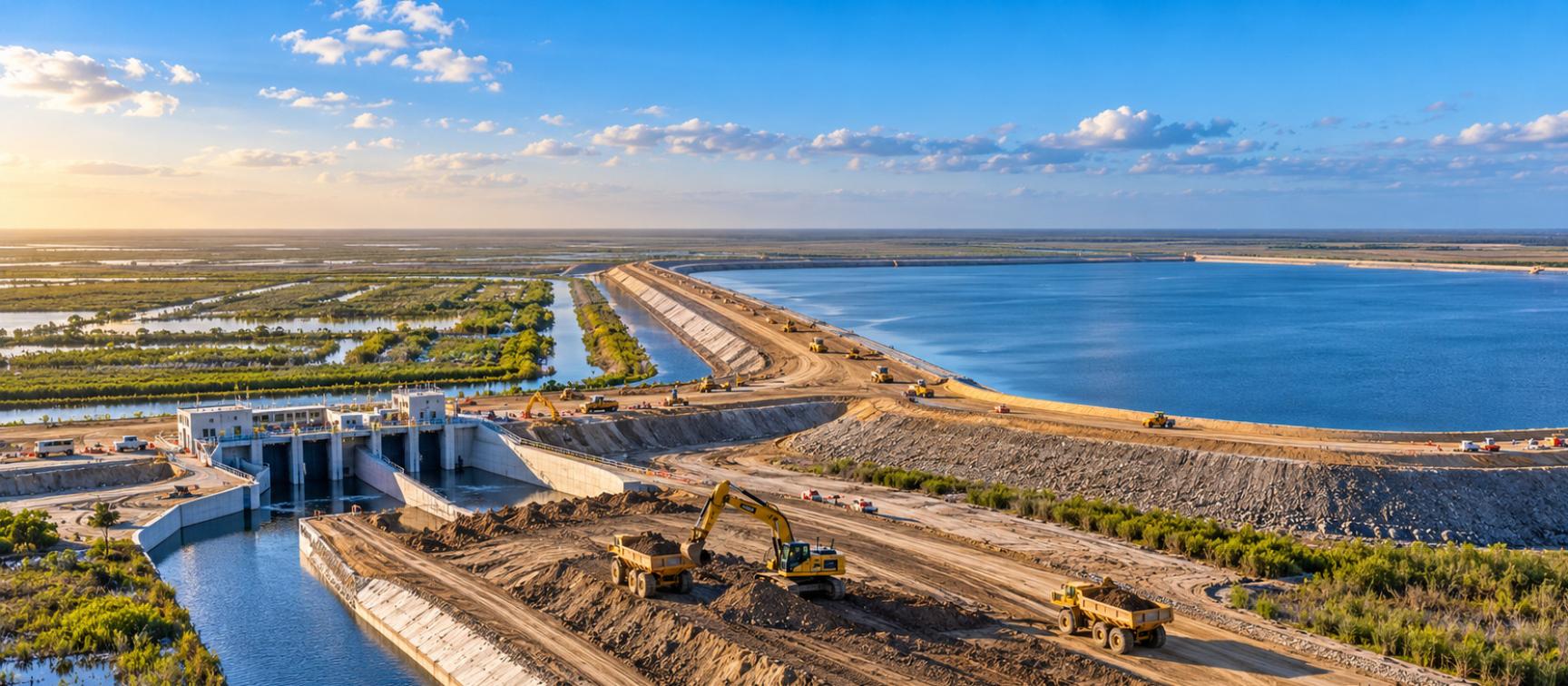
Inside Florida's EAA Reservoir: The Major Construction Project Helping Restore the Everglades
South of Lake Okeechobee, one of the largest water infrastructure and environmental restoration projects in the United States is taking shape. The Everglades Agricultural Area (EAA) Reservoir Project is transforming thousands of acres of South Florida land into a major water storage and treatment system designed to improve the movement of freshwater through the Everglades.
The project combines a 10,500-acre reservoir capable of storing 240,000 acre-feet of water with a 6,500-acre stormwater treatment area, extensive embankments, canals, pumping stations and water control structures.
The construction effort is substantial. Contractors are developing a reservoir surrounded by approximately 18 miles of embankments, with major earthworks, foundation preparation and structural construction taking place across the site.
In April 2026, the U.S. Army Corps of Engineers confirmed that the project was progressing toward an accelerated 2029 construction completion target, five years earlier than the previous schedule.
For the U.S. heavy civil construction industry, the EAA Reservoir represents a significant example of the engineering, equipment and specialist expertise required to deliver major water infrastructure while supporting one of the country's most important environmental restoration programs.
Why Florida Is Building the EAA Reservoir
The Florida Everglades once formed part of an extensive natural water system, with freshwater flowing gradually south from Lake Okeechobee through wetlands and into Florida Bay.
Over decades, the construction of canals, levees and other water management infrastructure changed how water moved across South Florida. Much of this infrastructure was developed to support agriculture, flood protection and expanding communities.
Although these systems provide important benefits, they have also altered the natural movement of freshwater through the Everglades.
During periods of heavy rainfall, excess water from Lake Okeechobee may need to be discharged east and west through the St. Lucie and Caloosahatchee estuaries. These releases can affect the ecological balance of coastal waterways, while the Everglades farther south may not receive the freshwater it needs.
The EAA Reservoir Project is intended to help address that imbalance.
By capturing and storing water south of Lake Okeechobee, the system will allow more freshwater to be directed toward the central and southern Everglades when conditions require it.
The project is a major component of the Comprehensive Everglades Restoration Plan (CERP), a long-term partnership between the federal government and the State of Florida to improve water quality, restore natural water flows and protect the region's ecosystems.
A 10,500-Acre Reservoir Designed to Store 78 Billion Gallons
The reservoir itself is one of the most substantial components of the construction program.
Once completed, it will cover approximately 10,500 acres and hold up to 240,000 acre-feet of water, equivalent to more than 78 billion gallons.
Unlike a conventional reservoir formed by constructing a dam across a valley, the EAA Reservoir is being developed on relatively flat land within the Everglades Agricultural Area.
This requires a different engineering approach.
Rather than relying on surrounding hillsides to contain the stored water, contractors are constructing an extensive perimeter embankment system to create the reservoir's storage capacity.
The embankments will extend approximately 17.75 miles around the reservoir, reaching heights of up to 38 feet.
Constructing these structures requires extensive excavation, foundation preparation, material processing and carefully controlled placement of engineered fill.
The project also includes water control structures, spillways and supporting infrastructure that will allow operators to manage water entering and leaving the reservoir.
For heavy civil contractors, the scale of the work creates substantial requirements for earthmoving equipment, construction planning, surveying and quality control.
One of Florida's Largest Earthmoving Operations
One of the defining features of the EAA Reservoir is the amount of material that must be excavated, processed and placed to construct the reservoir embankments.
According to the U.S. Army Corps of Engineers, the project involves approximately 33.2 million cubic yards of excavation, equivalent to hundreds of thousands of truckloads of material.
The construction site is operating on a scale more commonly associated with major mining operations or large dam construction programs.
Excavators, draglines, haul trucks, dozers, graders and compactors are being used to prepare the site, excavate material and construct the embankments.
One particularly interesting aspect of the project is the use of large draglines to support excavation and material handling.
These machines are well suited to substantial earthmoving operations where large quantities of material need to be removed from designated areas.
The construction team must carefully manage the movement of material between excavation areas, processing locations and embankment construction zones.
Material quality is especially important because the completed embankments must safely retain substantial volumes of water.
Contractors need to ensure that the materials used meet engineering specifications and that placement, moisture control and compaction are completed to the required standards.
For Project Managers and Earthworks Superintendents, maintaining productivity across an operation of this scale while meeting strict quality and safety requirements is a considerable challenge.
A Major Construction Milestone in 2026
Construction activity reached a significant milestone in 2026 when the U.S. Army Corps of Engineers completed one of the project's largest controlled rock excavation operations.
The operation involved approximately 2,700 drilled holes and 140,000 pounds of explosive material, moving nearly 270,000 cubic yards of material in a single carefully planned event.
The excavated material is being processed for use in the reservoir's embankment construction, reducing the need to transport equivalent quantities of material from external sources.
This approach demonstrates how major earthworks projects can make use of suitable materials available within the construction site.
It also highlights the importance of specialist planning and safety management when undertaking large-scale rock excavation.
Controlled blasting operations require detailed engineering, monitoring, exclusion zones and coordination between drilling teams, explosives specialists, equipment operators and site management.
Following excavation, the material must still be processed and assessed before being incorporated into the permanent embankment structures.
For the construction industry, the milestone provides a clear indication of the scale of operations underway at the EAA Reservoir site.
The Engineering Behind the Reservoir Embankments
The reservoir's perimeter embankments are among the most technically important elements of the project.
Their purpose is straightforward: safely contain billions of gallons of stored water. Achieving that requires extensive geotechnical engineering, foundation preparation and quality-controlled construction.
The U.S. Army Corps of Engineers divided the reservoir construction into several major contracts.
Contract 11A focuses on foundation preparation and cutoff wall construction, while Contract 11B covers the embankments, outlet structures and spillways.
The foundation works are particularly important because water storage structures must be designed to control seepage through and beneath their foundations.
Cutoff walls and other seepage control measures help reduce the movement of water through underlying ground conditions, protecting the long-term stability and performance of the reservoir.
Once foundation sections have been prepared, embankment construction can progress.
This requires careful coordination between excavation, material processing, placement and testing teams.
The project also includes four gated outlet structures, an ungated overflow spillway and a multibay gated spillway, allowing water levels and releases to be managed under different operating conditions.
These structures introduce substantial reinforced concrete, mechanical and water control construction alongside the main earthworks.
Building the Canals That Connect the System
Although the reservoir receives much of the attention, the surrounding canal infrastructure is equally important.
The project requires a network capable of transporting water into the reservoir, moving it toward treatment facilities and ultimately directing it south through the wider Everglades system.
In September 2025, the U.S. Army Corps of Engineers celebrated the completion of Contract 10A, which included approximately 8.3 miles of inflow and outflow canal, a seepage canal and an associated maintenance road.
These facilities form essential connections between the reservoir and the surrounding water management network.
Canal construction involves significant excavation, embankment formation, grading, erosion protection and the installation of associated control infrastructure.
In South Florida, contractors must also consider groundwater conditions, drainage management and the potential effects of heavy rainfall during construction.
Completing the canal works ahead of the reservoir's main structures represents an important milestone, allowing subsequent construction packages to progress toward eventual system integration.
A Pumping Station Capable of Moving 3 Billion Gallons Per Day
One of the most significant remaining elements is the reservoir's inflow pumping infrastructure.
In November 2025, the South Florida Water Management District broke ground on the EAA Reservoir Inflow Pump Station.
The facility is designed to move approximately 3 billion gallons of water per day into the reservoir when required.
Constructing a pumping station of this capacity involves major civil, structural, mechanical and electrical engineering.
Large pumps, reinforced concrete structures, intake and discharge systems, valves, electrical equipment and automated controls must all be designed to operate reliably under changing water management conditions.
The facility will also need to integrate with the reservoir, canals and wider water management network.
For construction teams, this requires close coordination between civil contractors, mechanical installation specialists, electrical engineers and instrumentation and controls professionals.
The pumping station is being delivered by the South Florida Water Management District as part of the wider division of responsibilities between the state and federal project partners.
Its completion will be essential to the reservoir's operation, allowing large volumes of water to be moved into storage during appropriate conditions.
The 6,500-Acre Stormwater Treatment Area
Storing water is only one part of the EAA Reservoir Project. Improving water quality is equally important.
Alongside the reservoir, the South Florida Water Management District has developed a 6,500-acre stormwater treatment area, designed to remove nutrients from water before it is released toward the Everglades.
The treatment area uses constructed wetlands to improve water quality through natural biological and physical processes.
This is particularly important because elevated phosphorus concentrations can affect the Everglades' sensitive ecosystems.
The stormwater treatment area includes engineered treatment cells, canals, embankments and water control structures that regulate the movement of water through the wetlands.
Construction began in 2020, and the District started filling the treatment area in January 2024.
The facility subsequently entered an operational testing and monitoring phase, allowing its performance to be assessed while work on the reservoir continues.
The integration of the reservoir and treatment wetlands is a defining feature of the project.
Water can be stored when it is available, treated to improve its quality and released south when it is needed.
This combination of large-scale civil infrastructure and environmental treatment systems makes the EAA Reservoir different from a conventional water storage development.
Accelerating Construction Toward 2029
The EAA Reservoir Project has progressed significantly in recent years, with federal and state agencies working to accelerate delivery.
In July 2025, the State of Florida and the U.S. Department of the Army reached an agreement intended to bring the reservoir's completion forward by five years.
The previous target of 2034 was replaced with an accelerated 2029 construction completion goal.
In April 2026, the U.S. Army Corps of Engineers confirmed that the remaining federally managed construction contracts required to support the accelerated schedule had been executed.
The updated program places considerable importance on coordinating the remaining foundation works, embankment construction, pumping facilities and water control structures.
According to the Corps, Contract 11A, covering the reservoir foundation, is scheduled for completion by March 2028, while Contract 11B, involving the embankments and water control structures, has a required completion date of December 2029.
The accelerated schedule creates additional demands for construction planning, equipment availability, workforce coordination and the management of interfaces between separate contracts.
Although the target reflects significant progress, successful delivery will depend on completing the remaining infrastructure and integrating the system safely and effectively.
The Construction Professionals Behind the Project
The EAA Reservoir demonstrates the range of specialist construction experience required to deliver major water management infrastructure.
Heavy Civil Project Managers are responsible for overseeing complex construction packages, coordinating subcontractors, managing budgets and maintaining progress against demanding schedules.
Earthworks Superintendents play a particularly important role in organizing excavation, material processing, haulage and embankment construction across the extensive site.
Project Engineers support technical coordination, construction documentation, quality requirements and the management of interfaces between design and field operations.
Estimators and Schedulers are also essential, particularly where construction involves substantial equipment fleets, multiple work areas and complex dependencies between contractors.
The project requires experienced geotechnical specialists, surveyors, safety professionals and quality control personnel to ensure that foundation preparation and embankment construction meet the required standards.
As pumping stations and water control facilities progress, mechanical, electrical and instrumentation specialists will become increasingly important.
For construction professionals working in the U.S. heavy civil and water infrastructure sectors, projects like the EAA Reservoir offer exposure to major earthworks, dam construction, water conveyance systems and multidisciplinary infrastructure delivery.
Restoring the Flow of Water Through the Everglades
The EAA Reservoir is ultimately about improving how water moves through South Florida.
For decades, the region's water management infrastructure has played an essential role in supporting communities, agriculture and flood protection. However, those changes have also altered the natural freshwater flows on which the Everglades depends.
The reservoir and treatment area are intended to help restore part of that balance.
By capturing excess water, improving its quality and allowing more freshwater to move south, the project aims to reduce harmful discharges to coastal estuaries while supporting the health of the central Everglades and Florida Bay.
Delivering those benefits requires an extraordinary construction effort.
A 10,500-acre reservoir, nearly 18 miles of embankments, millions of cubic yards of earthworks, major pumping infrastructure and thousands of acres of treatment wetlands must operate together as one integrated water management system.
With construction advancing and the project targeting completion in 2029, the EAA Reservoir represents one of the most significant heavy civil and environmental restoration programs underway in the United States.
For the construction industry, it highlights the engineering expertise, specialist equipment and experienced professionals required to deliver infrastructure on this scale.
For South Florida, it represents an important investment in the long-term health of the Everglades and the water systems that support surrounding communities.
At Approach Talent USA, we specialize in recruitment across the U.S. water, wastewater and heavy civil construction sectors. We work with contractors seeking experienced Project Managers, Superintendents, Project Engineers, Estimators and other construction professionals to deliver major infrastructure projects throughout the United States.
Recent News
Inside California's $6 Billion Sites Reservoir: Building One of America's Largest New Water Storage Projects
Expert Advice to Prepare for a Construction Job Interview: Building Your Career in the U.S.
Inside Tampa Bay's $181 Million Water Treatment Expansion: Building for Florida's Future