

Inside the $3.2 Billion Fargo-Moorhead Flood Diversion: Building One of America's Largest Flood Protection Projects
Across the Red River Valley, on the border between North Dakota and Minnesota, one of the most ambitious flood protection projects in the United States is transforming the landscape.
The $3.2 billion Fargo-Moorhead Area Diversion Project is creating an extensive flood management system designed to protect Fargo, North Dakota, Moorhead, Minnesota, and surrounding communities from the devastating effects of major flooding.
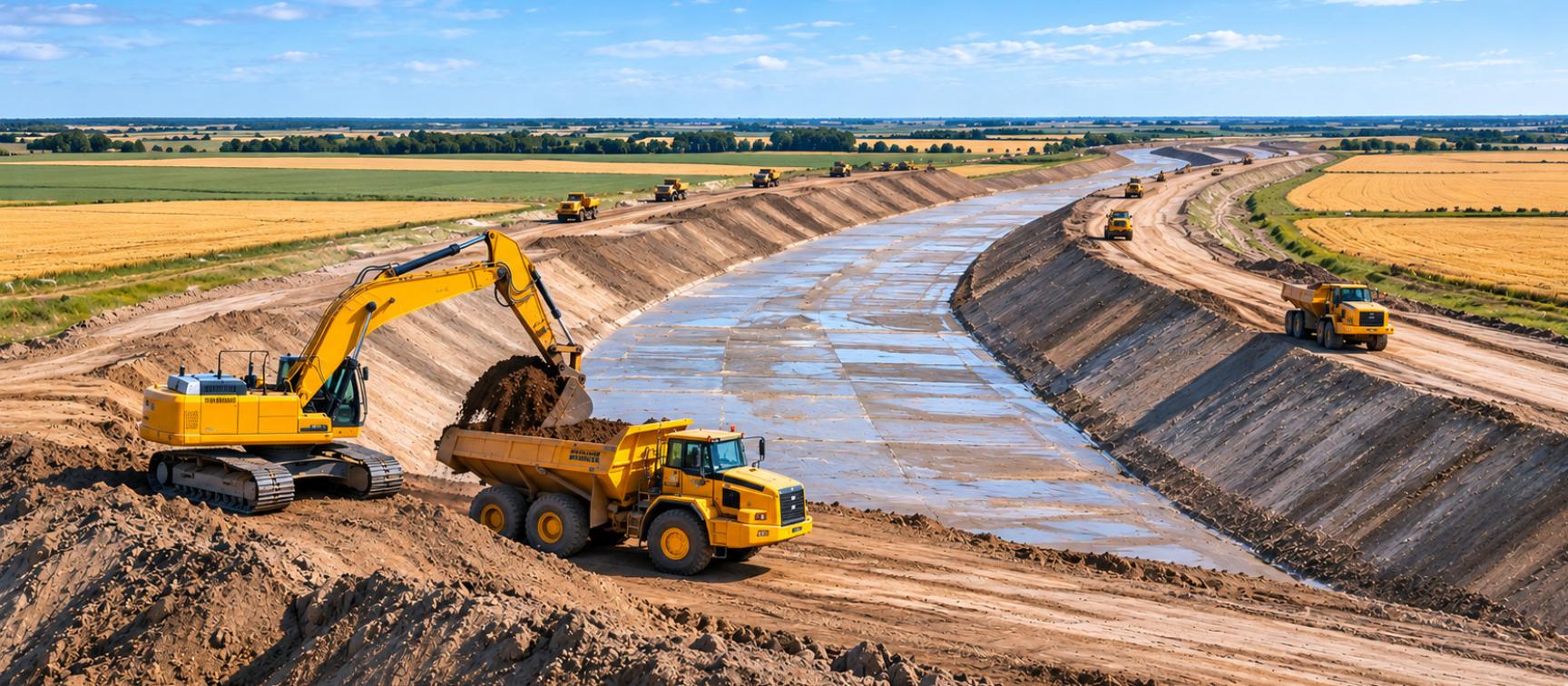
At the center of the program is a 30-mile diversion channel, supported by embankments, water control structures, aqueducts, bridges and associated highway infrastructure. Together, these components will provide an alternative route for floodwater, reducing pressure on the Red River as it passes through the metropolitan area.
The project is particularly significant because of the scale of its construction operations. Excavating the diversion channel requires moving tens of millions of cubic yards of material, while contractors must simultaneously deliver major bridge structures, hydraulic facilities and road connections across a substantial geographical area.
Unlike conventional flood defense schemes that rely primarily on strengthening existing riverbanks, the Fargo-Moorhead project involves constructing an entirely new system for managing floodwater.
For the U.S. heavy civil construction industry, it represents a major example of the engineering expertise, specialist equipment and experienced construction professionals required to deliver infrastructure designed to protect communities for generations.
Why Fargo and Moorhead Need Major Flood Protection
The Red River of the North has a long history of flooding, particularly during spring when melting snow and rainfall combine to increase river levels.
The geography of the Red River Valley makes the region especially vulnerable. The surrounding landscape is remarkably flat, meaning floodwater can spread across extensive areas when river levels rise.
Unlike many rivers in the United States, the Red River flows north toward Canada. During spring, snow and ice can remain farther downstream while southern sections of the watershed begin to thaw, creating additional challenges for water movement.
Fargo and Moorhead have experienced several major floods over the past century, with particularly serious events in 1997, 2009 and 2011.
The 2009 flood was especially significant, with the Red River reaching a record crest of approximately 40.8 feet at Fargo.
Thousands of residents, emergency responders and volunteers worked to construct temporary flood barriers and protect homes, businesses and essential infrastructure.
Although the communities successfully avoided some of the worst potential damage, the event highlighted the enormous financial and operational burden of relying on emergency flood protection measures.
The Fargo-Moorhead Area Diversion Project was developed to provide a more permanent solution.
Rather than repeatedly constructing temporary defenses during major flood events, the system will redirect substantial volumes of water around the metropolitan area, reducing flood levels and improving long-term resilience.
The completed project is designed to provide protection against a 100-year flood event, with additional features intended to manage larger events.
For a growing region with important transportation routes, agricultural operations and commercial activity, the investment is about more than protecting individual properties. It is intended to provide greater certainty for future development and economic growth.
What Is Being Built?
The Fargo-Moorhead Area Diversion Project is a complex system of interconnected infrastructure rather than a single construction site.
Its main components include a 30-mile diversion channel running west of Fargo, a southern embankment system, three major river control structures and numerous bridges, aqueducts and drainage facilities.
The diversion channel will provide a new route for floodwater around the western side of the metropolitan area before reconnecting with the Red River downstream.
To manage how water enters the system, the project includes control structures on the Red River and the Wild Rice River, along with a diversion inlet structure.
During major flood events, these facilities will regulate water movement, allowing a portion of the flow to be temporarily managed upstream before being directed through the diversion channel.
The southern embankment, approximately 22 miles long, is another essential component.
This structure helps create a temporary water storage area during major floods, allowing the system to control water levels and release flows through the diversion infrastructure.
The project also includes major transportation improvements where the new channel intersects existing roads and railways.
These crossings are essential because the diversion channel cuts across a large section of the regional transportation network.
For contractors, the challenge is to construct all of these elements so they operate as one integrated flood management system.
A completed channel alone cannot provide the intended protection without the associated control structures, embankments and connections.
This makes construction sequencing, interface management and commissioning particularly important.
Excavating a 30-Mile Flood Diversion Channel
The diversion channel is the largest and most visually impressive part of the construction program.
Extending approximately 30 miles through the Red River Valley, the channel requires substantial excavation across agricultural land and other relatively flat terrain.
The main channel is designed to carry large volumes of floodwater during significant events, with its dimensions varying according to local engineering and hydraulic requirements.
Construction involves removing enormous quantities of soil, forming the channel slopes and preparing the base to the required design profile.
The project requires approximately 45 million cubic yards of excavation, making it one of the largest earthmoving operations associated with a flood protection project in the United States.
To put that into perspective, the volume is equivalent to millions of conventional dump truck loads.
However, moving material on this scale is not simply a matter of deploying more equipment.
Contractors must carefully plan excavation sequences, material handling, haul routes, equipment maintenance and the placement or disposal of excavated soils.
The flat landscape creates advantages for equipment access, but it also presents challenges involving groundwater, drainage and the management of wet or unsuitable materials.
During periods of heavy rainfall or snowmelt, ground conditions can deteriorate rapidly, affecting the productivity of excavation and hauling operations.
For Earthworks Superintendents and Heavy Civil Project Managers, maintaining efficient equipment utilization across such a large construction corridor is a major operational challenge.
The project also requires extensive surveying and quality control to ensure that the completed channel meets the specified dimensions, slopes and hydraulic performance requirements.
Even relatively small deviations in grading can become significant when repeated across 30 miles of infrastructure.
The Engineering Behind the Southern Embankment
While the diversion channel provides a route for floodwater, the southern embankment is designed to help control how water enters the system.
The approximately 22-mile embankment extends across parts of North Dakota and Minnesota, forming a critical element of the upstream flood management area.
During major flood events, the system will temporarily store water upstream of the embankment before directing it through the control structures and diversion channel.
Constructing such an extensive embankment requires detailed geotechnical engineering.
The foundation must be prepared to support the structure, while the embankment materials need to meet strict requirements for strength, permeability and long-term stability.
Contractors must manage excavation, foundation treatment, material placement and compaction over a considerable distance.
Because the structure will retain water during flood events, controlling seepage and preventing erosion are essential design considerations.
Drainage features, erosion protection and associated structures must be incorporated into the works to ensure the embankment performs as intended.
The length of the embankment also creates logistical challenges.
Construction teams may be operating at numerous locations simultaneously, requiring coordinated material deliveries, equipment movements and inspection activities.
For Project Engineers and Quality Control professionals, maintaining consistent standards across such a large work area is critical.
Constructing the Water Control Structures
The project's hydraulic control structures are among its most technically demanding elements.
These facilities are designed to regulate water movement through the flood protection system, allowing operators to manage flows during major flood events.
The Red River Structure and Wild Rice River Structure are particularly important because they control water movement along the existing river channels.
The diversion inlet structure provides another critical connection, allowing floodwater to enter the new channel.
Construction involves substantial reinforced concrete works, deep excavation, foundation preparation and the installation of large mechanical gates and operating equipment.
These structures must be designed to withstand significant hydraulic forces while remaining reliable during infrequent but potentially severe flood events.
The work also involves integrating the structures with existing waterways, requiring careful management of temporary water diversion, erosion protection and environmental conditions.
Unlike conventional buildings or highway structures, hydraulic control facilities must be constructed with particular attention to watertightness, durability and long-term operational reliability.
Gate mechanisms, electrical systems and monitoring equipment must function correctly when required, even after extended periods without major flood activity.
Testing and commissioning will therefore be an important part of the final construction program.
For contractors, these facilities combine heavy civil construction with specialist mechanical, electrical and hydraulic engineering.
Building Bridges Across the Diversion Channel
One of the most significant consequences of constructing a new 30-mile waterway is the need to maintain existing transportation connections.
The diversion channel crosses several major highways, county roads and railroad routes.
As a result, the project includes two interstate highway crossings, 12 county road crossings and three railroad crossings.
These structures are essential to maintaining regional connectivity once the channel is operational.
Bridge construction involves piling and foundation works, reinforced concrete structures, structural steel or precast components, deck construction and associated highway improvements.
The crossings must be designed to span the diversion channel while accommodating the required floodwater capacity.
For highway and railroad contractors, maintaining traffic and rail operations during construction is a major consideration.
In some locations, temporary access routes or staged construction arrangements are required to allow new structures to be built safely.
The project also involves substantial coordination between the diversion construction teams, transportation authorities and railroad operators.
Bridge foundations and structures must be completed in accordance with the overall channel excavation sequence, creating dependencies between different construction packages.
For Bridge Superintendents, Project Managers and Schedulers, managing these interfaces is an important part of delivering the program efficiently.
A Major Public-Private Partnership
One of the most interesting aspects of the Fargo-Moorhead Area Diversion Project is its delivery model.
The project is being delivered through a combination of traditional public construction contracts and a major public-private partnership.
The Metro Flood Diversion Authority is responsible for overseeing the overall program, working alongside the U.S. Army Corps of Engineers and other project partners.
The 30-mile diversion channel and associated infrastructure are being delivered through a public-private partnership with the Red River Valley Alliance, a consortium led by ACCIONA and other infrastructure partners.
The agreement includes the design, construction, financing, operation and maintenance of the diversion channel infrastructure.
This model allows the project authority to combine private-sector construction expertise with long-term operational responsibilities.
It also places significant importance on lifecycle performance.
Contractors are not simply constructing infrastructure to meet an immediate completion milestone. The project must also be designed and delivered to perform reliably over many decades.
For construction management teams, this creates a strong connection between engineering decisions, construction quality, maintenance requirements and long-term asset performance.
The U.S. Army Corps of Engineers is delivering major components of the southern embankment and associated control structures through separate construction contracts.
Coordinating these different delivery arrangements is a significant part of the overall project management challenge.
The Challenges of Construction in the Red River Valley
The Red River Valley presents a distinctive construction environment.
The landscape is relatively flat, with extensive agricultural land and soils that can become difficult to work during wet conditions.
Construction activities must also contend with North Dakota and Minnesota's demanding seasonal weather.
Winters can bring prolonged freezing temperatures, snow and frozen ground, while spring thaw and heavy rainfall can affect access and earthmoving productivity.
These conditions make construction scheduling particularly important.
Contractors must plan major excavation, embankment placement and concrete operations around periods when weather and ground conditions are suitable.
The size of the project adds another layer of complexity.
Construction activities are spread across a corridor extending for dozens of miles, meaning equipment, materials and personnel must be coordinated between multiple work locations.
Large earthmoving fleets require significant maintenance support, fuel supplies and logistical planning.
At the same time, construction teams must manage environmental requirements, landowner interfaces and the protection of existing drainage and agricultural infrastructure.
For Project Managers and Superintendents, maintaining consistent progress across such a large and geographically dispersed program requires strong communication, detailed planning and experienced field leadership.
Construction Progress and the Road to Completion
Construction of the Fargo-Moorhead Area Diversion Project has progressed across multiple major packages since the program moved into its principal delivery phase.
Work on the southern embankment and control structures has advanced alongside construction of the diversion channel and associated transportation crossings.
The Red River Valley Alliance began major channel construction following financial close on the public-private partnership in 2022.
Since then, contractors have undertaken extensive site preparation, excavation, bridge construction and infrastructure development along the diversion alignment.
The overall program is targeting completion in 2027, with the diversion channel and associated facilities scheduled to become operational once the required construction, integration and commissioning activities are complete.
The remaining work includes continued channel excavation, completion of transportation crossings, final embankment works and the integration of the hydraulic control structures.
The project also requires extensive testing to ensure the system operates as intended.
Because the infrastructure is designed to manage major flood events, the finished system must be capable of performing reliably under conditions that may occur only occasionally.
This makes commissioning and operational readiness particularly important.
The project's completion will represent a major milestone for Fargo, Moorhead and the surrounding communities, providing a permanent flood protection system developed through years of engineering, planning and construction.
The Construction Professionals Behind the Project
Major heavy civil programs such as the Fargo-Moorhead Area Diversion require experienced professionals across a broad range of construction disciplines.
Heavy Civil Project Managers are responsible for overseeing construction packages, managing budgets, coordinating subcontractors and maintaining progress against demanding schedules.
Earthworks Superintendents play a central role in organizing excavation, hauling, grading and embankment construction across the extensive project corridor.
Project Engineers support technical coordination, construction documentation, quality requirements and the interfaces between design teams and field operations.
Estimators and Schedulers are essential to managing equipment resources, construction costs and the complex dependencies between excavation, structures and transportation works.
The project also requires experienced Bridge Superintendents, Civil Construction Managers, Surveyors, Geotechnical Engineers, Safety Managers and Quality Control professionals.
As the hydraulic structures progress toward completion, mechanical, electrical and commissioning specialists become increasingly important.
For construction professionals working in the U.S. heavy civil sector, projects like Fargo-Moorhead offer valuable experience in major earthworks, hydraulic infrastructure, bridge construction and the delivery of large-scale public infrastructure programs.
Protecting Communities Through Major Infrastructure Investment
The Fargo-Moorhead Area Diversion Project is one of the most significant flood protection investments currently underway in the United States.
By constructing a 30-mile diversion channel, a substantial southern embankment and an integrated network of hydraulic control structures, the program aims to reduce the impact of major flooding on communities along the Red River.
Its engineering challenges are considerable.
Contractors must excavate tens of millions of cubic yards of material, construct major bridges and hydraulic structures, manage challenging ground conditions and coordinate construction activities across a large geographical area.
The project also demonstrates how modern infrastructure delivery can combine public investment, private-sector expertise and long-term operational planning.
With construction progressing toward its targeted completion, the Fargo-Moorhead diversion is becoming an important example of how major civil engineering can improve community resilience.
For the U.S. construction industry, it highlights the expertise, specialist equipment and experienced construction professionals required to deliver infrastructure on an extraordinary scale.
For Fargo, Moorhead and the surrounding region, it represents a long-term investment in protecting homes, businesses, transportation networks and the communities that depend on them.
At Approach Talent USA, we specialize in recruitment across the U.S. heavy civil, water, wastewater and infrastructure construction sectors. We work with contractors seeking experienced Project Managers, Superintendents, Project Engineers, Estimators, Schedulers and construction leaders to deliver major infrastructure projects throughout the United States.
Recent News
Inside the $16 Billion Hudson Tunnel Project: Building a New Rail Connection Beneath the Hudson River
Inside Virginia's $3.9 Billion Hampton Roads Bridge-Tunnel Expansion: Building Beneath One of America's Busiest Waterways
Inside Florida's EAA Reservoir: The Major Construction Project Helping Restore the Everglades