

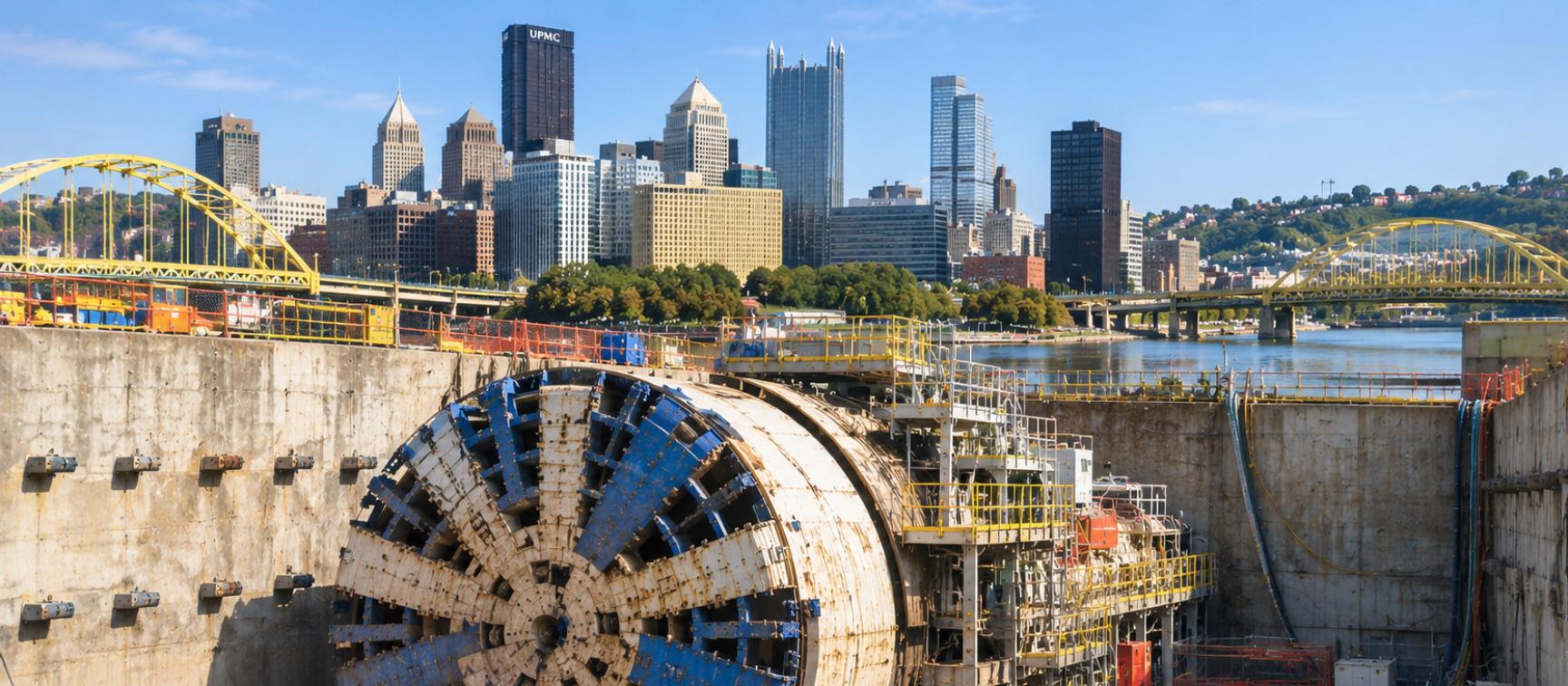
Inside Pittsburgh's $1 Billion Ohio River Tunnel: Building a Major Underground Wastewater System
Deep beneath Pittsburgh, Pennsylvania, one of the city's most ambitious wastewater infrastructure projects is beginning to take shape.
The $1 billion Ohio River Tunnel Project is the first major component of a planned underground tunnel network designed to reduce sewage overflows into Pittsburgh's three rivers.
On October 22, 2026, the Allegheny County Sanitary Authority (ALCOSAN) officially broke ground on the project, marking the start of a significant new phase in the region's wastewater infrastructure investment.
The work will involve constructing approximately five miles of underground tunnels, deep access shafts, hydraulic structures and associated surface infrastructure.
The main tunnel will run beneath the Ohio River corridor, capturing excess wastewater during heavy rainfall and temporarily storing it until the treatment system has sufficient capacity to process it.
Construction is being delivered by Steel City Tunnel Partners, a joint venture between The Lane Construction Corporation, a subsidiary of Webuild, and Brayman Construction Corporation.
For the U.S. heavy civil construction industry, the project represents a substantial engineering undertaking, combining tunnel boring, deep excavation, reinforced concrete construction and complex underground infrastructure.
It also highlights the growing importance of major wastewater investment across America's older cities, where existing sewer systems are being modernized to meet environmental requirements and protect waterways.
Why Pittsburgh Needs a New Wastewater Tunnel
Pittsburgh's identity has always been closely connected to its rivers.
The Allegheny and Monongahela Rivers meet in the heart of the city to form the Ohio River, creating one of the most recognizable river landscapes in the United States.
These waterways have supported Pittsburgh's industrial development, transportation networks and economic growth for generations.
However, the city's aging wastewater infrastructure presents significant environmental challenges.
Like many older American cities, Pittsburgh has areas served by combined sewer systems.
These systems collect both domestic wastewater and stormwater through the same network of pipes.
During normal weather conditions, the system transports wastewater to treatment facilities, where pollutants are removed before the treated water is discharged.
During periods of heavy rainfall, however, the volume of water entering the network can exceed the capacity of the existing infrastructure.
When this happens, combined sewer overflows can release untreated wastewater mixed with stormwater into local waterways.
These discharges can affect water quality, aquatic ecosystems and recreational use of the rivers.
The problem is not unique to Pittsburgh.
Cities including Cleveland, Washington, D.C., Indianapolis and St. Louis have invested in major underground storage tunnels to reduce combined sewer overflows.
For ALCOSAN, the Ohio River Tunnel is a central part of a long-term strategy to improve wastewater management across the Pittsburgh region.
Rather than relying entirely on expanding the capacity of existing pipes, the project will create substantial underground storage that can capture excess flows during storms.
This allows wastewater to be retained and treated later, reducing the amount discharged directly into the rivers.
What Is Being Built?
The Ohio River Tunnel Project involves constructing a network of deep underground tunnels and associated hydraulic infrastructure.
The principal component is the Ohio River Tunnel itself, which will extend approximately 3.7 miles beneath the Pittsburgh area.
The main tunnel will have an excavation diameter exceeding 16 feet and will be constructed at depths generally ranging from approximately 120 to 150 feet below ground.
Two smaller connecting tunnels will form part of the same construction program.
The Chartiers Creek Tunnel will extend approximately 0.8 miles, while the Saw Mill Run Tunnel will measure approximately 0.3 miles.
Together, the tunnels will provide approximately five miles of underground infrastructure designed to capture and convey excess wastewater.
The construction scope also includes deep access shafts, flow regulation structures, two technical buildings and a new river outfall.
These elements are essential to the operation of the system.
The tunnels must connect to existing wastewater infrastructure, allowing excess flows to enter the underground network when rainfall increases.
Water can then be stored temporarily before being conveyed to ALCOSAN's wastewater treatment facility for processing.
Constructing the tunnels is therefore only one part of the challenge.
The project must also integrate new underground infrastructure with existing sewer networks, pumping facilities and treatment operations.
For Project Managers and Construction Superintendents, coordinating these connections will be a critical element of delivery.
The Engineering Behind the Tunnel Boring Operation
One of the most technically demanding aspects of the project will be the excavation of the main Ohio River Tunnel.
Construction will use a tunnel boring machine (TBM), a specialized piece of equipment designed to excavate underground tunnels while supporting the surrounding ground.
The machine will work at significant depths beneath Pittsburgh, advancing through the geological conditions encountered along the alignment.
Unlike conventional open excavation, tunnel boring allows major underground infrastructure to be constructed while limiting disruption to buildings, roads and existing services at the surface.
However, operating a TBM requires extensive planning and engineering.
Before excavation begins, contractors must construct a launch shaft large enough to accommodate the machine and associated equipment.
The TBM is then assembled and lowered into position before excavation can begin.
As the machine advances, excavated material must be removed from the tunnel through a carefully coordinated system of conveyors, rail equipment or other material handling arrangements, depending on the final construction methodology.
The tunnel must also be supported to maintain ground stability and provide the structural integrity required for long-term operation.
Tunnel lining systems, waterproofing and connections to the access shafts are important parts of the construction process.
Groundwater management is another significant consideration.
At depths exceeding 100 feet, contractors must account for groundwater pressure and the potential movement of water through surrounding geological formations.
Geotechnical investigations help engineers understand the ground conditions and determine the most suitable excavation and support methods.
For tunneling specialists, maintaining consistent TBM performance while managing changing geological conditions is one of the most important challenges.
Even relatively small interruptions can have substantial consequences for the schedule when a machine is operating deep underground.
Constructing the Deep Access Shafts
Before the main tunneling operation can begin, contractors must construct the access shafts required to launch and receive the tunnel boring machine.
These shafts provide access to the underground alignment and allow construction teams to transport equipment, materials and personnel between the surface and the tunnel.
They also provide essential connections to the wider wastewater network.
Constructing shafts more than 100 feet deep requires specialized excavation and ground support techniques.
Depending on the geological conditions and final design, construction may involve reinforced concrete shaft walls, temporary excavation support, groundwater control and substantial lifting operations.
The work must be carried out within a restricted footprint while maintaining safe access for personnel and equipment.
Excavated material needs to be lifted to the surface and transported away from the site.
Large cranes, specialist lifting systems and heavy construction equipment are therefore important components of shaft construction.
The project also requires careful planning around existing utilities and surrounding infrastructure.
In an established urban environment, contractors may encounter underground services, transportation routes and structures that influence where shafts can be constructed.
For Heavy Civil Superintendents and Project Engineers, deep shaft construction requires a strong understanding of excavation support, geotechnical conditions, lifting operations and construction safety.
Building Beneath an Established City
One of the defining challenges of the Ohio River Tunnel is its location.
Pittsburgh is a densely developed city with major highways, bridges, rail corridors, industrial facilities and underground utility networks.
Delivering a major tunnel project in this environment requires detailed planning.
Although most excavation will take place underground, the construction sites at the surface will support substantial operations.
Contractors will need space for equipment assembly, material storage, excavation spoil handling and construction personnel.
Truck movements must be coordinated with local traffic, while noise, vibration and other construction impacts need to be carefully managed.
The underground alignment also requires consideration of existing foundations, buried infrastructure and geological conditions.
Monitoring systems may be used to assess ground movement and identify potential impacts on nearby structures.
The project will require close coordination between construction teams, engineers, local authorities and utility operators.
For the contractor, successful delivery depends on maintaining efficient underground operations while minimizing disruption to the surrounding communities.
This balance between construction productivity and urban logistics is one of the reasons major tunneling projects require experienced management teams.
Steel City Tunnel Partners Selected to Deliver the Project
The Ohio River Tunnel is being delivered by Steel City Tunnel Partners, a 50/50 joint venture between The Lane Construction Corporation and Brayman Construction Corporation.
Lane is the U.S. subsidiary of international infrastructure group Webuild and has extensive experience delivering major tunneling and heavy civil projects.
Its previous work includes the Northeast Boundary Tunnel and Anacostia River Tunnel in Washington, D.C., as well as Seattle's Ship Canal Water Quality Project.
These projects involve underground wastewater infrastructure designed to capture excess flows and improve water quality.
Brayman Construction is a Pennsylvania-based heavy civil contractor with experience in complex infrastructure, foundations and underground construction.
The combination of Lane's major tunneling experience and Brayman's regional heavy civil expertise will be important for a project of this scale.
The construction contract was awarded in June 2026, with the official groundbreaking taking place in October.
The project will require coordination between tunneling teams, structural contractors, geotechnical specialists, mechanical and electrical subcontractors, and engineering consultants.
Managing these interfaces will be particularly important as construction progresses from shaft excavation into the main tunnel boring operations.
Construction Progress and the Road Ahead
The October 2026 groundbreaking marks the beginning of the project's principal construction phase.
The initial work will focus on preparing construction sites and developing the deep access shafts required for the tunnel boring operation.
These activities are essential because the main tunnel boring machine cannot begin excavation until the launch infrastructure is ready.
According to the project's published construction program, the main TBM is expected to arrive in late 2027.
Once assembled and commissioned, the machine will begin excavating the Ohio River Tunnel.
Construction of the connecting tunnels and associated hydraulic structures will be coordinated with the main underground works.
The project will also require substantial mechanical and electrical installations, along with connections to the existing wastewater system.
Following construction, the completed infrastructure must undergo testing and commissioning to confirm that it can safely capture, store and convey wastewater under the required operating conditions.
The project represents a multiyear construction program, with major activities extending well beyond the initial groundbreaking.
For the heavy civil industry, it provides a significant pipeline of specialist underground construction work in the Pittsburgh region.
Part of ALCOSAN's Wider Clean Water Plan
The Ohio River Tunnel is the first major component of ALCOSAN's planned Regional Tunnel System.
The wider program includes additional tunnels associated with the Allegheny and Monongahela Rivers.
Together, these underground facilities are intended to improve the capacity of the regional wastewater network and reduce overflows during major rainfall events.
The Regional Tunnel System forms part of ALCOSAN's multibillion-dollar Clean Water Plan.
This wider investment includes treatment plant improvements, sewer network upgrades and green infrastructure.
The authority's long-term program aims to reduce annual sewer overflows by approximately seven billion gallons.
This is a substantial environmental objective.
By capturing more wastewater and directing it toward treatment facilities, the system is intended to reduce pollution entering Pittsburgh's rivers.
ALCOSAN has also expanded its wastewater treatment capacity to 480 million gallons per day, representing another important element of the wider improvement program.
The tunnel infrastructure and treatment plant improvements are closely connected.
Increasing underground storage capacity allows the network to capture more wastewater during storms, while additional treatment capacity helps the authority process those flows.
For engineers and contractors, this demonstrates the importance of planning wastewater infrastructure as an integrated system rather than a series of individual construction projects.
Why Deep Tunnel Projects Require Specialist Construction Expertise
Large underground infrastructure projects demand a particularly experienced construction workforce.
Unlike conventional surface construction, tunneling involves continuous interaction between excavation equipment, geological conditions, groundwater and structural support systems.
Work must be coordinated within restricted underground environments, often with limited access and complex logistical requirements.
Safety is a major consideration.
Construction teams must manage underground access, ventilation, emergency procedures, lifting operations and the movement of heavy equipment.
Tunnel boring operations also require continuous monitoring of machine performance and ground conditions.
The excavation process must be carefully controlled to maintain productivity and protect surrounding infrastructure.
Project schedules are heavily influenced by the performance of the tunnel boring machine.
Delays involving equipment maintenance, ground conditions or material handling can affect the entire construction sequence.
This makes detailed planning and experienced field leadership particularly important.
Major tunneling projects also require specialist engineering knowledge.
Geotechnical engineers, tunnel engineers and structural specialists must work closely with construction teams to manage ground behavior and ensure the completed infrastructure meets its design requirements.
For contractors, attracting professionals with relevant underground construction experience can be one of the most important factors in successful project delivery.
The Construction Professionals Behind the Ohio River Tunnel
The Ohio River Tunnel will require experienced construction professionals across a range of heavy civil and underground infrastructure disciplines.
Heavy Civil Project Managers will be responsible for overseeing major construction packages, managing budgets, coordinating subcontractors and maintaining progress against the overall program.
Tunnel Superintendents will play a central role in managing underground excavation, coordinating TBM operations and ensuring construction activities are completed safely and efficiently.
Project Engineers will support technical coordination, construction documentation, quality control and the interface between design teams and field operations.
Estimators and Schedulers will be important throughout the project, helping manage construction costs, equipment resources and the complex dependencies between shaft construction, tunneling and hydraulic infrastructure.
The project will also require experienced Geotechnical Engineers, Shaft Construction Superintendents, Structural Engineers, Safety Managers and Quality Control professionals.
Mechanical and Electrical Construction Managers will support the installation of the systems required to operate the completed wastewater infrastructure.
As construction progresses, specialist commissioning teams will be needed to ensure the tunnel network and associated facilities perform as intended.
For professionals working in the U.S. heavy civil sector, projects like the Ohio River Tunnel provide valuable experience in deep excavation, underground engineering and the delivery of major public infrastructure.
A Major Investment in Pittsburgh's Future
The Ohio River Tunnel represents an important step toward modernizing Pittsburgh's wastewater infrastructure and improving the environmental condition of its rivers.
By constructing approximately five miles of deep underground tunnels, ALCOSAN is developing a system designed to capture excess wastewater during heavy rainfall and reduce the volume of untreated flows entering local waterways.
The engineering challenges are substantial.
Contractors must excavate deep access shafts, operate specialist tunnel boring equipment, manage complex ground conditions and construct new hydraulic infrastructure beneath an established urban environment.
The project also demonstrates the importance of long-term infrastructure planning.
Rather than relying solely on incremental improvements to existing sewer networks, Pittsburgh is investing in major underground infrastructure intended to provide benefits for decades.
With construction officially underway as of October 2026, the Ohio River Tunnel is becoming one of the most significant active wastewater tunneling projects in the United States.
For the U.S. construction industry, it highlights the specialist engineering, equipment and experienced professionals required to deliver infrastructure on this scale.
For Pittsburgh and the surrounding communities, it represents an investment in cleaner waterways, improved wastewater management and a more resilient regional infrastructure network.
At Approach Talent USA, we specialize in recruitment across the U.S. heavy civil, water, wastewater and infrastructure construction sectors. We work with contractors seeking experienced Project Managers, Superintendents, Project Engineers, Estimators, Schedulers and construction leaders to deliver major infrastructure projects throughout the United States.
Recent News
Inside the $3.2 Billion Fargo-Moorhead Flood Diversion: Building One of America's Largest Flood Protection Projects
Inside the $16 Billion Hudson Tunnel Project: Building a New Rail Connection Beneath the Hudson River
Inside Virginia's $3.9 Billion Hampton Roads Bridge-Tunnel Expansion: Building Beneath One of America's Busiest Waterways