

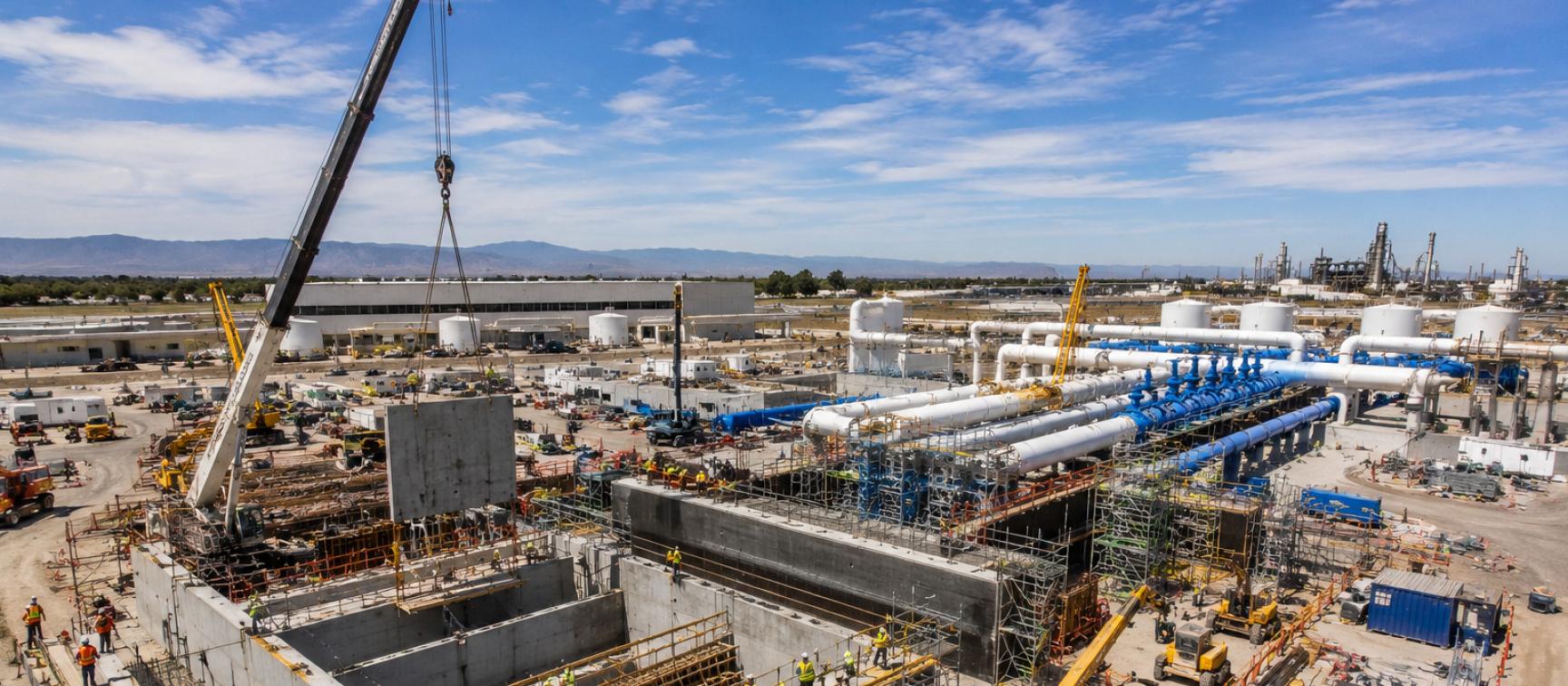
The World's Largest Water Recycling System: How Orange County's Groundwater Replenishment System Is Setting the Global Standard
As communities across the United States face increasing pressure from drought, population growth, and aging infrastructure, one California project continues to prove that innovation can solve some of the country's biggest water challenges.
The Orange County Groundwater Replenishment System (GWRS) isn't just another water treatment facility. It is the world's largest advanced water purification system for groundwater recharge and has become the benchmark for potable water reuse worldwide.
Since entering service in 2008, the system has transformed how utilities think about water security. Today, it produces up to 130 million gallons of purified water every day, enough to supply approximately one million people, while recycling 100% of Orange County's reclaimable wastewater flows.
For engineers, contractors, and construction professionals, it also demonstrates the growing demand for technically complex water infrastructure projects across the United States.
Turning Wastewater Into One of California's Most Valuable Resources
Southern California has long depended on imported water from Northern California and the Colorado River.
As drought conditions have become more frequent and demand has continued to grow, local agencies have focused on developing more resilient water supplies.
Rather than viewing treated wastewater as a resource to discharge into the Pacific Ocean, Orange County saw an opportunity to recycle it into a reliable source of drinking water.
Using advanced purification technology, highly treated wastewater undergoes multiple treatment barriers before being returned to the Orange County groundwater basin. The purified water helps replenish local aquifers, protects against seawater intrusion along the coast, and strengthens the region's long-term water supply.
Engineering on a World-Leading Scale
Few water infrastructure projects can match the scale of the Groundwater Replenishment System.
The facility now produces 130 million gallons of purified water every day, following its final expansion completed in 2023. That expansion increased capacity from 100 million gallons per day while enabling the system to recycle every available gallon of reclaimable wastewater from the adjacent sanitation district.
Since operations began, the facility has produced more than half a trillion gallons of purified water, an achievement that highlights both the reliability of the technology and its importance to Southern California's long-term water strategy.
The treatment process combines three advanced technologies:
- Microfiltration
- Reverse osmosis
- Ultraviolet light with hydrogen peroxide advanced oxidation
Together, these processes remove bacteria, viruses, pharmaceuticals, dissolved salts, and microscopic contaminants, producing water that exceeds state and federal drinking water standards before it is recharged into local aquifers.
Why Utilities Around the World Are Paying Attention
The Groundwater Replenishment System has become a global reference point for indirect potable reuse.
Utility owners, engineers, and government agencies from around the world regularly visit Orange County to study its design, operational performance, and public outreach strategy.
The success of the project has influenced similar investments across California and is helping shape water reuse programs now under development in states including Texas, Colorado, Utah, and Nevada.
With California approving regulations that support direct potable reuse, many industry experts believe Orange County's experience will continue to influence the next generation of advanced water treatment facilities across North America.
The Construction Behind the Innovation
Projects of this complexity require far more than advanced treatment technology.
The most recent expansion increased production from 100 million gallons per day to 130 million gallons per day and included major upgrades to treatment facilities, process equipment, pumps, chemical systems, electrical infrastructure, automation, and conveyance systems. Contractors also installed new blowers, chemical storage facilities, dosing equipment, and extensive mechanical and electrical components to support the additional treatment capacity.
Delivering this type of infrastructure requires close coordination between owners, designers, specialty contractors, equipment manufacturers, and commissioning teams while maintaining continuous operation of critical public infrastructure.
What It Means for Construction Hiring
Advanced water treatment facilities are among the most technically demanding projects in the heavy civil market.
Unlike conventional municipal construction, they combine complex civil engineering with sophisticated mechanical systems, electrical infrastructure, automation, instrumentation, and process engineering.
As more cities pursue water reuse and drought resilience programs, demand continues to grow for experienced:
- Project Managers
- Construction Managers
- Superintendents
- Civil Engineers
- Mechanical Engineers
- Electrical Engineers
- Instrumentation and Controls Engineers
- Process Engineers
- Commissioning Engineers
- Estimators
- Quality Control Managers
- Safety Professionals
For contractors, securing professionals with previous water and wastewater experience is becoming increasingly important as utilities invest in larger, more complex treatment facilities.
Looking Ahead
Orange County's Groundwater Replenishment System demonstrates how forward-thinking infrastructure investment can strengthen water security while reducing reliance on imported supplies.
What began as an ambitious regional project has evolved into a global example of advanced water reuse, proving that recycled water can play a central role in building resilient communities.
As municipalities across the United States accelerate investment in water reuse, groundwater recharge, and advanced treatment technologies, projects like the Groundwater Replenishment System are likely to become the blueprint for the next generation of municipal infrastructure.
For the construction industry, that means sustained investment, increasingly sophisticated engineering, and continued demand for the skilled professionals capable of delivering some of America's most important infrastructure projects.
At Approach Talent USA, we work with contractors, EPC firms, engineering consultancies, and municipal infrastructure specialists across the United States, helping them build the teams needed to deliver complex water and wastewater projects with confidence.
Recent News
Inside Austin’s $1.5 Billion Wastewater Expansion: Building for a Growing City
Why the Right Recruitment Consultant Could Be One of the Best Connections in Your Water Career
From Wastewater to Drinking Water: Inside El Paso's First-of-Its-Kind Pure Water Center