

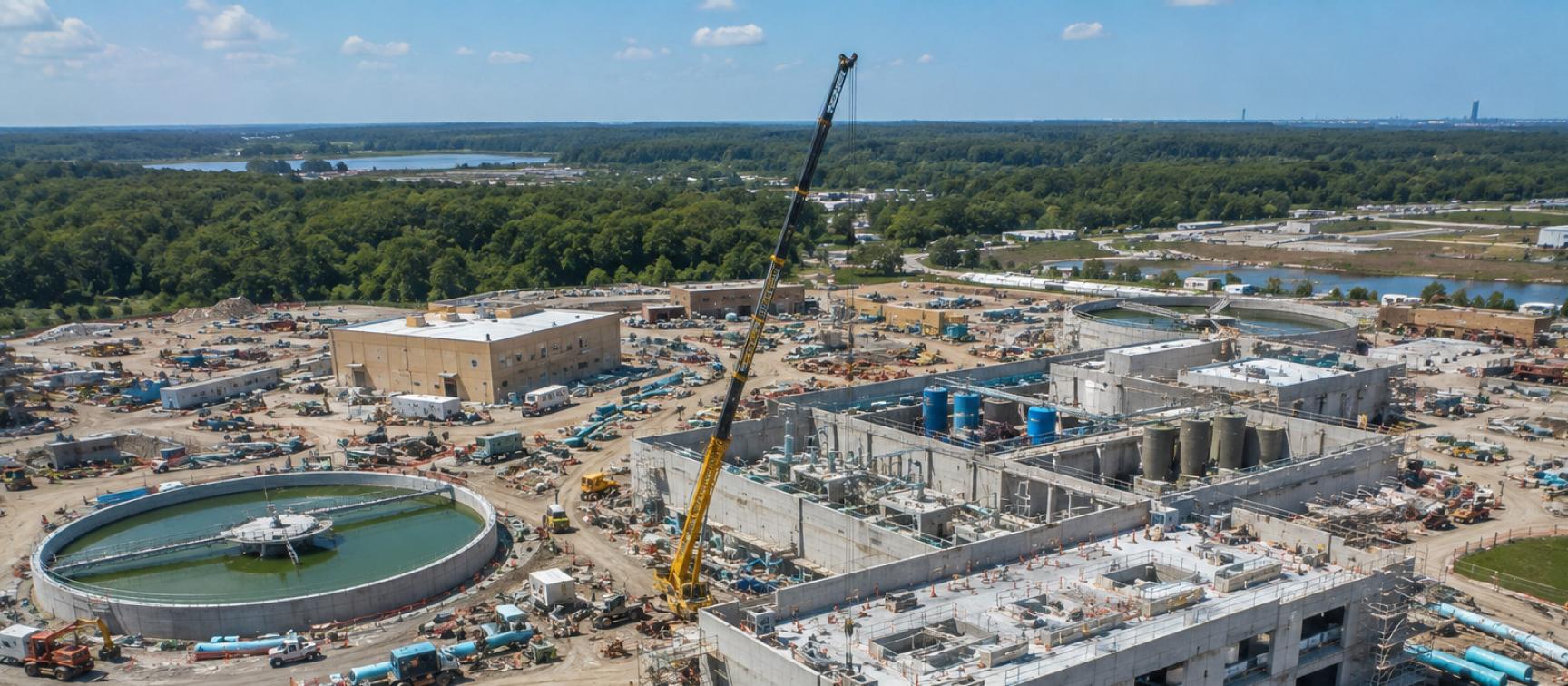
Inside Virginia's SWIFT Program: The Multibillion-Dollar Water Project Tackling Three Problems at Once
Most major infrastructure projects are designed to solve one problem.
Virginia's Sustainable Water Initiative for Tomorrow, better known as SWIFT, is tackling several at the same time.
Hampton Roads Sanitation District (HRSD) is building an advanced water treatment and groundwater recharge system that will eventually be capable of placing up to 100 million gallons of highly treated water per day back into the Potomac Aquifer.
The goal goes far beyond water reuse. SWIFT is designed to help restore declining groundwater levels, reduce saltwater intrusion, slow land subsidence, and significantly reduce the amount of nitrogen and phosphorus entering the Chesapeake Bay.
It is also driving billions of dollars of infrastructure investment across southeast Virginia, creating a major pipeline of work for the contractors, engineers, and construction professionals tasked with delivering it.
What Is the SWIFT Program?
HRSD provides wastewater treatment services across the Hampton Roads region of Virginia.
Traditionally, treated wastewater from its plants has been discharged into local rivers that ultimately flow toward the Chesapeake Bay.
SWIFT changes that model.
Wastewater is first treated through HRSD's conventional treatment process. A significant portion then goes through additional advanced treatment until the resulting SWIFT Water meets drinking water quality standards.
Rather than being discharged into rivers, that highly treated water is pumped underground to recharge the Potomac Aquifer, one of eastern Virginia's most important groundwater resources.
Once the full program is operational, HRSD intends to recharge the aquifer with up to 100 million gallons every day.
That is what makes SWIFT unusual. It isn't simply a wastewater treatment upgrade. It connects wastewater treatment, advanced water purification, groundwater management, nutrient reduction, and climate resilience within one regional infrastructure strategy.
A Multibillion-Dollar Infrastructure Program
The scale of the investment reflects the complexity of the work.
The U.S. Environmental Protection Agency described the initial SWIFT Program as approximately $2.9 billion when it announced another major financing package in 2024.
Under a WIFIA master agreement, EPA financing is expected to provide $1.3 billion, representing nearly half of those initial program costs.
In October 2024 alone, EPA announced a further $268 million WIFIA loan for SWIFT.
The program consists of numerous individual construction projects spread across HRSD's network, rather than one enormous treatment facility.
That means work ranges from advanced treatment plants and recharge wells to major pipelines, pump stations, electrical infrastructure, controls, existing plant upgrades, and the conversion or retirement of older assets.
Nearly $1 Billion at Nansemond Alone
One of the clearest examples of SWIFT's scale can currently be seen at HRSD's Nansemond Treatment Plant in Suffolk.
The combined projects there are valued at approximately $952 million.
HRSD breaks that investment down into approximately:
- $300 million for Advanced Nutrient Reduction Improvements
- $570 million for the SWIFT facility
- $82 million for recharge wells
Construction on the Advanced Nutrient Reduction Improvements began in 2023 and is scheduled to continue into fall 2026.
Construction of the Nansemond SWIFT Facility began in fall 2025 and is currently scheduled to run through spring 2029.
Once complete, Nansemond will be capable of producing up to 34 million gallons of SWIFT Water per day.
Current construction activity includes recharge-well drilling, SWIFT Water supply and backflush lines, stormwater improvements, new electrical buildings, motor control centers, aeration tank work, clarifier improvements, and extensive power and controls installation.
This is a huge multidisciplinary construction program operating within an existing wastewater treatment environment.
19 Recharge Wells
Producing highly treated water is only half the challenge.
HRSD also has to get that water back into the aquifer.
At Nansemond, the managed aquifer recharge system requires 19 wells. Eleven are located on HRSD property, with another eight planned within the adjacent community.
These aren't conventional water wells designed to extract groundwater.
They work in the opposite direction.
SWIFT Water is delivered through the wells into the Potomac Aquifer, helping replenish groundwater that has been depleted by decades of withdrawals.
That creates a highly specialized construction requirement involving drilling, well development, pipelines, pumping systems, monitoring equipment, controls, and integration with the advanced treatment facility.
Can a Water Project Help Stop the Ground From Sinking?
One of the most interesting parts of SWIFT has nothing to do with what happens above ground.
Eastern Virginia has experienced declining groundwater levels as water has historically been pumped from the Potomac Aquifer.
When groundwater is removed, pressure within underground sediments can decrease. Those sediments can compact, contributing to land subsidence, where the ground surface gradually sinks.
For a low-lying coastal region already dealing with sea level rise and flooding, even small changes in land elevation matter.
By returning large volumes of highly treated water to the aquifer, HRSD intends to help reverse groundwater declines and slow or reduce subsidence.
SWIFT is also expected to reduce the risk of saltwater intrusion, another major concern when freshwater aquifers near coastal areas are heavily depleted.
That makes the program as much a groundwater resilience project as a wastewater project.
A Major Chesapeake Bay Project
SWIFT also plays an important role in one of America's largest environmental restoration efforts.
The Chesapeake Bay has struggled for decades with excessive nutrient loading, particularly nitrogen and phosphorus.
Those nutrients can stimulate excessive algae growth. When algae die and decompose, oxygen levels in the water can fall, creating conditions that are harmful to fish, shellfish, and other aquatic life.
Wastewater treatment plants are one source of those nutrients.
SWIFT provides HRSD with another way of addressing the problem.
By applying advanced treatment and diverting significant volumes of water away from surface-water discharge, the program will substantially reduce the amount of nitrogen and phosphorus HRSD sends toward the Chesapeake Bay.
EPA has previously estimated that the wider program could reduce HRSD wastewater discharges to the Chesapeake Bay watershed by approximately 90%.
So the same infrastructure that replenishes groundwater can also contribute to Chesapeake Bay restoration.
A 31,000-Foot Pipeline and a Remarkable River Crossing
Some of the most impressive engineering is happening between HRSD's Boat Harbor and Nansemond facilities.
Closing and converting the aging Boat Harbor Treatment Plant requires wastewater to be transferred to Nansemond for treatment.
To make that possible, HRSD is constructing approximately 31,000 feet of pipeline, ranging from 42 to 54 inches in diameter.
Part of that route crosses the James River and Newport News Shipping Channel.
Contractor Garney Construction used horizontal directional drilling to create the crossing beneath the shipping channel.
The numbers involved are remarkable.
A 5,700-foot section of fused pipeline had to be installed approximately 168 feet beneath the Newport News Shipping Channel.
Crews initially drilled a 12-inch pilot hole before gradually enlarging the bore to 54 inches.
The final pipe pull was carried out as one continuous operation lasting approximately 22 hours, beginning May 1, 2024 and finishing the following day.
It is a great example of how SWIFT combines advanced water treatment with serious heavy civil engineering.
James River Adds Another 16 Million Gallons Per Day
Nansemond isn't the only major SWIFT construction site.
HRSD's James River Treatment Plant is home to the first full-scale SWIFT implementation project.
Once complete, improvements there will produce up to 16 million gallons of SWIFT Water per day while also improving the quality of the plant's remaining effluent.
Construction began in spring 2022 and is scheduled to continue through late 2026.
The facility provides another important step toward HRSD's ultimate 100-million-gallon-per-day recharge goal.
Billions in Funding Require Long-Term Planning
Infrastructure programs of this scale aren't financed through conventional annual capital budgets alone.
EPA's WIFIA program has played a major role in SWIFT.
The federal government initially committed more than $1 billion in long-term WIFIA assistance to the program, with that commitment subsequently reaching approximately $1.3 billion under the master agreement described by EPA in 2024.
Virginia's Clean Water State Revolving Fund is another major financing source.
Access to long-term, low-interest financing allows HRSD to spread the cost of infrastructure that will serve the region for decades while reducing the burden that would otherwise fall on current ratepayers.
What SWIFT Means for Construction
From a construction perspective, SWIFT is particularly interesting because of the range of disciplines required.
This isn't simply concrete and pipe.
The program combines:
- Heavy civil construction
- Advanced water treatment
- Wastewater treatment plant upgrades
- Enhanced nutrient removal
- Large-diameter pipeline construction
- Horizontal directional drilling
- Deep well drilling
- Mechanical process systems
- Electrical infrastructure
- Motor control centers
- Instrumentation and controls
- Pumping systems
- SCADA and automation
- Testing and commissioning
That complexity creates demand for professionals who understand how these disciplines come together.
Project Managers, Superintendents, Project Engineers, Estimators, Schedulers, Civil Engineers, Mechanical Engineers, Electrical Engineers, Controls specialists, Safety Managers, Quality Managers, and Commissioning professionals all have a role to play.
The challenge for contractors isn't simply finding experienced construction professionals. It is finding people with the right experience for technically demanding water and wastewater environments.
Why SWIFT Matters Beyond Virginia
Perhaps the biggest reason to watch SWIFT is that its impact could extend far beyond Hampton Roads.
Water utilities across the United States are facing similar challenges.
Groundwater supplies are under pressure. Coastal communities are dealing with saltwater intrusion and land subsidence. Nutrient limits are becoming more demanding. Aging treatment plants need billions of dollars of investment. At the same time, cities need reliable water supplies that can withstand population growth and changing environmental conditions.
SWIFT demonstrates that these problems don't necessarily have to be addressed independently.
One investment can improve wastewater treatment, protect surface water, recharge groundwater, increase resilience, and reduce pressure on existing freshwater supplies.
That is a powerful proposition for utilities planning the next generation of water infrastructure.
Building the Next Generation of U.S. Water Infrastructure
The numbers behind SWIFT are impressive: billions of dollars of investment, up to 100 million gallons of groundwater recharge every day, a $952 million construction program at Nansemond, 19 recharge wells, a 31,000-foot transmission pipeline, and a river crossing extending 168 feet beneath a major shipping channel.
But the real significance of SWIFT is what those numbers achieve.
Cleaner water entering the Chesapeake Bay.
More water going back into an overdrawn aquifer.
Less risk from saltwater intrusion.
A potential reduction in land subsidence.
And a more resilient water system serving communities across Hampton Roads.
For America's construction industry, projects like SWIFT also point toward where the water market is heading: larger programs, more sophisticated treatment technology, greater integration between environmental and infrastructure objectives, and growing demand for professionals who know how to deliver them.
At Approach Talent USA, we work with contractors and engineering firms delivering major water, wastewater, and heavy civil infrastructure projects across the United States, helping connect experienced construction professionals with the teams building the country's next generation of critical infrastructure.
Recent News
Mental Health in U.S. Construction: The Safety Issue We Can't Afford to Ignore
Inside Portland's $2.56 Billion Bull Run Filtration Project
The World's Largest Water Recycling System: How Orange County's Groundwater Replenishment System Is Setting the Global Standard