

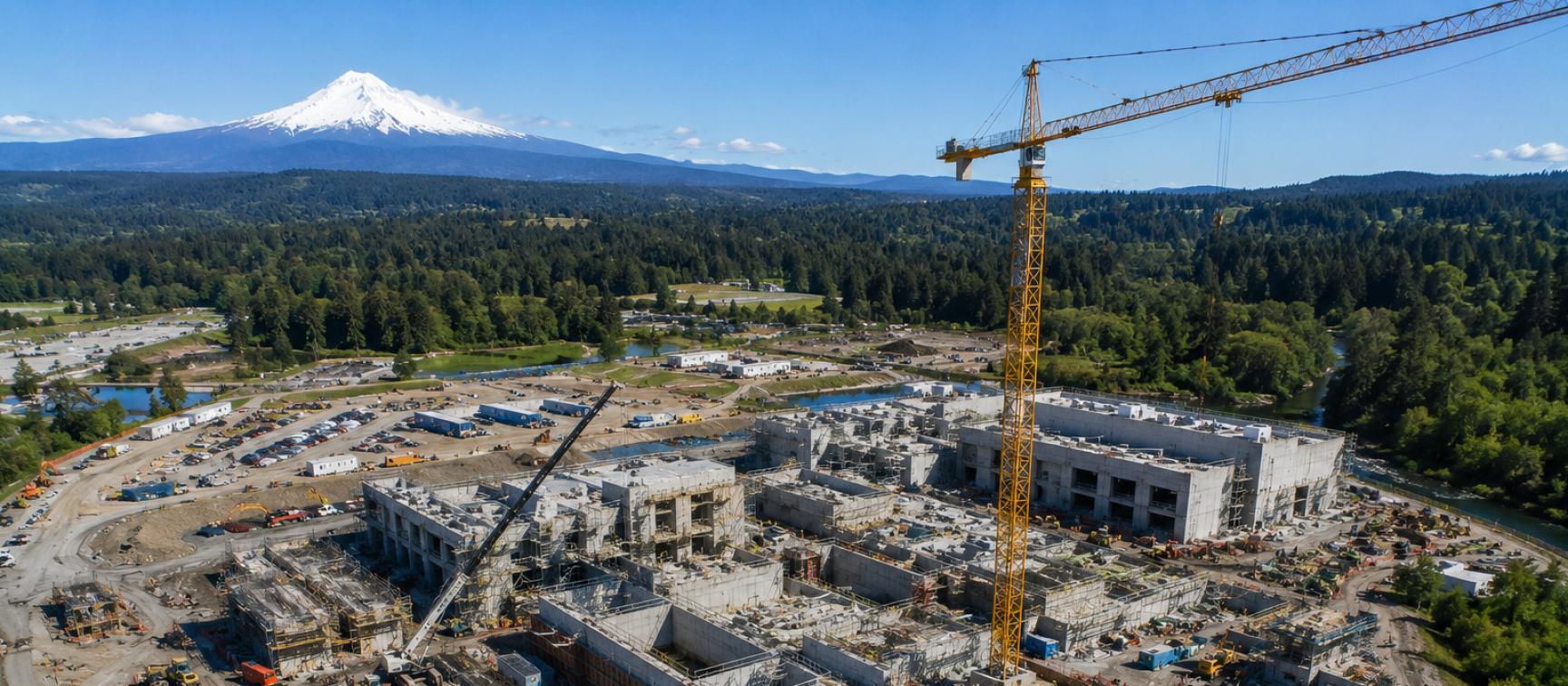
Inside Portland's $2.56 Billion Bull Run Filtration Project
Portland, Oregon is delivering one of the most significant drinking water construction projects underway in the United States.
The Bull Run Filtration Project will add a new 135 million-gallon-per-day filtration facility to Portland's water system, alongside miles of large-diameter, seismically resilient pipelines. The latest project estimate stands at $2.56 billion, and more than 400 skilled craftworkers are already working on the construction program.
Behind those headline numbers is a much bigger story about public health, major infrastructure investment, construction jobs, seismic resilience, and the challenge of delivering a highly complex water project while costs and schedules continue to evolve.
Why Is Portland Building the Bull Run Filtration Project?
The Bull Run Watershed is Portland's primary drinking water source and has supplied the region for more than a century.
Unlike many major U.S. water systems, Portland has historically been able to use Bull Run water without conventional filtration because of the protected nature and high quality of the watershed.
Federal drinking water requirements changed that equation.
The new facility is being built primarily to remove Cryptosporidium, a microscopic parasite that can cause gastrointestinal illness. The project will allow Portland to comply with federal and state drinking water requirements while also removing sediment, organic material, and other potential contaminants.
The improvements are expected to make the water system more resilient to wildfires, landslides, major storms, earthquakes, and other events that could affect water quality or disrupt supply.
The Oregon Health Authority has approved a revised compliance deadline requiring filtered Bull Run water to be delivered by September 2029.
$2.56 Billion of Infrastructure Investment
As of February 2026, Portland's estimated cost for the filtration facility and associated pipelines stands at $2.56 billion.
That figure covers the project from planning and design through construction and commissioning, including materials, equipment, labor, permitting, insurance, legal costs, project management, and approximately $100 million in contingency funding.
By the end of June 2026, Portland had already spent approximately $881 million, meaning more than a third of the current project budget has moved through the program.
Financing is coming from a combination of water revenues, bonds, and low-interest federal loans.
The U.S. Environmental Protection Agency has provided substantial support through its Water Infrastructure Finance and Innovation Act, better known as WIFIA. EPA lists a $727 million WIFIA loan for the wider Bull Run Treatment Program and estimates that WIFIA financing will save Portland approximately $247.5 million compared with alternative financing.
For a project of this size, the financing strategy is almost as important as the engineering.
A 135 Million-Gallon-Per-Day Facility
The scale of the physical construction is considerable.
The filtration plant is being built on a 95-acre site east of Portland and will have capacity to treat as much as 135 million gallons of water every day.
The facility itself is only part of the work.
A major network of new large-diameter pipelines is also required to connect the plant with Portland's existing water system and replace aging sections of infrastructure.
The planned pipeline installation includes more than:
- 5,500 linear feet of 72-inch pipe
- 10,000 linear feet of 66-inch pipe
- 4,700 linear feet of 60-inch pipe
- 4,000 linear feet of 42-inch pipe
- 3,000 linear feet of 12-inch pipe
- 4,100 linear feet of 6- to 8-inch pipe
Additional sections ranging from 36 to 66 inches in diameter are also included.
By 2026, crews had already installed more than 10,200 feet, or approximately 1.9 miles, of new resilient pipeline.
Much of this infrastructure is being designed with seismic resilience in mind, an important consideration in a region exposed to earthquake risk.
1,000 Cubic Yards of Concrete Every Week
The construction numbers provide a sense of just how active the project has become.
Major excavation is complete and structural work is now transforming the 95-acre site.
During current construction activity, crews are placing approximately 1,000 cubic yards of concrete every week across treatment process areas and buildings.
At the same time, equipment and materials are arriving continuously, pipeline construction is progressing, and the treatment structures are beginning to emerge above ground.
For anyone working in heavy civil construction, those figures show that Bull Run isn't simply a water technology project. It is a major concrete, pipeline, mechanical, electrical, and process construction program.
More Than 400 Craftworkers Already on Site
The workforce behind Bull Run is another reason the project deserves attention.
More than 400 highly skilled craftworkers are contributing to construction, including carpenters, electricians, pipefitters, equipment operators, laborers, ironworkers, cement masons, and other trades.
The workforce is large enough that workers are being bused to the filtration facility as part of daily site operations.
The project's impact extends much further than the current headcount.
The EPA estimates that its Bull Run Treatment Program investment will support approximately 4,745 jobs. That figure encompasses the wider economic and employment impact associated with delivering the program.
It's an important reminder of how major water projects affect far more than the utility commissioning the work. Engineering firms, general contractors, specialty subcontractors, equipment manufacturers, suppliers, logistics businesses, and professional services all become part of the delivery chain.
Investing in the Next Generation of Skilled Workers
Bull Run also has a significant workforce development component.
The construction program has committed 20% of total workforce hours to apprentices across as many as 17 trades.
Those trades include electricians, carpenters, ironworkers, plumbers, pipefitters, steamfitters, equipment operators, cement masons, boilermakers, sheet metal workers, piledrivers, truck drivers, and others.
As of March 2026, apprentices had completed 15.65% of total construction workforce hours, covering a dozen different trades.
For an industry facing long-term concerns around skilled labor availability, major public infrastructure programs can provide an important pipeline for bringing new workers into construction while allowing them to develop experience on technically demanding projects.
Nearly $400 Million Going to Certified Businesses
The economic impact also extends into Portland's supplier and subcontractor base.
As of June 2026, approximately $396.56 million in contracts had been allocated to businesses certified through Oregon's Certification Office for Business Inclusion and Diversity.
That includes approximately:
- $280.46 million with Minority Business Enterprises
- $68.92 million with Women Business Enterprises
- $4.30 million with Disadvantaged Business Enterprises
- Additional contracts with emerging small businesses and other certified firms
For a single water infrastructure program to generate close to $400 million in certified business contracting demonstrates the scale of spending flowing through the project.
Why Has the Cost Increased?
Bull Run also provides a useful case study in the challenges facing large infrastructure projects across the U.S.
The current $2.56 billion estimate is substantially higher than earlier projections.
Portland attributes the increase to several factors, including construction material and labor inflation, an extended delivery schedule, additional site and permitting requirements, and delays associated with the land-use approval process.
The city said permitting delays alone contributed approximately $450 million to the revised project estimate.
An extended schedule creates costs of its own. Equipment remains rented for longer, construction teams remain mobilized, site maintenance continues, and inflation has more time to affect labor and material pricing.
The project therefore provides a real-world example of why schedule certainty has become such an important issue for owners and contractors delivering major U.S. infrastructure programs.
A Huge Requirement for Construction Expertise
The technical demands of a project like Bull Run extend far beyond the craft workforce.
A $2.56 billion water program requires experienced professionals capable of coordinating civil construction, large-diameter pipeline installation, concrete structures, mechanical process systems, electrical infrastructure, instrumentation, controls, commissioning, quality, and safety.
That creates demand across positions such as:
- Project Managers
- Senior Project Managers
- Superintendents
- General Superintendents
- Project Engineers
- Construction Managers
- Estimators
- Schedulers
- Civil Engineers
- Mechanical Engineers
- Electrical Engineers
- Instrumentation and Controls Engineers
- Quality Control Managers
- Safety Managers
- Commissioning Managers
Water and wastewater experience is particularly valuable because these facilities combine traditional heavy civil construction with sophisticated process equipment and strict regulatory requirements.
More Than a Water Treatment Plant
The numbers behind Bull Run are impressive: $2.56 billion of investment, 135 million gallons of treatment capacity per day, a 95-acre construction site, more than 400 craftworkers, roughly 1,000 cubic yards of concrete being placed each week, and thousands of feet of major pipeline.
But the project's significance goes beyond its size.
Portland is effectively changing the way one of America's major metropolitan water systems treats its primary drinking water source.
The finished system will provide another layer of public health protection while giving Portland greater resilience against wildfires, severe storms, landslides, earthquakes, and changing source-water conditions.
For the construction industry, Bull Run also illustrates the scale of opportunity emerging from America's water infrastructure market.
Major treatment plants, pipelines, pump stations, water reuse systems, and resilience projects are moving through planning and construction across the country. Delivering them will require not only billions of dollars in capital, but also experienced people who understand how to build complex water infrastructure.
At Approach Talent USA, we work with contractors and engineering firms delivering major water, wastewater, and heavy civil infrastructure projects across the United States, connecting them with the construction professionals needed to keep critical projects moving.
Recent News
The World's Largest Water Recycling System: How Orange County's Groundwater Replenishment System Is Setting the Global Standard
Construction Interviews: How to Stand Out in a Competitive Market
America's Aging Water Infrastructure: Why the Next Decade Will Redefine Construction